Book review

Loneliness and the love of friends

From our UK edition

When Hugh and Mirabel Cecil’s book In Search of Rex Whistler was published in 2012, the late Brian Sewell reviewed it with typical insight and lack of generosity. Despite recognising the artist as an extraordinary talent and perhaps the inventor of neo-romanticism, he regretted that Whistler would never be taken sufficiently seriously and pronounced it the last book on him. Happily the Cecils have now proved Sewell wrong several times over. Hugh Cecil’s father, David, was a close friend of the artist, and these volumes seem in part to constitute the continuation of a family’s love for a man who inspired affection wherever he went.

Jonathan Coe’s raucous social satire smoulders with anger behind the fun

From our UK edition

When Rachel, one of the unreliable narrators of Number 11, wants to ‘go back to the very beginning’, she starts with the death of Dr David Kelly, the former United Nations weapons inspector, discovered dead in woodland on Harrowdown Hill in Oxfordshire on 18 July 2003, shortly after casting doubt on the government dossier that claimed Saddam Hussein possessed weapons of mass destruction. Rachel was ten at the time, staying with her grandparents and school friend Alison in the nearby village of Beverley. For the next ten years — during which she gets into Oxford from a state school, graduates with a 2:1 in English, and becomes a private tutor for the offspring of the superrich — Rachel thinks about Kelly’s death often.

A soothing Negroni for la dolce vita

From our UK edition

The first draft of the famous story was called ‘A Martini as Big as the Ritz’. That’s not true, but F. Scott Fitzgerald was certainly at work in the First Cocktail Age. The Algonquin circle also floated into literary history on a choppy ocean of toxically high-ABV mixed drinks. The quotes and jokes are legend: Robert Benchley says to Ginger Rogers in a 1942 Billy Wilder film ‘Why don’t you get out of that wet coat and into a dry martini?’ (The line is also attributed to Mae West.) And ours is the Second Cocktail Age. While we wait for its literary heroes, three appreciative books are here to be enjoyed in immoderation. My generation prefers wine. Sometimes I feel we actually discovered Chardonnay, but a generation younger has rediscovered the cocktail.

John Paul Stapp: the fastest man on earth, who saved millions

From our UK edition

There’s a moment in Craig Ryan’s spectacular biography of John Paul Stapp — the maverick American Air Force doctor who, in the 1950s, became the fastest man on earth — where the reader falls inexorably in love with Ryan’s subject. It’s on page 17, when Stapp encounters what his Baptist missionary father had taught his sons to prepare for: ‘The epiphany that would illuminate the nature of their calling.’ Christmas is three days gone, and Stapp’s two-year-old cousin, momentarily alone in front of the fireplace, throws part of the Sunday newspaper over the grate. It ignites, catching the boy’s cotton pyjamas, setting them ablaze. Someone plunges the child into a tub of icy water outside, but the burns are horrific.

Patti Smith grows old too gracefully

From our UK edition

‘Jesus died for somebody’s sins/ but not mine’: the opening lines of Patti Smith’s 1975 debut album, Horses, find a young woman marking her territory with fierce conviction. Raised as a Jehovah’s Witness, she was (or was treated as) an invalid for much of her New Jersey childhood. The restrictions were physical and spiritual. But in her twenties the androgenous daughter of blue-collar workers used her punk poetry to reclaim the freedoms North American culture had stolen from her. And while she relieved Jesus of responsibility for her sins, she certainly didn’t count her compulsion to write and lust and holler among them.

Charles Williams: sadist or Rosicrucian saint?

From our UK edition

Charles Williams was a bad writer, but a very interesting one. Most famous bad writers have to settle, like Sidney Sheldon, for the millions and the made-for-TV adaptations and the trophy wife. Williams had a following, and in the 1930s and 1940s some highly respected literary figures declared him to be a genius. But why did Williams appeal so strongly to a particular age — and what, if anything, can he offer us now? He belonged to that wonderful generation liberated by the 19th-century spread of education. He came from a family with no resources, but a terrible, pathetic yearning for literature. His father, Walter, managed to scrape into print, writing moralising short stories and sentimental poems for the cheapest magazines.

Too much gush

From our UK edition

The cover of Edna O’Brien’s 17th novel sports a handsome quote from Philip Roth: ‘The great Edna O’Brien has written her masterpiece.’ Late Roth and late O’Brien have something in common. In The Plot Against America (2004), Roth provided an alternative history of the 20th century: what if Roosevelt had been defeated by the anti-Semitic Charles Lindbergh? O’Brien, whose stellar career began 55 years ago with her wonderful debut, The Country Girls (1960), is increasingly interested in exploring real-life events. Down by the River (1997) fictionalised the true story of a 14-year-old rape victim, while In the Forest (2002) was inspired by the Cregg Wood murders of 1994.

Celebrity lives

From our UK edition

I learned from this little lot that if one has read The Diary of a Nobody, then one can derive pleasure from even the most pedestrian life story, as there’s always an unintentional chuckle to be had. The former racing driver Nigel Mansell’s Staying on Track (Simon & Schuster, £20) delighted me with its Pooterish charms, from bullied boyhood : One time I was due to race for England abroad. The school announced the exciting news in assembly one morning... that afternoon I was attacked viciously with a cricket bat in the playground. I thought the other children would be proud of me. How wrong can you be? — to triumphant adulthood, bashing himself up for pleasure and profit: Let me tell you about the time I told a priest to get lost.

A chronic case of mass hysteria

From our UK edition

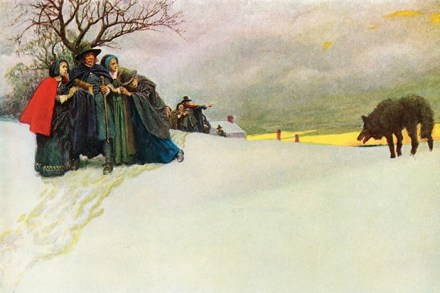
There have been many books devoted to the terrible events that took place in the small rural community of Salem Village and its larger sister, Salem Town, between February 1692 and May 1693. As Stacy Schiff points out, most of them are shaped by particular theses — she lists 13 in all. This approach doesn’t just offer readers the consolation of an overriding explanation, but gives authors built-in filters, enabling them to concentrate on what proves their particular case. Such a strategy is tempting because of the unruly complexity of the Salem phenomenon, with its hundreds of accusers, accused, magistrates, ministers and fearful bystanders. Schiff’s own selective cast of characters runs to six closely printed pages and lists 88 names.

Warning: this book only contains strong language

From our UK edition

Dan Marshall, the author of this memoir, loves to swear. ‘It’s very difficult for me to write a sentence without using a bad word,’ he tells us. ‘That last sentence, for instance, was fucking impossible for me to write.’ Dan is young, rich and American. One day, in his twenties, he and his girlfriend, Abby, were on holiday, lying poolside at the Marriott resort in Desert Springs, California. He is in a world of material and sexual abundance. ‘My siblings and I were lucky, living with the proverbial silver spoon jammed firmly up our asses,’ he tells us. He has lots of sex. So does his gay brother Greg. His mother’s cancer was ‘under control’.

When escape to the sun — or even to Devon — goes horribly wrong

From our UK edition

A character in Sophie Hannah’s A Game for All the Family (Hodder, £14.99, pp. 432) presents a theory: ‘Mysteries are the best kind of stories because you only get the truth at the very end, when you’re absolutely desperate.’ This makes us realise just how scarce truth is. In books, as in life. It’s an idea to keep in mind as we follow former television producer Justine on her quest to start a new, quieter life in Devon. This dream proves elusive, as her teenage daughter makes a new friend at school, a friend who the teachers insist doesn’t actually exist. Is the friend real, or just a product of a girl’s imagination?

Frank’s world

From our UK edition

‘He never went away. All those other things that we thought were here to stay, they did go away. But he never did.’ Who was Bob Dylan talking about earlier this year? Woody Guthrie? Elvis Presley? Or maybe, halfway through the sixth decade of his own career, himself? But no. The man in question was Frank Sinatra — the inspiration behind Dylan’s latest album, Shadows in the Night. That record is a collection of covers —from the great American songbook — ‘Autumn Leaves’, ‘The Night We Called it a Day’, ‘What’ll I Do’. We call such songs standards, as if they have been set, if not in stone, then at least on the stave, forever. But that isn’t so.

To the ends of the earth

From our UK edition

What’s in a name? The identity of the author offers a clue to one of the themes of this intriguing novel: Naomi, a good Hebrew name; Williams, a stout Welsh name; born in Japan; lives in California. The earth is spanned. Landfalls charts the voyage of two French frigates exploring the world at the end of the 18th century, after Cook but before the Revolution. Based on true events, the story unfolds in discrete episodes, short stories indeed, told from a variety of points of view, in changing cases and in differing person. The dramatis personae remain more or less constant; they cross-inform each others’ stories. In its work as historical fiction, Williams subtly outlines the cusp between ancien regime and republic.

Umberto Eco really tries our patience

From our UK edition

Colonna, the protagonist of Umberto Eco’s latest novel, is the first to admit he is a loser. A middle-aged literary nègre, he dreams of writing his own book, but can’t break the habit of alluding to others’ work: he even refers to himself as a ‘man without qualities’. One day in 1992, he is commissioned to ghostwrite a memoir about a newspaper being launched in Milan. Domani (‘Tomorrow’) will never be published: a tycoon who finances it plans to use it as a blackmail tool in his shady dealings. The proposed title of the memoir, Domani: Yesterday, sets the tone for this pacy book that doesn’t take itself too seriously.

Where would America be without Gloria Steinem?, asks Carmen Callil

From our UK edition

This is a book written by a most admirable woman, which is nevertheless — with some rare and excellent exceptions — most tiresome to read. Gloria Steinem has done heroic work as a founding force of American feminism and as an organiser, in America, for a myriad of causes. She is an icon of 1960s feminism, when persons such as she explained to women — mostly western women, but you have to start somewhere —that some sort of equality could be fought for and, if won, could change the world for all men and women. She spent some early years after university in India and a Gandhian philosophy permeates her good works.

From the Big Smoke to the Big Choke

From our UK edition

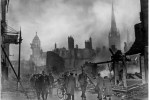
‘A foggy day in London town,’ croons Fred Astaire in the 1937 musical comedy A Damsel in Distress, puffing nonchalantly on a cigar as he wanders through a wood that has already been half obliterated by belching Hollywood smoke machines. Today Gershwin’s lyrics conjure up a nostalgic vision of life in the city, involving pale fingers of fog wrapping themselves around lamp posts and the muffled clop of hooves on cobbles. Actually, for many years the reality of a London fog was far less appealing. It clogged your lungs and made your eyes smart; it turned the air into a murky kaleidoscope of colours (yellow, grey, blue) that appeared to be on the verge of turning into a solid.

Through the eyes of spies

From our UK edition

Spying is a branch of philosophy, although you would never guess it from that expression on Daniel Craig’s face. Its adepts interrogate the surface of reality — people, landscapes, texts — knowing that they will discover extraordinary hermetic meanings. They study fragments of documents, whispers of messages, and from these, they summon entire worlds. Possibly one of the reasons Max Hastings cannot pretend to be hugely impressed by the boasts of wartime spies is the philosophical nebulousness of what constitutes ‘results’ in secret-agent speak. Soldiers fight, shoulder to shoulder; battles are clearly lost and won.

The best British short stories — from Daniel Defoe to Zadie Smith

From our UK edition

Philip Hensher, the thinking man’s Stephen Fry — novelist, critic, boisterously clever — begins his introduction to his two-volume anthology of the British short story with typical gusto. ‘The British short story is probably the richest, most varied and most historically extensive national tradition anywhere in the world.’ Take that, ye upstart Americans, with your dirty realism and your New Yorker swank! Read it and weep, ye Johnny-come-latelys! Look to your laurels, Chekhov and Carver. Jorge Luis Who? Maupassant? Bof! And there’s more — much much more.