Book review

War on Mount Olympus

From our UK edition

It is a curious fact that the modern Hebrew for ‘atheist’, Tim Whitmarsh notes in passing, is apikoros. The word derives from Epicurus, who set up shop as a philosopher in Athens around 306 BC, but it became so domesticated in Hebrew that the medieval thinker Moses Maimonides, till he found out better, thought it was of home-grown Aramaic origin. In ancient Jewish usage, however, I think apikoros meant someone who denied that God takes care of the world, which was indeed the claim of Epicurus. Though Whitmarsh sets out to show that atheism was quite normal in ancient (Greek) history, atheism turns out to be a slippery notion. Epicurus declared that the whole boundless world was made up of an infinite number of indestructible atoms in unpredictable motion.

In the wrong club

From our UK edition

Groucho Marx was delighted when he heard that the script for one of his old Vaudeville routines was being reprinted in H.L. Mencken’s The American Language. ‘Nothing I ever did as an actor thrilled me more,’ he said. Indeed, argues Lee Siegel in his brief biographical study of the most verbal Marx Brother, Groucho’s ‘greatest regret in life … was that he had become an entertainer rather than a literary man’. How else to explain that excruciating evening in June 1964 when Groucho and his wife dined at the home of Mr and Mrs T. S. Eliot and Groucho thought to lecture Eliot on King Lear? To be fair, it was Eliot who, three years earlier, had written to the then 71-year-old Groucho requesting a photograph of his favourite funnyman.

One man’s war through 45 objects

From our UK edition

Attempts by soldiers themselves to describe to us our 21st-century wars have come, so far, in a few recognisable varieties: the movie-ready tactical accounts narrated by infallible tough guys, grading into versions of what one Iraq war veteran-writer, Roy Scranton, has termed the ‘myth of the trauma hero’: those dramas of personal suffering that ignore, or even presumptively redeem, a war’s wider consequences. Certain more or less lachrymose recent Navy Seal memoirs, for example, have synthesised these two modes; more gifted introspections like Kevin Powers’s The Yellow Birds, with its callowly incontinent lyricism (‘fires on the hillsides… like a tattered quilt of fallen stars’), take the second as far as it can go.

Muses, nurses and punch-bags

From our UK edition

The conceit of this book — the author’s third on Robert Lowell — is strong, although its execution is less successful. Lowell made his love life central to his aesthetic project, especially in For Lizzie and Harriet and The Dolphin, and so it makes sense to read his work through his major emotional attachments.

Vile deeds and voyeurism

From our UK edition

The title comes from Hamlet but the spirit that hovers over the pages of Javier Marías’s new novel is — as ever — that of Proust. The visiting and revisiting of the past; the dwelling on the minutiae of memory; the attention to social hierarchy, the demands of lust and the force of cruelty — not to mention the labyrinthine sentences weighted with subordinate clauses… Marcel would breathe easily here. Trying to encapsulate a novel by Marías in a few lines is as frustrating as attempting to ‘explain’ Velázquez’s ‘Las Meninas’ in one sentence. Both are minutely detailed — but what are we seeing? What are we being told?

Ruling the digital waves

From our UK edition

Everyone, we hear these days, must learn to code. Being able to program computers is the only way to be sure a computer can’t steal your job. So doctors, dancers, drivers and dieticians must all acquire programming skills, and coding needs to be at the centre of modern secondary education. Well, evidently it is in the interests of giant technology corporations to have future generations of employees educated to their precise specifications at the public expense. The message is amplified by journalists anxiously extrapolating from their own predicament. (Generating ‘content’ is an increasingly unrewarded dead end; the cool things are data and ‘sharing’.) But the all-must-become-programmers idea does imply a rather weird future culture.

Waspish traditionalist

From our UK edition

Randolph Schwabe (b. 1885) was a measured man in art and in life. His drawings are meticulous, closely observed models of draughtsmanship and represent a school of art that has now largely been lost or dismissed as irrelevant. To some, though, Schwabe seemed old-fashioned even in 1930 when he ascended to the position of Principal of the Slade school of art, taking over from the formidable Henry Tonks. The publication of his diaries from 1930 until his death in 1948 offers a welcome insight into the divergence in British art between the traditionalists and the new breed of modernists. Schwabe was emphatically of the former camp, and never lost his scepticism about the merits of the latter.

‘Existentialism? I don’t know what it is’

From our UK edition

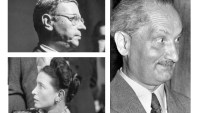
I’m certainly the wrong person to be reviewing this book, never having succeeded in understanding anything that a philosopher said about anything — but particularly the collected utterances of the existentialist school. Nevertheless, I think it fair to say that between the ages of 15 and 18, I had the wardrobe down to a T. In Yorkshire in the early 1980s, if you wanted to be existentialist, you wore duffle coats and drainpipe jeans and, of course, the famous black polo-neck. I knew kids who smoked Gauloises and one who actually went in for smoking a pipe. Your spectacles were those NHS free type popularised by John Lennon; your shoes might be Hush Puppies. (A little later they were black Doc Martens with thick rubber soles.

Escaping the Inferno

From our UK edition

I read this, Meg Rosoff’s first novel for adults (though her previous fiction, aimed at teenagers, is widely enjoyed by older readers), curled up with my beautiful lurcher, Una, twitching her ears beside me. Appropriately so, as the novel concerns the relationship between a young man and two dogs, super-intelligent collie Dante and devoted spaniel Sissy. All dog-owners will recognise how Rosoff describes their interactions: Jonathan worries about ‘the practical and spiritual difficulties of caring for other sentient beings’, and spends hours imagining ‘the Byzantine quality’ of their inner lives (when I read that sentence, I exchanged glances with Una; she lifted her tail as if to say, You didn’t know?

A love letter to Italy

From our UK edition

Imagine you’re an unknown young writer whose first collection of stories wins the Pulitzer prize. Your first novel is filmed, your second is shortlisted for the Man Booker and your next collection of stories goes straight to No.1 in the New York Times bestseller list, while prizes and honours are showered on you. Might the words ‘rest’ and ‘laurels’ come to mind? Not for Jhumpa Lahiri. The Bengali-American author of Interpreter of Maladies and The Namesake chose instead to swap New York for Rome with her husband and two young children for what she calls ‘a trial by fire’ into a new life and a new language: for nearly three years she read and wrote exclusively in Italian.

Putting Germany together again

From our UK edition

The purpose of Lara Feigel’s book is to describe the ‘political mission of reconciliation and restoration’ in the devastated cities of Germany after 1945 (though no politicians were directly involved). The chief needs of the shattered population at the time were, of course, practical: food, water, sanitation and the reconstruction of buildings. But a vital supplementary effort was made to address what was left of German culture and history after the crimes and falsifications of the Nazis. The idea was that the arts should revive an alternative, peaceful and civilised way of life in the ruins of the country.

One fine spring day

From our UK edition

The opening of Graham Swift’s new novel clearly signals his intent. ‘Once upon a time’ tells us that this will be a book about adversity and triumph. We know, because this is how fairy tales work, that there is the possibility of a happily ever after. And there is the hint too, in these opening lines, that the telling of the story will be as important as the tale itself. Once upon a time there was a servant girl, a foundling, who had no family to visit on Mothering Sunday. It is 30 March 1924, a holiday for domestic staff. The Nivens and Sheringhams — occupants of the neighbouring households of Beechwood and Upleigh — are taking lunch at a hotel while their staff travel to visit their families. But Jane Fairchild, maidservant to the Nivens, is left behind.

Beautiful losers

From our UK edition

When Henry Worsley died last month attempting the first solo, unaided expedition across the Antarctic, he was 30 miles short of the finish line. He fits right in with a long British tradition of heroic failures: General Gordon killed at Khartoum; the defeat of the British by the Zulus at Isandlwana. And the most precise parallel with Worsley’s tragedy, Captain Scott, who also died in the Antarctic, just 11 miles short of the next food depot. Stephanie Barczewski, Professor of History at Clemson University in South Carolina, is on to something when she identifies a peculiarly British propensity for glorifying disaster. Where she is crashingly wrong is in her interpretation of the reason why: that it’s all down to the desire to show the British empire in a good light.

Whatever next?

From our UK edition

‘Ah, Jeremy,’ remarked Tony Blair at a smart dinner party in Islington not long before he became prime minister, ‘he hasn’t made the journey.’ As it turned out, this was something of an understatement. And yet here we are, 20 years on, and the Right Honourable Jeremy Corbyn is leader of Her Majesty’s Opposition. It is as if New Labour never happened. You couldn’t make it up. How do we explain the miraculous rise of a man who, before he emerged blinking into daylight from the political shadows, had made not the merest ripple on the national consciousness? Who, despite more than 30 years in parliament, had rarely featured in the public prints or seen the inside of a television studio?

In praise of affectation

From our UK edition

Aversion to pretentiousness was probably an English trait before Dr Johnson famously refuted Bishop Berkeley’s arguments for the immateriality of the world by booting a stone. There are plausible historical reasons for this. Suspicious of the Catholicism of neighbouring Ireland and France (where words were thought to contain spiritual power even if they were not understood), the English easily adapted the Reformation’s injunction to simplify scripture into a more general doctrine of ‘say what you mean’. This attitude is exemplified most famously in George Orwell’s essay of 1946, ‘Politics and the English Language’, in which long and Latinate words are anathematised.

The heavens are falling

From our UK edition

The dystopian novel in which a Ballardian deluge or viral illness transforms planet Earth has become something of a sub-genre, and Clare Morrall’s astute and vigorously imagined novel follows on from the best of them, such as Margaret Atwood’s MaddAddam trilogy and (most recently)Emily St John Mandel’s Station Eleven and Antonia Honeywell’s The Ship. Intriguingly, the future that Morrall imagines very much resembles the past. Following 50 years of climate catastrophe, and the spread of the population-depleting Hoffman’s disease, the only hope for humanity’s survival is to find ways of ‘living with the weather’, or learning ‘skills that don’t depend on failing technology’.

Viewing the view

From our UK edition

Landskipping is about viewing the view, from the 18th century to the present. From the title (which is the only self-conscious thing about this terrific book) I feared we might be in for a heavy dose of Wordworthishness and ‘the lone enraptured male’ school of writing. But Anna Pavord, along with Kathleen Jamie, Dorothy Wordsworth and Jane Austen, is more down-to-earth than any Romantic moper. Like the author of Sense and Sensibility, she sees both sides of the coin. Romantic mopers, however, do crowd the early pages. Once a ‘correct’ taste for landscape became a desirable attainment in the mid-18th century, the way you looked at wild places was a way of demonstrating sensibility rather than sense.

The inglorious Twelfth

From our UK edition

Most people know more about the 12th century than they think they do. This is, as Richard Huscroft reminds us in his lively new history, because it is a story often told. Stephen and Matilda. Thomas Becket’s murder. Richard the Lionheart. Bad King John and Magna Carta. These are the familiar friends of Sellar and Yeatman’s ‘guide to all the history you can remember’. Huscroft sets out to find a new way in to this history through its oft-forgotten supporting cast — the men and women caught up in the political eddies caused by the great — and gives us ten tales from an assortment of princesses, adventurers, clerics and exiles. The long 12th century started in 1066 with the Battle of Hastings and ended with the death of King John in 1216.