Book review

Among the snobs, slobs and scolds

From our UK edition

The author of this jam-packed treasure trove has been a film critic at the New York Times since 2000 and is also professor of film criticism at Wesleyan University. As if these platforms weren’t enough, he’s now written a book about the tangled worlds of films, books, music, paintings and criticism, dragging in Aristotle, Pope, Plato, Matthew Arnold, Isaiah Berlin and millions of others — but not, alas, my former next-door neighbour, the wonderfully controversial Brian Sewell. Crammed in alongside George Orwell’s ‘All writers are vain, selfish and lazy’ and H. L. Mencken’s ‘Literature always thrives best in an atmosphere of hearty strife,’ the author’s own views often hit hardest.

Bribes, bickering and backhanders

From our UK edition

The decrepitude of old age is a piteous sight and subject. In his second book Michael Honig — a doctor-turned-novelist and sharp observer of the body’s frailties, and the mind’s — zanily explores it through the imagined senility of Vladimir Putin, once supremely powerful, now struggling to tie his laces. The horror, sadness and momentary furies of dementia are all traced in Vladimir’s plight, plus the tedium and — especially — the bleak comedy. As the story opens, he is visited by his successor: ‘I’m going to fire that bastard,’ he says. ‘Have we got cameras?’ On a lakeside walk he strips off for phantom paparazzi.

A sex vampire on wheels

From our UK edition

The title of this book tells you a lot. Jack Sutherland, who grew up in London and Los Angeles, worked as a personal assistant to Michael Stipe, the singer in REM and, later, to Mickey Rourke. He also worked as a limo driver in Hollywood. A drug addict, he gravitated toward crystal meth, which can make you both wired and horny, sometimes for days on end. So we know to expect a particular brew of glamour, indignity and recrimination that perhaps some readers (including me) have come to enjoy. Sutherland certainly delivers — with a bit of glamour, an awful lot of indignity and not too much recrimination. But there’s something else going on here. This book is a collaboration between Jack the addict and his adoptive father John Sutherland.

Pox-ridden and power-crazed

From our UK edition

Poor old Henry IV: labelled (probably unfairly) as a leper, but accurately as a usurper, he has been one of England’s most neglected monarchs. He is best known through his Shakespearean starring roles — which little resembled the real man, according to Chris Given-Wilson — and as the father of the ultimate warrior-king, Henry V, rather than in his own right. Ian Mortimer began redressing the balance in 2007; now Given-Wilson has produced this meticulous and definitive life of the troubled king for Yale’s ‘English Monarchs’ series. Though he was the son of John of Gaunt and his heir to the Duchy of Lancaster, England’s richest estate, Henry was not guaranteed an easy life of privilege.

Mother courage

From our UK edition

Helen Stevenson’s daughter Clara has cystic fibrosis. Love Like Salt is an account of living with the disease, but it is much else besides. Stevenson calls it a memoir, because it is an intensely personal version of events. It is also a scrapbook, a commonplace book, a series of meditations, an exercise in self-scrutiny. It is emphatically not a medical handbook. Stevenson is a writer, translator and musician; her husband Nico, ‘the kindest man on earth’, is a retired academic and translator of poetry. The book is structured like a piece of music. I’m too ignorant to give you the correct terminology, but there are three movements, and all the shorter passages branch away from, and then return to, the central theme. The effect is cumulative.

One of history’s saddest chapters

From our UK edition

One afternoon in the early 1990s, an elderly gentleman from Alicante told me of the tragedy that had occurred at his city’s port on the last day of the Spanish Civil War. He pointed towards the docks and in a hurried whisper spoke of the many thousands of desperate Republicans who had gathered there at the end of March 1939, their eyes searching the horizon for the promised ships meant to carry them to safety abroad. The rest of their territory had fallen to Franco, his execution squads busy eliminating remnants of the ‘anti-Spain’; Alicante would be the last corner to fall into the caudillo’s hands. Yet as the hours passed and no ships appeared, the would-be refugees lost hope. Dozens, perhaps hundreds, committed suicide on the spot, preferring death to capture.

Too high, too fast

From our UK edition

You have to get nearly halfway through this book before it starts to show some life. Until that point, as Rowan Moore ambles in his wry manner through pages of familiar description of the capital’s built and social history, you find yourself wondering what it is all for. After all, if you choose to write a book about the architecture of London you are putting yourself in some pretty distinguished company. Ian Nairn, say, whose magnificently off-kilter, beer-goggled 1966 hymn to the city, Nairn’s London, has been reissued as a Penguin Modern Classic to universal acclaim. Or Peter Ackroyd, whose colossal 2001 London: The Biography is drizzled with lazy assumptions but is an eloquent advocate of the city as living organism.

A gift from beyond the grave

From our UK edition

When Virgil died at Brindisium in 19 bc, on his way back to Rome from Greece, he left the Aeneid unfinished. When Seamus Heaney died in Dublin in 2013, his translation of Book VI was also unfinished, but like the whole of the original, his 1,222 lines were found to be in a publishable condition (‘final’, he wrote on the last draft, which allows for it not being ‘complete’). The coincidence is touching. So too is the fact that this book is concerned with news from the afterlife. Aeneas descends into the underworld to visit his father, Anchises, and receives there a history lesson that leads beyond the founding of Rome to the glories and struggles that lie in the future. Heaney’s version is also a kind of gift from beyond the grave.

A devilish instrument of war

From our UK edition

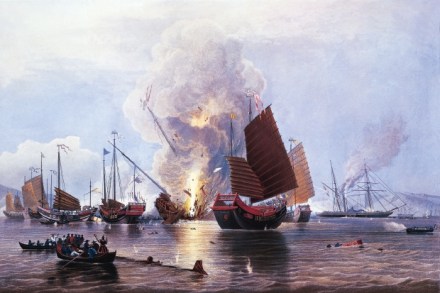
‘China is a sleeping lion,’ Napoleon reportedly remarked. ‘When it wakes, the world will tremble.’ There is no need to fear China, its current leaders are quick to stress — with President Xi Jinping claiming that the country’s rise will be ‘peaceful, pleasant and civilised’. Such words are of little comfort to hawks in the United States who watch the Asia-Pacific region with a growing sense of alarm — even if the Chinese economic slowdown of recent months has made it more likely that we will hear a growl rather than a blood-curdling roar as the lion awakes. This interesting new book asks why it is that China has been sleeping for so long.

About a boy

From our UK edition

A boy, a car, a journey, a question: the first sentence of Elizabeth Day’s new novel goes like this: From the back seat of the old Chevette, heading north, the boy asked his question into the restless air. The restless air? The reader makes the mental adjustment: it’s not the air that’s restless, it’s the boy and probably his whole family. So why the transferred epithet at this early stage? It sets the tone for a transferred-epithet-filled novel so full of anguish and poetic touches that you’ll find yourself reading it in a hushed voice. Jim, the boy in question, ‘read the air around people, the calm or seasick air’. His mother, Nancy, notices how ‘the sun was warming his sunrise bones’.

An innocent abroad | 10 March 2016

From our UK edition

For those who read the weekly music press during the 1980s, David Quantick’s was a name you could rely on. Unlike some of the more Derridean elements at the NME, his reviews of new bands and LPs were both comprehensible and authentically funny. He has gone on to become a successful comedy broadcaster and writer for radio, TV and film: The Day Today, The Thick of It, Harry Hill’s TV Burp. Recently he was part of the team that won an Emmy for the US political comedy series Veep. The Mule is Quantick’s second novel (his first, Sparks, came out in 2012).

Away with the fairies | 10 March 2016

From our UK edition

As an erstwhile obituarist, I pity the poor hack who had to write up the life of Laurence Oliphant — adventurer, diplomat, war correspondent, mystic, spy (and the subject of Bart Casey’s biography) — when he died, aged 59, in 1888. The first paragraph should (according to the well-seasoned formula) contain some characterising incident or achievement, giving the measure of the man, the impact he made on the world and those around him, and an indication of his interior life. The anecdote must — like cherry-picked quotations for a Shakespeare exam — inform more than one facet of a broader narrative. Any runner-up contenders can be dropped into paragraphs four, eight and 12.

Finders keepers

From our UK edition

Isis’s blowing up of the Roman theatre at Palmyra should concentrate our minds: our world heritage is vulnerable. Not that we should need any such reminder after the depredations of the Taleban in Afghanistan, or Isis’s earlier rampage through the museum in Mosul and its attacks on sites at Hatra and Nimrud. A former director at the Institute of Ideas and a visiting fellow at the LSE, Tiffany Jenkins applies her considerable experience of cultural policy to construct an excellent survey that rehearses the issues. Who is responsible for the great examples of our shared heritage? Where should they be located: where they originated; where they have ended up; or where they can best be looked after, seen and understood?

Fifty shades of blue

From our UK edition

Like a lot of people, Olivia Laing came to New York to join a lover. Like a lot of people, she soon became unjoined. She stopped eating and drifted, moved from sublet to sublet, wandered the streets in a desperate daze. She craved intimacy and shied away from it, was painfully self-conscious but also anxious that she was in danger of vanishing. What does loneliness feel like? It feels, she says, ‘like being hungry when everyone around you is readying for a feast. It feels shameful and alarming, and over time these feelings radiate outwards, making the lonely person increasingly isolated, increasingly estranged.’ The Lonely City is memoir, art criticism and a portrait of the Big Apple seen through the eyes of an accidental flâneuse.

Rich and fruity

From our UK edition

F.R. Leavis once denounced the Twickenham edition of Pope’s Dunciad for producing a meagre trickle of text through a desert of apparatus, the trickle sometimes disappearing altogether. In this volume of T. S. Eliot’s letters, from 1932–1933, the footnotes, the infantry and the grunts, are the stars — shooting stars, flares with flair, illuminating apparently unpromising basic materials. For example, this is a letter to Auden in April 1932 in all its Spartan amplitude: Dear Auden, The modifications of the few passages which I discussed with you the other day have been agreed upon.

A leap in the dark

From our UK edition

The first and most important thing to say about The Drowned Detective is that it’s a very good novel and (which is not always the same thing) a pleasure to read. After that, it gets more complicated. The book defies tidy categorisation. Set in a nameless eastern European country, it opens in the literary territory of the crime thriller, with private investigators on the trail of a government minister on the way to visit his rubber-clad mistress. One of them, the narrator Jonathan, is English. He’s furiously jealous of his employee Frank, a hunk who has had a fling with Sarah, Jonathan’s archaeologist wife. In another case, the parents of a missing girl have retained Jonathan to search for their daughter, Petra.

The ultimate nightmare

From our UK edition

On an April morning in 1999, two teenagers, Eric Harris and Dylan Klebold, walked into Columbine High School in Colorado and murdered 12 fellow students and a teacher, wounded many others, then turned their guns on themselves. Among the many questions fired at Klebold’s stunned parents in the wake of this appalling event, two were especially hard for them to hear. Did they ever hug their kids? And — this from one of the many bereaved — ‘Were you a family that ever spent much time at the dinner table together?’ When brutal and frightening things happen, people want brutal and frightening explanations: the need for causality becomes paramount. If this family bred a monster, then they must have done something monstrous.

Foreign body count

From our UK edition

China Miéville’s work is invariably clever, inevitably dense and usually interwoven with hard-left political and social concerns, but its author rarely loses sight of the delightfully mind-warping possibilities of his chosen genres. Last year’s story collection, Three Moments of an Explosion, offered brief slices of imaginary futures in which icebergs floated above London streets, archaeologists hauled crystal statues from the Mediterranean earth and urban hipsters attended parties wearing the heads of butchered animals.