Book review

Pandora’s box

From our UK edition

While I’ve read plenty of books worse than Television: A Biography, I can’t immediately think of any that were more disappointing. After all, here’s David Thomson — a film critic about whom it’s hard not to use the word ‘doyen’ — looking back on more than 60 years of TV viewing for what should be a magisterial summation of the whole medium. Yet, although some of his analyses of individual shows are as sharp as ever, the overall result is often contradictory, occasionally incomprehensible and at times plain weird. At first, it seems as if the main problem will merely be the traditional snootiness of the intellectual movie buff towards telly, and the damage it supposedly does to all of us by offering only mind-numbing reassurance.

Atlas shrugs

From our UK edition

In his Forward Prize-winning collection of 2014, A Cartographer Tries to Map a Way to Zion, Kei Miller’s hero describes his craft thus: ‘My job is to imagine the widening/ of the unfamiliar and also/ the widening ache of it;/ to anticipate the ironic/ question: how did we find/ ourselves here.’ This bringing of the unfamiliar into scope looms large in three new collections of cartographic curiosities which tell us about places that never were, places we’ve never been and places we will never go to. Edward Brooke-Hitching’s beautifully illustrated The Phantom Atlas presents the stories of over 50 locations that unwarrantedly found their way on to maps.

A choice of first novels | 17 November 2016

From our UK edition

Constellation by Adrien Bosc (Serpent’s Tail, £12.99) picks nimbly along the divide between fiction and non-fiction. It’s really a speculative group biography, telling the story of a Air France plane crash in the Azores in 1949, and the lives of the plane’s passengers, mostly (except for a quintet of migrating Basque shepherds) of an appropriately stellar socio-economic stratum.

Things fall apart | 17 November 2016

From our UK edition

Ali Smith is that rare thing in Britain: a much-beloved experimental writer. Part of her attraction for readers is that she continually connects formal innovation and the freedom to reinvent a story with the freedom to reinvent the self. It’s a beguiling proposition that can make liberation seem like a matter of style. Following the success last year of How To Be Both, the most dazzling and accomplished of her novels, Smith planned to write a long-gestated novel quartet, its four volumes reflecting successive seasons — an idea that would allow her to pursue her fascination with what is perhaps the novel’s greatest subject: time.

Christmas stocking fillers

From our UK edition

The gift books come in all shapes and sizes this year: big, little, tiny, huge, long, short, fat and thin, rather like their writers, I would guess. Biggest and fattest of them all is The Art of Aardman (Simon & Schuster, £16.99). This is a coffee-table book, pure and simple, that celebrates 40 years of animation at Aardman Studios, who make Wallace & Gromit, Shaun the Sheep and others, and I would suggest that you have known since the beginning of this sentence whether or not you want this book for Christmas. It’s everything you would wish for from such a volume, featuring stills from the films, drawings from the animators’ sketchbooks, portraits of sets, technical drawings for props, manifold character studies and very, very few words indeed.

A fateful squiggle on the map

From our UK edition

When turbaned warriors from Daesh (or Isis) advanced on Raqqa in Syria two years ago, they whooped wildly about having ‘broken the Sykes-Picot Agreement’. They were celebrating athe destruction of national frontiers which had stood for nearly a century, since the fall of the Ottoman empire in 1918. They were also venting their spleen against the two villains (as they saw it) of the piece — one British, Sir Mark Sykes, and the other French, François Georges-Picot, who, after months of diplomatic haggling, had drawn metaphorical lines in the desert sand to reach their secret 1916 agreement apportioning Ottoman lands and creating the modern Middle East. In doing so, Sykes and Picot set aside promises of an Arab homeland made to Sharif Hussein of Mecca.

Figures in a landscape | 10 November 2016

From our UK edition

Timothy Hyman’s remarkable new book makes the case for the relevance of figurative painting in the 20th century, a period effectively dominated by modernist abstraction. He identifies an alternative tradition of potent human-centred painting, coming out of Cubism and Expressionism and tracing its lineage through Chagall and Leger, the Italians Carlo Carra and Mario Sironi, the Germans Max Beckmann, Otto Dix and George Grosz, to Stanley Spencer, Edward Burra and William Roberts. Hyman claims many of the great independent artists for his argument — Balthus, Kirchner, Bonnard, Ensor — and registers them as resistance fighters in the war of influence and received opinion.

A very special relationship

From our UK edition

You learn startling things about the long entanglement of the British with Spain on every page of Simon Courtauld’s absorbing and enjoyable new book, which is not a travelogue but a collection of historical vignettes arranged geographically. Did you know, for instance, that the first Spanish football team was founded by two Scottish doctors working for Rio Tinto in Huelva, and that in 1907 a team of seminarians from the English College in Valladolid defeated one representing Real Madrid? Or that the first visit by a reigning British monarch to Spain occurred when Queen Victoria went to have lunch with Queen Maria Cristina at the Aiete Palace in San Sebastián, travelling by train from Biarritz and returning the same afternoon?

Worse than Big Brother

From our UK edition

The California novelist T.C. Boyle has often taken true stories and created alternative histories, from John Harvey Kellog and the birth of the breakfast cereal in The Road to Wellville to Alfred Kinsey and the creation of sexology in The Inner Circle. This might draw comparisons with James Ellroy, Boyle’s exact contemporary, except that where Ellroy aims at the very darkest version of a tabloid reality, Boyle takes a New Age perspective conveyed though whimsy and surrealism. Ellroy, of course, was born in California while Boyle chose to live there. He is a native of the culture rather than the territory. This is a problem in The Terranauts, where the assumptions and aspirations of a group of scientists inside a giant geo-desic dome are left unexplained.

Weird and wonderful

From our UK edition

The Un-Discovered Islands could not be more different in substance — though it is similar in style — to Malachy Tallack’s debut, Sixty Degrees North. In that he book he took a revealing pilgrimage around the places which lay, like his home of Shetland, on the 60th parallel, and found a range of concerns about ecology, land ownership, both solitude and community, and what it means to be considered peripheral. This book is an account of 24 non-existent islands, yet is suffused with the same elegiac frostiness as before. Tallack’s style is precise without being perjink, and the overwhelming feeling is of something lost, or disappearing. It’s just this time, what is lost never was.

Soldiers of the Queen

From our UK edition

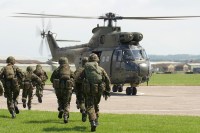
It’s not immediately obvious, but the silhouette on the dust jacket — soldiers advancing in single file, on foot (‘boots on the ground’) isn’t one squad, but five soldiers from different campaigns. From left to right, first comes the British infantryman of the second world war; next is a ‘jock’ from (I think) the Korean war; then a jungle fighter from the Malayan Emergency or the Borneo ‘Confrontation’; then, unmistakably, the long-suffering foot soldier of Operation Banner, the 38-year counter-insurgency (or police action, no one ever quite knew which) in Northern Ireland; and finally, the technology-festooned warrior of Iraq and Afghanistan.

Fine silks and fiery curries

From our UK edition

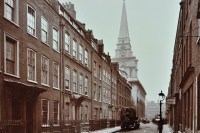
Genial, erudite and companionable over most of its 760 pages, this stout Georgian brick of a neighbourhood history at length flings itself in fury through a toff’s window. Much of Dan Cruickshank’s book has shown with learned charm how, in its tangle of ancient streets just east of the City of London, Spitalfields has always hosted the rough with the smooth, tumult beside elegance. The East End patch where he has lived for four decades — his own 1720s home, a finely embellished history of inner London in itself, gets 15 loving pages — has ‘constantly embodied paradox: great wealth alongside appalling poverty, beauty juxtaposed with squalor’. As he nears his finale, the twin streams of this urban microcosm join.

No one turned a hair

From our UK edition

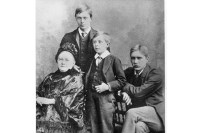
The Benson family was one of the most extraordinary of Victorian England, and they certainly made sure that we have enough evidence to dwell on them. Edward White Benson was a brilliantly clever clerical young man of 23 when he proposed to his 11-year-old cousin Minnie Sidgwick. He had been the effective head of his family since his father’s death nine years earlier; Minnie, too, was fatherless. Despite doubts from Minnie’s mother, they agreed to marry when Minnie was 18. She, too, was clever — Gladstone famously described her as ‘the cleverest woman in Europe’ — but had no real attachment to Benson or to any other man. Her romantic passions were always directed towards women.

The milk of human kindness

From our UK edition

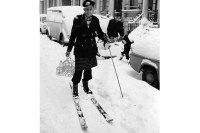
One of David Cameron’s choices on Desert Island Discs, this book reminds us, was ‘Ernie (The Fastest Milkman in the West)’. The book does not, however, explain why Cameron chose the Benny Hill ditty. Consulting the online archive, I found the then leader of the opposition explaining that ‘when you’re asked to sing a song’, ‘Ernie’ was the only one to which he could remember all the words. Sue Lawley tested him, and Cameron responded: ‘You can hear the hoof beats pound as they race across the ground, the clatter of the wheels as they span round and round’. It’s a miracle the Notting Hill Set was ever seen as smart.And yet I know what Cameron means. For our generation milkmen are an exercise in nostalgia.

Surreal parables

From our UK edition

There is a common assumption that experimental writing — for want of a better term — is obscure, joyless and arid. Or worse: that it is fake (or ‘pseudy’), a deception practised upon either the deluded or gullible reader. So I wonder what people who hold such assumptions would make of this. It constitutes the final paragraph of ‘Specialist’, one of the stories in this collection. The story itself is, not untypically for this book, less than a page long: The cyclist hit me, and it’s vile after my life ends in the afterlife. Lots of incense, resin, apes and giraffe-tails — all acquired tastes. I don’t like that kind of thing. Several things may strike you.

Divinely decadent

From our UK edition

‘Oh the Mediterranean addiction, how we fall for it!’ So sighed Sybille Bedford, who spent the 1920s and 1930s in Sanary-sur-Mer. Aldous Huxley settled in the same fishing village in 1930, writing to his sister-in-law: ‘Here all is exquisitely lovely. Sun, roses, fruit, warmth. We bathe and bask.’ James Lees-Milne perched further along the coast at Roquebrune from 1950–61. In a reverie, he later recalled the smells of brioche, coffee, pine needles, ‘the senses heightened, expectant of lovely future days without end’.

Bewitching stuff

From our UK edition

Richard Francis’s new novel covers ostensibly familiar ground. Set in and around Boston in the 1690s, it tells the story of the Salem trials, which resulted in the execution of 20 people (14 of them women), and which are sometimes regarded as a hinge event in the evolution of American secularism. As the historian George Lincoln Burr put it in 1914: ‘Salem witchcraft was the rock on which the theocracy shattered.’ This seismic moment was last visited by Francis in his 2005 biography of Samuel Sewall, the judge who presided over the trials. And it is to Sewall’s life that Francis returns in Crane Pond. He opens his story in January 1690, at which time Sewall is engaged in trying a handful of men for piracy.

Intimations of immortality

From our UK edition

A preoccupation with death is felt from the start of Margaret Drabble’s new novel, which opens with Francesca Stubbs, in her seventies, considering whether her last words will be ‘you bloody old fool’ or ‘you fucking idiot’. Fran is central to the web of characters that populate the book, linked by varying degrees of friendship and kinship, but tied more firmly together by the approach of death. Drabble squares up to old age with pragmatism: she shows us its terrible physical pain, loneliness and expense, but lightens what could threaten to be a grim read with observational humour, delighting in her characters’ eccentric pleasures.