Book review

Thirty years on

From our UK edition

One of the pleasures of Alan Judd’s books is their sheer variety. His work includes biographies of Ford Madox Ford and Sir Mansfield Cummings, the first head of what became MI6, as well as nine novels, many of which have little in common with each other apart from unflashy but elegant prose. The Devil’s Own Work, for example, is a brilliant novella, almost a fable, that explores the fatal temptation of a novelist and the relationship between art and success. Another, The Kaiser’s Last Kiss, shows us both the Third Reich and the elderly Kaiser Wilhelm in a wholly unexpected light. Three of Judd’s novels, however, have both a protagonist and certain themes in common.

Patriot or traitor?

From our UK edition

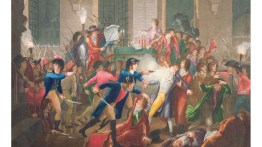
The mighty convulsion that was the French Revolution has stirred the blood of historians from Thomas Carlyle to Simon Schama and consideration of it still inflames opinions. At its centre stood Maximilien Robespierre — 5’ 3”, stern, unaffacted in manner or dress, Spartan in his domestic habits — deified by his followers as the ‘Incorruptible’ and vilified by his opponents as a traitor to the ideals of 1789, bent on dictatorship. Peter McPhee spares us speculation (Robespierre left no memoirs or diaries) on his subject’s ‘inner life’.

The triumph of failure

From our UK edition

In l958, my hero in life, the person I most wanted to be, was Keith Dewhurst. I had arrived on the Manchester Evening Chronicle straight from Durham as a graduate trainee reporter, which was a laugh, as they did no training. Keith was the paper’s Manchester United reporter, knew all the players, went to all the games, and he wore a white raincoat with the collar turned up. Rapture. I don’t think I exchanged more than a few words with him, just ogled his raincoat from afar. Have never met him since. If I were to, I am sure he would deny he ever wore a white raincoat. It was all part of my fantasy.

A paralysed landscape

From our UK edition

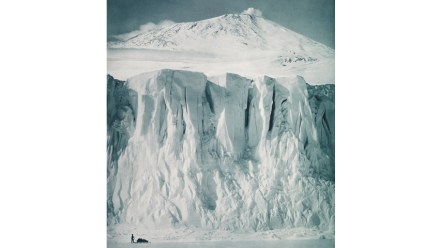
‘Very, very, very sexy’, a field-researcher scratches in his Antarctic notebook. He is describing a meteorite the size of a £1 coin that he has just picked up off the ice. The episode, recounted in Gabrielle Walker’s hugely informative book, reveals the passion of intrepid polar scientists. From the enthusiasm and diligence on display in these pages, one senses that the author shares their feelings. With a PhD in natural sciences and a solid career in science journalism, Walker is well placed to tackle the wide range of polar disciplines. She calls the Antarctic a ‘science playground’, and has visited five times, kneeling over holes in the ice with many of the world’s leading researchers.  The book is structured geographically.

Apocalypse now

From our UK edition

The blurb on the front of Grace McCleen’s debut novel (from Room author Emma Donoghue) proclaims it to be ‘extraordinary’, and goes on to praise it as ‘brutally real’, commending its mixture of ‘social observation and crazy mysticism, held together by a tale of parent-child love’. Unusually for a blurb, this is all accurate. McCleen’s novel may not be perfect, but it has a compelling and, at times hideously tense narrative that makes it an arresting read. It is deservedly named as one of Waterstones’ most promising debut novels of 2012.

The end of the affair?

From our UK edition

Of those caught up in the 1963 Profumo affair, the only winner seems to have been that blithe spirit Mandy Rice-Davies. Everyone else lost. Profumo’s family bore the brunt, of course, especially his son David, archetype of the boy sent crying home from school, who wrote a brilliant book about it, Bringing the House Down (2006). Harold Macmillan and the Conservative party were driven from office. Yevgeny Ivanov was recalled to Russia. Stephen Ward was hounded to death.

Charming, cold-eyed cosmopolitan

From our UK edition

At last a diary as penetrating on Berlin as the Goncourt brothers’ on Paris has been translated into English. The author, Count Harry Kessler, resembled a character from Sybille Bedford’s masterpiece, A Legacy. Born in Paris in 1868, he was educated in England, France and Germany. His father was a Hamburg banker; his mother was an Irish-Scottish beauty called Alice Blosse Lynch, admired by the Emperor Wilhelm I. At once German and European, Kessler rotated, as freely as some do today, between London, Paris and Berlin. After a year in the army, and a voyage round the world, Kessler devoted himself to the arts. Exhibitions and parties, and  long descriptions of landscape, fill his diary. He did not find social life hollow.

Bookends: Down on the farm

From our UK edition

Can we please have an inquiry into why already talented people are allowed to go off and be brilliant at something else too? As a quarter of Blur, Alex James (above), spent a decade creating critically acclaimed yet commercially successful pop anthems, thereby earning himself access to more drink, drugs and Doris than you could shake a Fender Precision bass at. Fair enough, say the rest of us (through gritted teeth). What isn’t on is the fact that it now seems James, having retired to a farm in the Cotswolds, can also write like a god. This won’t come as a total surprise to readers of The Spectator, where the ex-pop star used to detail his cheese-making, barn-building, sow-sourcing adventures.

Man of mysteries

From our UK edition

It was always William Wilkie Collins’s good luck — though in later life something of a humiliation — that he was dragged along on Dickens’s coat-tails — not least in this bicentennial ‘year of Dickens’. In December, the BBC will be showing a dramatisation of The Moonstone. T. S. Eliot (no less) called that tale of theft, somnambulism, Scotland Yard, opium and wily Indian thugs ‘the first and best of detective novels’. That, one imagines, would have elicited a snort of contradiction from the author of Bleak House, but the compliment is not far off the mark. Andrew Lycett is currently at work on a full-length biography and, in the meantime, Peter Ackroyd offers us this elegant extended essay between hard covers.

Fatal impact theory 

From our UK edition

As schools are for education, so universities are for higher education. In a civilised society, children should leave school literate, numerate and with some knowledge of science, history and culture. But society also needs an elite educated to a higher level. Universities are for the preparation of the next generation of doctors, United Nations interpreters, lawyers, structural engineers, archaeologists, nuclear-weapon designers, literary critics, astronomers, economists and so forth. That’s the short answer. The long answer would require a great deal more than is found in Stefan Collini’s brisk and very witty book.

Resounding successes

From our UK edition

The British Library’s ‘Spoken Word’ series, drawing heavily on the BBC archives, has already shown quite a range — from Tennyson’s famously crackly reading of ‘Charge of the Light Brigade’ to Scott Fitzgerald declaiming a speech from Othello. Now, it moves on to the short story and, despite the curious decision to include two tales apiece from Somerset Maugham and Algernon Blackwood (none of them especially overwhelming), once again nobody is likely to complain about a lack of variety. The three discs are kicked off by Maugham’s chatty reading of ‘Salvatore’, a story in praise of a lithe young Italian fisherman. According to the final lines, this is a plucky attempt to hold our attention with a portrait of simple goodness.

Portraits of an age

From our UK edition

By a fine coincidence, two legendary icons of British art were being feted in London on the same evening last month, and both are primarily famous, to the public at least, for their depiction of the Queen. At the National Portrait Gallery, the director Sandy Nairne hosted a dinner to celebrate the portrait oeuvre of Lucian Freud, while the Victoria and Albert Museum opened its major exhibition of Cecil Beaton’s lifetime lensing of Elizabeth II. In the 1950s these two artists were the epitome of London society. Beaton, by way of his groomed exquisite taste and laconic manner, was the epicene idol of sophisticated drawing rooms; the nascent Freud, 30-odd, untidy, brooding, supremely sexual, was a magnetic talisman for every smart hostess’s house, and often her bed.

His dark materials

From our UK edition

Like the dyslexic Faustus who sold his soul to Santa, the life of John Dee was a black comedy of errors. His vain and vulgar efforts to harness the occult for material ends often rendered him ridiculous. But there is a darker tale in Dee’s work for the Tudor state: a story of dodgy dossiers, fear-mongering and greed. During the Tudor period no clear distinction was made between science and magic. John Dee’s study at Cambridge of arithmetic, geometry and astronomy enabled him to become a navigational consultant, who worked with England’s greatest explorers. But it also helped him measure the rays of celestial virtue that emanated from the stars and influenced human affairs. Mathematics helped him predict the future — and that was a much sought-after skill.

Tragedy of Antigone

From our UK edition

Sofka Zinovieff’s absorbing first novel has two narrative voices. Maud is the English widow of Nikitas, whose death in a mysterious accident leads her to contact Antigone, the mother-in-law she has never met. A former Communist freedom fighter, Antigone was forced to leave Greece for the Soviet Union following the Greek civil war. She gave birth to Nikitas, her only child, in prison, and handed him over to her family when he was three years old, severing all further contact. Maud was the third wife of the dominant, swaggering Nikitas. She remained passive throughout their marriage; now, liberated by his death, she starts asking the questions to which she ought always to have known the answers — answers which can be supplied only by Antigone.

The view from the top

From our UK edition

Halfway through this book, the veil lifted, and I thought: ‘I see! I see what he’s trying to do!’ Pickering gets his characters, and moves them along, and then, after 150 pages, he manages to convey a really powerful sensation of something; you might call it amorality, or nihilism, or the sense of the pointlessness of it all. For the first 12 chapters, you are walking uphill, and then you get the view. For the hero, there is horror, and a Graham Greene-like sense of things not being what they seem. Before this moment, it’s a strange set up. I suppose it’s meant to be. Malone, our Greene-ish hero, is an American airman in his late twenties. He’s in Afghanistan, but not with the military — he flies supplies around.

Man with a mission | 3 March 2012

From our UK edition

He was a Persian aristocrat who struggled to make his country a democracy. Given to mood swings and sulks worthy of Achilles, Mohammed Mossadegh was born in June 1882 just a month before Britain bombarded and occupied Egypt. His formidable mother, Najm al-Saltaneh, belonged to the family of Qajar Shahs who ruled Iran from 1794 to 1925 and instilled in him a strong noblesse oblige that matured into genuine dedication to democratic and constitutional government. During his childhood, the country barely governed itself, yielding important decisions to the Russian and British empires that held it in joint subjugation. Mossadegh’s father, Mira Hedayatullah Vazir-Daftar, had been a minister of finance and was 40 years older than his wife.

A choice of recent thrillers

From our UK edition

Sam Bourne’s new thriller, Pantheon (HarperCollins, £12.99), is set just after Dunkirk in the darkest days of the second world war. James Zennor, an experimental psychologist, returns to his family’s Oxford home to discover that his biologist wife has disappeared, taking with her their two-year-old son. Zennor, scarred in body and mind by his experiences in the Spanish Civil War, fears that she may have fled from his ungovernable rages. Or was she acting under coercion? He pursues her to neutral America where uncomfortable truths gradually emerge in another university city. This novel is something of a departure for Bourne. Zennor’s emotional fragility lends an extra dimension to a powerful plot, skilfully constructed and narrated.

Bookends: Wasp without a sting

From our UK edition

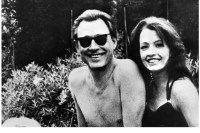
‘It may be hard to accept that a chaste teenage girl can end up in bed with the President of the United States on her fourth day in the White House.’ In 1962, 19-year-old Mimi Beardsley (pictured above) landed ‘the plummiest of summer jobs’, an internship in the White House press office. On day four, she was invited for a lunchtime swim in the presidential swimming pool. John F. Kennedy was, not surprisingly, ‘taller, thinner, more handsome in person than he looked in photographs’. The affair lasted 18 months and involved a lot of waiting around in hotel rooms, like most affairs. Amazingly, no one found out until 2003, when a newspaper finally named her.