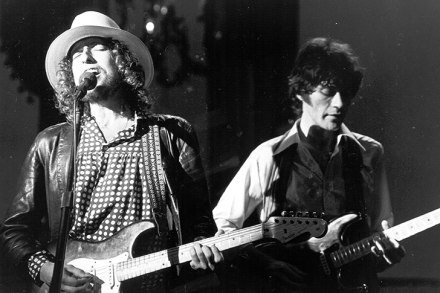
Bob dylan

Time for Jack Kerouac to hit the road

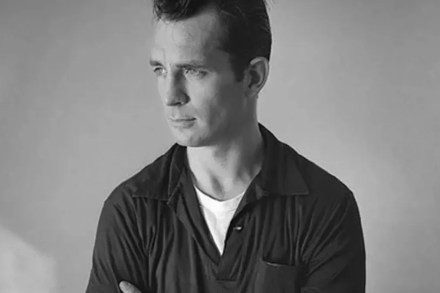
I saw the best minds of my generation destroyed by madness, starving hysterical naked, dragging themselves through the last pages of Naked Lunch at dawn looking for an angry fix of good literature, angelheaded hipsters burning for the ancient heavenly connection between plot and prose, who poverty and tatters and hollow-eyed and high sat up reading Kaddish, who bared their brains to the delights of On the Road in the pursuit of just a fraction of the “angels staggering on tenement roofs illuminated.” Everyone knows the Beats: from Jack Kerouac to William Burroughs to Allen Ginsberg, their influence has been undeniable, if not always delightful. And on March 12, their lodestar, Jack Kerouac would have been 100 years old.

kerouac

Truth in Duluth

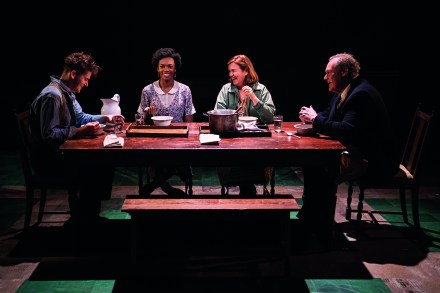
The Venerable Bede writes of a pagan priest in seventh-century England who, sizing up the meager life of man, compares it to a sparrow flying through a well-warmed dining hall on a stormy winter night. The priest admits to knowing nothing about the cold darkness before or after the brief passage. He can only speak to the time the bird spends in the light. In Girl from the North Country (open run at the Belasco Theatre), the season is the Great Depression in 1933, and the dining hall is a flophouse in Duluth, Minnesota, where down-and-outers blow through like so many birds on the wind. The innkeeper, Nick Laine (Jay O.

north country

On the road with Bob Dylan

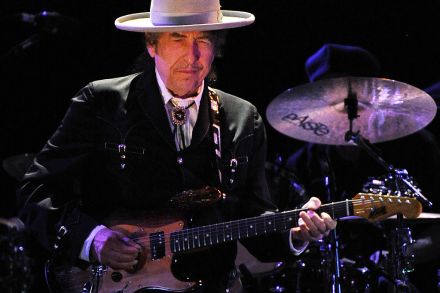
Bob Dylan has just concluded the first leg of his revitalized “Never Ending Tour,” which was paused, along with the world, after March 2020. Scheduled to travel to Japan last April, Dylan canceled his dates in Tokyo and Osaka, and presumably sheltered at home in California. He wasn’t resting, though. Just after midnight on March 27, 2020, his website posted a nearly 17-minute-long song, “Murder Most Foul,” circling around and about the assassination of President John F. Kennedy. Excited rumors of a record of new Dylan songs proved true when Rough and Rowdy Ways, his 39th studio album, was released on June 19, 2020. A year and a half later, Dylan and a newly constituted band finally took the record on tour.

Lumpily scripted and poorly plotted: Cry Macho reviewed

From our UK edition

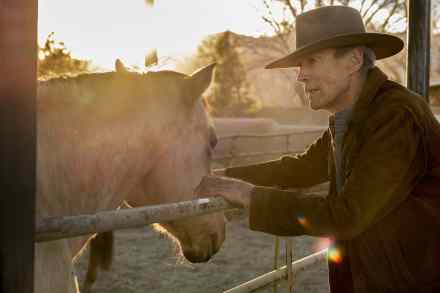
Clint Eastwood is 91; Cry Macho may well be his last film. Or maybe not. He has, after all, been directing himself as majestically craggy old guys for decades. Craggiest and most majestic of all, he was, in 1992, Will Munny in Unforgiven and, in 2008, Walt Kowalski in Gran Torino. In both those films, and now in Cry Macho, he is not just craggy, he is also broken. Munny is an old, widowed gunfighter barely surviving on his pig farm in Kansas. Kowalski, also widowed, is angry with America and missing, bitterly, the great days of the Detroit car makers. And now, in Cry Macho, he is Mike Milo, widowed and a ruined rodeo star-turned-horse breeder. He has been looking old but tough for 30 years; now he really looks old and not so tough.

The lost king of the blues

February 15, 1981, the day after Valentine’s Day. At 11 on a Sunday morning, a man’s body was found slumped in the passenger seat of a beige 1971 Mercury on a residential street in the Forest Hills section of San Francisco. All four doors were locked. A Valium bottle was in the pocket of a coat on the back seat. There was no ID: the body went to the morgue as John Doe #15. The dead man was 37-year-old Michael Bloomfield, a pioneering guitarist who brought blues to the mainstream and set Bob Dylan’s music alight. The cause of death was registered as cocaine and methamphetamine poisoning. Questions remain unanswered about how he died; why methamphetamine, which he avoided, was in his system; and why he was in a part of town where he knew no one.

bloomfield

Bob Dylan’s most iconic performances

From our UK edition

On 24 May Bob Dylan turns 80 and that gives fans like me the perfect excuse to celebrate our love of the great man (not that we ever really need one, of course). As well as regularly listening to the records, I spend far more time than is probably healthy trawling YouTube for videos of Dylan in action. So, if you fancy joining me down a freewheelin’ wormhole, here is a small sample of my favourite live performances from across his career. Boots of Spanish Leather, 1963 This is a YouTube video to listen to rather than watch. It’s an absolute wonder, not only because it is a lovely version of one of Dylan’s great ballads, but also because we hear him at ease, perhaps even enjoying himself, in an interview that bookends the performance.

‘There were no rules then’: Dana Gillespie’s 1960s childhood

From our UK edition

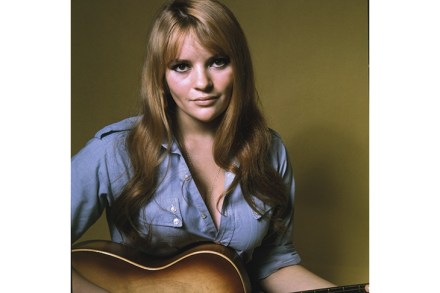
Although I can understand why Dana Gillespie might choose to call her memoir after her most famous album, for the first 170 pages I remained convinced she should have taken a leaf from John Cleland and called it Memoirs of a Woman of Pleasure. For hers has been an extraordinary life (or perhaps half life, as the trail of hi-jinks runs its course by the end of the 1970s). And so, despite reading at times like a cross between Terry Southern’s Candy and Confessions of a Window Cleaner’s screenplay — but with A-listers the ones shaking their sticks — as an evocation of the 1960s SW7-style, Weren’t Born a Man rings wholly true.

Contains the loveliest new song I’ve heard in decades: Bob Dylan’s new album reviewed

From our UK edition

Grade: A ‘Rough’ in terms of the mostly spoken vocals, but only ‘rowdy’ if you’re approaching your 80th birthday, which of course Dylan is. This is a sometimes playful and often self-deprecating Nobel Laureate at work, the lyrics (like the vocals) carrying a whiff of late Leonard Cohen, the arrangements of some of the slower, if not funereal, songs a nod to Tom Waits. In ‘I Contain Multitudes’, the grizzled old boomer has given us his best song since ‘Idiot Wind’; like many on here, the delicate melody is implied by the chord changes rather than explicitly stated.

I was born to be on this Bob Dylan podcast, says Geoff Dyer

From our UK edition

Podcasts will soon be like porn. Every interest, desire or idle flicker of curiosity will have been anticipated and catered for. Whatever you’re into there’ll be a podcast devoted to it, waiting to make itself heard. That’s easy for me to say because I’ve already found my perfect match: Is It Rolling, Bob? in which ‘Actors Kerry Shale and Lucas Hare talk to interesting people about Dylan’. Since nothing is more interesting than Dylan it follows that there is nothing more interesting than this podcast. I was alerted to it by my friend the writer Rob Doyle who had heard about it from his dad. (My friends, increasingly, are the children of my contemporaries; is this what Bob meant by staying for ever young?

‘Bob Dylan? He’s like Confucius’: Cerys Matthews interviewed

From our UK edition

‘Baby, It’s Cold Outside’ was a Christmas classic for more than half a century until people suddenly began to worry that it was about yuletide date rape. ‘It was because of the video Tom Jones and I made,’ says Cerys Matthews, in her smoky Welsh lilt. She recorded a cover with Jones in 1999. The video showed the craggy old Welsh crooner slip something in her drink that turns Cerys into a high camp vamp. ‘The song is really innocent and beautiful and fun — it’s got a huge heap of humour and wit and I love it. That song is not our enemy. That woman is a strong woman. She’s there because she wants to be! It’s cold outside. They’re making love. Come on!

Go, West

From our UK edition

My plan to cut the BBC out of my life entirely is working well. Apart from the occasional forgivable lapse — that excellent Margaret Thatcher documentary; Pointless and Only Connect because they’re the only programmes we can all watch together as a family — I find that not watching or listening to anything the BBC does is making me calmer, happier and better informed. I’m also learning stuff about myself that I never imagined possible. Like the fact that I have a massive man crush on the rap star Kanye West.

Bob Dylan is rum and cokey

Rock music is always so close to parody that the best and best known fictional film about a rock tour is This Is Spinal Tap. Rolling Thunder Revue, new on Netflix, is a rock documentary — a rockumentary, if you will — about Bob Dylan’s ‘Rolling Thunder’ tour of December 1975. Its producer is Martin Scorsese, who made The Last Waltz in 1976, when rockumentaries had yet to become mockumentaries by default. Really, it was the musicians who made The Last Waltz, and Scorsese who turned that material into not just one of the best concert films, but also a sharp-eyed study of musicians and the music business.

Rolling Thunder Revue: A Bob Dylan Story by Martin Scorsese

Peter Perrett: How The West Was Won

From our UK edition

Much though I loved it at the time, not a great deal of lasting worth came out of that fervid punk upheaval between 1976 and 1978. In terms of bands you would voluntarily listen to again, there was just The Clash and The Only Ones, in my book. The latter enjoyed no commercial success, despite leaving behind two of the best British albums of the decade and a single — ‘Another Girl, Another Planet’ — which has been called the finest three minutes of rock music ever, ever. Problem was they were too musicianly and literate for a time which exulted in bellowing, grunting, spitting and staccato stabs of noise. The band’s lead singer and songwriter, Peter Perrett, has just released his debut solo album.

2017 and all that

From our UK edition

This has not been an appalling year for pop music — it was better than 1984, for example, and 1961. Simply put, it was a year in search of a direction, one foot planted in 1980s cheese or bombast, the other still dipping its toe into the now mind-sapping boredom of EDM, with the occasional nod to a middle-class version of hip hop, a once garish and interesting subculture now utterly subsumed by the mainstream. And so everything rather swathed in both blandness and uncertainty — a year, then, without edge. Odd, really, considering the political climate. The biggest-selling albums of the year so far have come from the ubiquitous and unspeakable Ed Sheeran, Drake, Kendrick Lamar: folk, rap and hip hop assuaged into a kind of saccharine pap for the sake of mass acceptance.

Bob Dylan: Triplicate

From our UK edition

Having seen Bob Dylan play live a few years ago, I’m pretty sure he is not the first person I would choose to cover three albums’ worth of American jazz-age standards. The sound which came out of his mouth on that occasion resembled that of a demented, elderly dog. ‘Just Like A Woman’ had a chorus which went: ‘Grassum, grassum — rassum rassum rassum’, a neat twist on the original lyrics. It was joltingly inhuman. However, he has been on the Benylin, I think, because his voice here is not quite so gratingly hilarious.

The Band’s Barnacle Man

From our UK edition

The recent spate of rock memoirs has proved one of the less rewarding sub- genres in the post-digital Gutenberg galaxy. Obeying few rules of a good read, they usually suggest a variant on Frank Zappa’s biting assessment of rock journalists: ‘People who can’t write, ghosting for people who can’t talk, targeting people who can’t read.’ So it’s refreshing to find that Bruce Springsteen and Robbie Robertson, the two notable rock memoirists this festive season, have both dispensed with the ghostly intermediary, dusted off their PCs, loaded a thesaurus programme and writ large. Doorstop large.

Sweat-drenching, muscle-aching stuff

From our UK edition

‘John, we need your autobiography.’ ‘I thought I’d express my life experience in song.’ ‘That’ll be fine.’ This would be an odd agreement, and one the world would (rightly) be less than thankful for. But though not everyone plays music, we all have a relationship with prose. And recent years have seen a trend in rock memoirs away from the traditional ‘as told to’ (the method responsible for the footballer’s hagiography that often, in Martin Amis’s phrase, ‘runs the full gamut of human emotions from “gutted” to “chuffed”’) and towards autobiography proper: books written by the artists. That can be a problem.

Leonard Cohen – not Bob Dylan – should have won the Nobel prize

From our UK edition

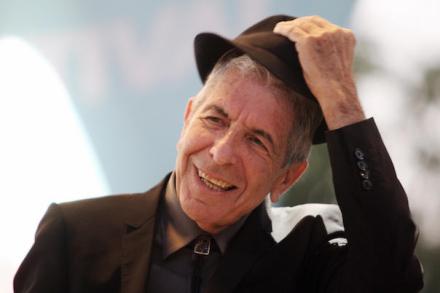
It’s rare for me to celebrate anyone’s financial misfortune, but if Leonard Cohen had not lost $5 million of his retirement savings due to alleged fiddling by his former manager, he might not have re-embarked on recording and touring in his seventies, and we would have heard much less of that uniquely stirring voice in his last years. The Canadian-born ‘poet-laureate of pessimism’ — who I contend would have been a more deserving and gracious Nobel winner than Bob Dylan — died in Los Angeles on the eve of the US election, so we’ll never hear the ballad of despair he might have composed on Trump’s victory.

Death of Leonard Cohen – how the light gets in

From our UK edition

For millions of people around the world the shock of the US election results will be enormously magnified by news of the death of Leonard Cohen, 82, a singer poet icon who had long sung about his own impending death. Thin and frail he died in Los Angeles in the early morning hours of November 8 -- the day of the US elections -- according to sources close to the family. A Canadian by birth he had long said that he wanted to be buried in his hometown of Montreal in the family graveyard lying alongside his Jewish forefathers, before any public announcement of his death was made. The formal announcement of his death has only spoken about a public memorial service to be held in the future in Los Angeles and there is no mention of where or when he was buried.

The Nobel Prize for literature, at long last, has been awarded to a complete idiot

From our UK edition

Bob Dylan has won the Nobel Prize for literature. And quite right too. But many people seem discomfited by the news, as if the award might represent a token gesture by the Swedish Academy. It doesn’t. The award is serious and we should take it seriously. The protests seem to fall into two camps. The first camp argues that Dylan is a musician, not a poet, and that therefore the award, while being made to a great artist, is a category mistake. The second camp grants that Dylan can be considered a poet, but that his poetry does not merit being ranked alongside that of Yeats, Eliot, Pasternak, Brodsky, Tranströmer and others. The first argument does not identify a category error so much as exemplify one.