Assad

Israel’s ‘neutral’ position towards Syria has created some strange bedfellows

From our UK edition

Over the weekend an Israeli-Arab flew from his home in the Jewish state on a paraglider, evading Israel's formidable air defences to land smack bang in the middle of the Golan Heights. Despite a search by the IDF so intense it provoked a flurry of tweets stating that an Israeli invasion of Syria was underway, he disappeared. No doubt he was hidden by one or other of the assorted jihadist groups based there, predominant among whom is the Al-Qaeda offshoot Al-Nusra Front. They long since booted out the UN peace-keeping mission in the No-Man's Land part of the territory and, to the delight of binocular-wielding day-trippers, have for the past two years been battling Syrian regime forces within a few miles of Israeli border.

How Putin outwitted the West

From our UK edition

Saddam Hussein hanged: is Iraq a better place? A safer place? Gaddafi murdered in front of the viewers: is Libya a better place? Now we are demonising Assad. Can we try to draw lessons? — Sergei Lavrov, Russian foreign minister, United Nations, 1 October Russia was right about Iraq and Libya, and America and Britain were dead wrong. Regime change doesn’t seem to have changed Middle Eastern countries for the better, as Vladimir Putin has been warning for years. His policy is not to support any armed groups ‘that attempt to resolve internal problems through force’ — by which he means rebels, ‘moderate’ or otherwise.

The Vicar of Baghdad – ‘Israel is the most intelligent country in the world’

From our UK edition

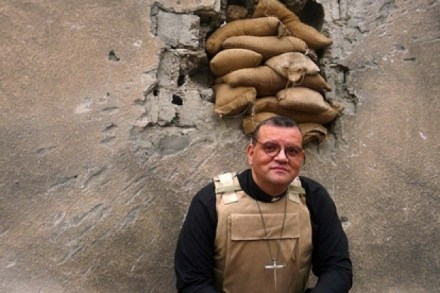
'We weren’t even at opposite ends of the table. Because he was in the eyes, and I was fighting over my own bit of space to keep the patient alive.' If you’re surprised to learn that Canon Andrew White used to work alongside Bashar al-Assad in the same London operating theatre, then you clearly haven’t met White – perhaps better known as the Vicar of Baghdad. Once you have, nothing about him will surprise you. A tall, bearish, immediately likeable man, his enthusiasm is contagious, whether it’s for vanilla ice cream, or intercession in war zones.

Forget Chilcot

From our UK edition

[audioplayer src="http://rss.acast.com/viewfrom22/jeremycorbynsbritain/media.mp3" title="Peter Hitchens and Fraser Nelson debate whether the Chilcot report needs to be published" startat=1916] Listen [/audioplayer]It might actually be better if Sir John Chilcot’s report is never published. I for one can no longer be bothered to be annoyed (though I used to be) by the increasingly comical excuses for its non-appearance. We all know the real reason is that the Iraq war was the product of lies, vainglory and creeping to the Americans, but they don’t want to admit it. I suspect Sir John and his colleagues would be more hurt by a patronising acceptance that they are a hopeless embarrassment than by any more anger.

Don’t expect to hear anything about Islamic State during the election campaign

From our UK edition

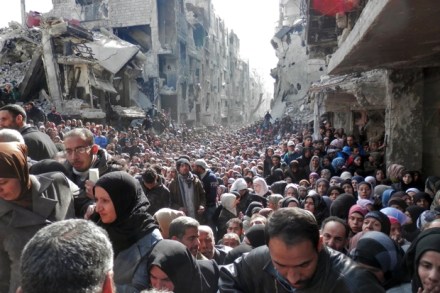
Granted, you don’t really expect foreign policy to feature much in an election campaign – we’re not saints - but it’s still shaming the way that the biggest foreign policy issue simply doesn’t register on the radar right now. I refer obviously to Islamic State, the group that just keeps on giving when it comes to reasons to want them wiped out. It’s a toss up really whether you go for the recently exhumed mass graves of the soldiers they massacred in Tikrit, the Yarmouk Palestinian refugee camp they seized control of, the images they obligingly posted of themselves smashing artefacts at Hatra or the blowing up an Assyrian church over Easter. Take your pick. And the response from the British Government?

The Labour party loves to hate Tony Blair

From our UK edition

I’ve met people at political events who seem otherwise normal, and then Tony Blair’s name is mentioned and their eyes light up in a way that suggest a chemical reaction has taken place in their brain. Likewise whenever the former Labour prime minister is mentioned online, it’s like a hand grenade has been thrown into the loony pond. Up they all chirp on social media, announcing how the war criminal must be sent to the Hague one day. The most recent case was Tony Blair’s offer to fund Labour candidates at the election, and the decision by two of them to turn it down; in both constituencies, Northampton North and Dundee East, Labour are close behind an incumbent party and really need the money, especially as the election will be the closest in decades.

Assad is hoping Isis will make his regime look moderate. This is no accident

From our UK edition

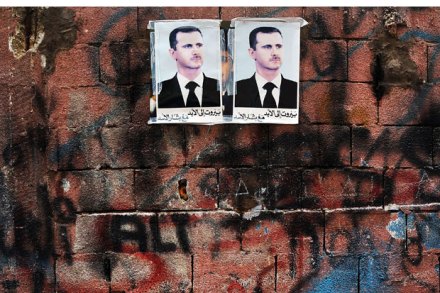
Jeremy Bowen's half-hour long interview with Bashar al-Assad is being heavily trailed by the BBC this morning.  And while it has little that is new it does provide an interesting insight into the Syrian President's current situation. The main story from it is Assad's confirmation that there is some line of communication between the Syrian regime and the Americans. Bowen put to Assad that there are American planes over Syria all the time engaged in the fight against Isis and that there must be some contact between them. While confirming that they do not speak directly, Assad did confirm that Iraq and other countries act as intermediaries.  But it was the way in which Assad said this that was most interesting. Assad: 'There's information but not dialogue.

The Saudis are playing a clever game with oil supplies. Here’s how to understand it

From our UK edition

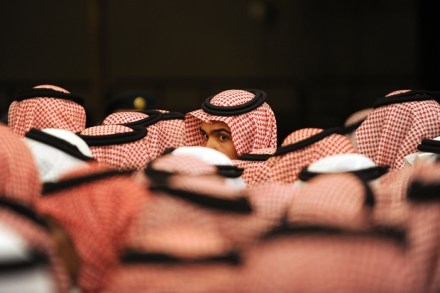
As oil prices continue to plummet, the rather sterile debate over Saudi intentions drags on. Some believe the Saudis are locked into a secret conspiracy with Washington to stiff Russia and Iran. Others prefer to take the Saudi oil minister at his word and believe that it’s all about market share. The truth is that the debate is founded on a false dichotomy: the Saudis are doing both things at once, and several other things as well. The best way to understand this is to try to step into the shoes (or sandals, rather) of a senior member of the al-Saud family. Your neighbourhood is convulsed in war and revolution, and you have seen apparently stable regimes in Tunisia and Egypt swept away, while your own vassal state of Bahrain is on the verge of civil war.

Your enemy’s enemy is not your friend

From our UK edition

The United States faces a very difficult task in Syria. It is trying to use air raids to contain and weaken ISIl. But, at the same time, it is trying to prevent the Assad regime from turning this intervention to its advantage. However, as the Washington Post reports today, the Assad regime have taken advantage of ISIl being pinned back to turn their fire on the moderate rebels, the very group that the US is trying to help. As the situation in Iraq is demonstrating, air strikes against ISIl can be effective when paired with ground operations. But in Syria, the US has no effective allies on the ground. The Turks could assist. But they are sitting on their hands. They aren’t even coming to the relief of Kobani, which sits on the Syrian Turkish border.

It’s time we apologised to Assad – he had a point about those rebels

From our UK edition

I saw MPs Peter Hain and Andrew Mitchell agreeing with each other on Newsnight about the need, now, to talk to President Assad, so that we might better combat the Islamic savages running amok in Syria and Iraq. Yee-haw. If I could see, two years back, that Assad was infinitely preferable to the majority of those people who took arms against him, then why couldn’t our politicians? Do they really still cleave to the idiotic view that the Arab people are 'just like us' and are ready and waiting for a pluralistic, representational democracy, perhaps with the alternative vote in place for local council elections, and maybe Baroness Ashton and the Howard League for Penal Reform ('can’t you just cut off his hand, rather than the whole arm?'). How could any sane person believe that?

No partnership with Assad (and no scrutiny till summer’s up)

From our UK edition

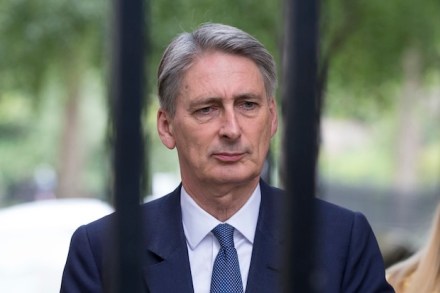
Philip Hammond this afternoon ruled out Britain working with President Assad in the fight against Isis, arguing that simply being aligned against a common enemy 'doesn't make us friends with someone'. It is nearly a year since the Commons rejected intervention in Syria against the Assad regime, and now figures such as Sir Malcolm Rifkind and Lord Dannatt are arguing that there may need to be some kind of alliance against the Syrian leader in order to defeat Isis. But the Foreign Secretary said: 'We may very well find that we are aligned against a common enemy, but that doesn't make us friends with someone It doesn't make us able to trust them, it doesn't enable us to work with them.

Ukraine and Syria expose the West’s lack of appetite for protecting human rights

From our UK edition

‘We must stop using the language of force and return to the path of civilized diplomatic and political settlement.’ So wrote Vladimir Putin in The New York Times in September last year. Last week, he invaded Ukraine. A system of ‘international law’ which gives a man like President Putin the right to decide whether a proposed action is legal or not, is morally bankrupt. Yet that is how the United Nations Security Council functions – and that is why Western democracies should not shrink from taking action even when the Russian veto stands in the way. President Putin’s New York Times piece was about Syria. He was appealing to the American public not to assist Bashar al-Assad’s opponents.

The one man who makes me hope for peace in Syria

From our UK edition

As Syria’s second peace conference looms, and we prepare ourselves for a lot of hot air drifting over from Geneva, I’ve been making a list of those players in the civil war who actually want peace and those who don’t fancy it one bit. The anti-peace side is easy. There’s Bashar al-Assad, of course. Hillary saw to that during the first conference. Perhaps she’s right that he shouldn’t be part of any transitional government, but if he loses all power, Assad and his Alawite clan are toast. So what use is peace to him?

Assad will go – the question is how much blood will be spilled

From our UK edition

As we approach next week’s Geneva II Conference, the desire of the majority of Syrians, the moderate majority, for a just and sustainable resolution to the conflict in Syria must be addressed. At Sunday’s meeting of the ‘Friends of Syria’ Foreign Secretary William Hague, Secretary of State John Kerry, Foreign Minister Laurent Fabius and representatives from the Gulf States were of one voice in supporting President Jarba and the Syrian Opposition Coalition and were in full agreement that Assad has no future in Syria. Even privately the Russians and Iranians are increasingly coming to the realisation that it is a question of ‘when’ not ‘if’ Assad goes. The question is how much blood, innocent Syrian blood must be spilled between now and then.

A new Islamist alliance among Syria’s rebels has given Assad the enemy he wants

From our UK edition

   Amman — Beirut — Istanbul I recently bumped into a senior officer with the rebel Free Syrian Army who was waiting in the passport queue at the Turkish border. I didn’t recognise him at first, out of uniform and without his entourage, and I told him so. He was following the example of the 7th-century Second Caliph, Omar bin al Khattab, he replied. The caliph was so humble he took turns with his servant riding a horse to Jerusalem to receive the city’s surrender. There was no imagery from Islamic history when I first met the officer a year ago. He was one of those ‘rebels’ western officials have in mind when they describe a ‘secular, moderate’ armed opposition.

In London, John Kerry Promotes World’s Smallest Syrian Whirlwind

From our UK edition

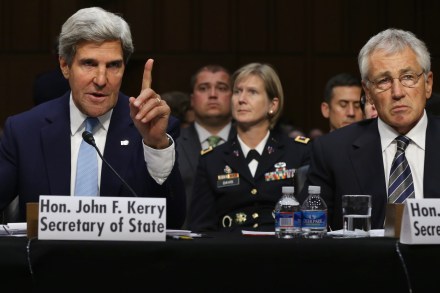
There's little need for people opposed to launching any kind of attack on Syria to expend much energy doing so when those tasked with making the case for reminding Bashar al-Assad that using chemical weapons is not something the international community can or will ignore are making such a bloody hash of the job. Here, for instance, is John Kerry, the US Secretary of State, reminding us all that the Americans really don't want to be taking action at all. They've been pushed into doing so, the result of both the Syrian regime's use of chemical weapons (why assume Assad's people are clever enough not to use them?) and by President Barack Obama's rhetoric about red lines and so on. But this is not where this American president would really like to be.

On Syria, parliament has voted to have no policy at all.

From our UK edition

A muddle and a cock-up. For all the talk of parliament reasserting itself, last night's vote on Syria showed a parliament that voted, twice, to oppose actions it actually supports. David Cameron has been humiliated but this was hardly a banner day for Ed Miliband either. The House of Commons has, for now, cut off its nose to spite its face. Perhaps surgery can repair the damage. Perhaps it can't. Because the longer and more deeply one contemplates yesterday's events the more evident it seems that there were no winners. The government motion was defeated. So was Labour's amendment. Since these motions were, in essence and in most practical respects, identical one wonders what on earth has happened.

Syria is not Iraq (but at least the Iraq War had a clear objective)

From our UK edition

A decade ago, I was sure that going to war in Iraq was the right thing to do. I persisted in that belief for a long time too, well beyond the point at which most supporters of the decision to remove Saddam Hussein from power had recanted their past enthusiasm. The link between 9/11 and Iraq was quite apparent. Not because (despite what some mistaken people insisted) Saddam had any involvement in the atrocity but because removing tyrants and dictators seemed the best way of spreading the pacifying forces of commerce and democracy that might, in time, render Islamist extremism and terrorism obsolete. Why Iraq? Because it was there and because it could be done. Besides, there was unfinished business. Not just from 1991 but from 1998 and Operation Desert Fox as well.

George Galloway blames Israel for the use of chemical weapons in Syria

From our UK edition

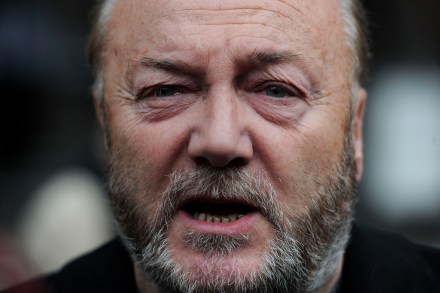
Say this for George Galloway: every time you think he cannot sink any lower he finds new ways to surprise you. His latest contribution to Press TV, Iran's propaganda station, speaks for itself. Parody is pointless. Given his history and his paymasters, we would expect him to defend the Assad regime in Syria. Even so, under-estimating his ability to sniff out the true villains is never sensible. Here's his "analysis" of the use of chemical weapons in Syria: "If there's been any use of nerve gas it's the rebels that used it. [...] If there has been a use of chemical weapons it was al-Qaeda who used chemical weapons. Who gave al-Qaeda chemical weapons?

If you think arming the rebels is the answer, then you don’t understand Syria

From our UK edition

The Spectator debate on Monday will no doubt pick up from Cameron’s statement to the House of Commons after the G8 meeting on Wednesday. It was wafer thin; so were his achievements. The spin generated by Number 10 in recent days has verged on the absurd. On Tuesday, according to The Times headline, Cameron was 'leading the West to ambush Putin on Syria'. Does anyone believe that this is the way to handle the Russians, let alone Putin? Nor, of course, did it happen. By Wednesday we were being told that 'The West tries to engineer a coup in Damascus'. No sign of that either. By the time the Prime Minister appeared in the House of Commons he had come down to earth.