Artificial intelligence

I’m writing a novel without using AI – and I can prove it

From our UK edition

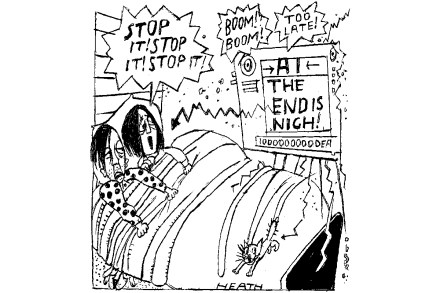
Everyone’s seen stories about the creep of AI into art of all kinds. Recently the people behind the music-fabrication website Suno have been making outrageous statements to the effect that people don't enjoy learning musical instruments and writing their own songs, so why not let AI do it for them? This is very new, very disturbing and very consequential. I could talk about graphic art and video and film-making, but you’ll know what’s been going on there. I’ll just cut to the chase and get to how AI tools are impacting and will continue to impact the writing of fiction.  I anticipate a future in which human authorship will need to be proven. A few years ago I simply wouldn’t have believed that this landscape could be possible.

Will AI kill off Captchas?

From our UK edition

It was a line on Poker Face (the excellent US detective drama currently streaming on Now TV) that piqued my interest. Hunched over a laptop, Natasha Lyonne’s heroine, Charlie Cale, claimed to be working as a ‘Captcha technician’ – someone who solves those fiddly, occasionally infuriating internet puzzles for money. You know – the ones that ask you to ‘Select all the squares with traffic lights’, ‘Select all the squares with bridges’ or simply tick a box to say you’re human before you can log into a website. Given the series has satirised everything from New York City rent controls to multi-level marketing schemes, I originally assumed it must be a joke.

Could Japan soon be governed by chatbots?

From our UK edition

Tokyo Could Japan be the world’s first -algocracy – government by algorithm? The concept has been flirted with elsewhere: in 2017 a chatbot called Alisa challenged Vladimir Putin for the Russian presidency. But there is reason to believe that if any major country is going to replace its politicians with AI, it will be Japan.  The citizens of Yokosuka in Kanagawa have had a remarkably lifelike AI avatar of their mayor, Katsuaki Uechi, at their service for over a year now. It (he?) speaks perfect English with a slight Japanese accent, with Uechi’s facial features manipulated to make it look as if he is pronouncing the words correctly. The avatar exists on the city’s website and YouTube channel, standing at a podium, making speeches.

In the age of AI, humans must keep learning

This year, colleges stopped teaching students to write. As artificial intelligence chatbots allow students to generate unique essays that can’t easily be vetted for plagiarism, professors have felt the need to replace essay assignments with written examinations in closed rooms. It’s a considerably shrunken version of the kind of university education that was on offer 75 years ago. In June, a study from MIT showed steadily waning brain engagement and originality as student essayists used AI more. The college business model is in trouble: $75,000 for a year’s worth of diversity, equity and inclusion nonsense already struck parents as a bit steep. But at least the kids were being taught something. The new limitations AI places on instruction may do a lot of colleges in.

Does AI belong on the tennis court?

From our UK edition

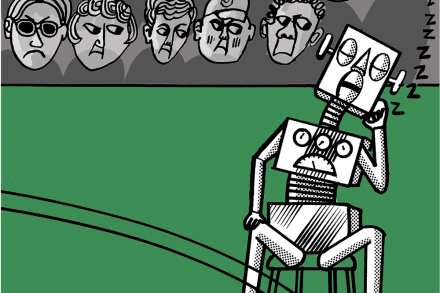
The evidence was clear, the official had dropped a clanger. At 4-4 in the first set of the women’s match at Wimbledon last Sunday, the British player Sonay Kartal should have had her serve broken when she hit a backhand long. Anastasia Pavlyuchenkova saw the ball land well out of court, as did those watching the replay, but the line judge remained mute. ‘Replay the point,’ the umpire said, leading the Russian to complain that ‘they stole the game’. This nameless offender – let’s call him Hugh after Hugh Cannaby-Serious, the official who used to wind up John McEnroe – was napping. It turned out that Hugh had been switched off for a few points. Robots can be human too. Cameras have replaced line judges at Wimbledon after 148 years.

My campaign to bring back real life

From our UK edition

A new book by an American writer, Christine Rosen, details the way in which we are losing touch with the real world: the one we evolved in, as opposed to the virtual one. All the scrolling and texting means we’re forgetting the look and feel of life unmediated by screens. The book is called The Extinction of Experience, and if we get more anxious year by year, then it’s not just wars or the cost of living, Rosen suggests, but because we’re grieving for the real world, whether we know it or not. I definitely know it. I’m Gen X, so I grew up without the internet, yet like other members of my generation now find myself caught in the smartphone itrap, dependent and resentful.

How deepfake fraud is rewiring our minds

We’re led to believe that America was once Mister Rogers’ Neighborhood, a place of cardigans and kindness where everyone got along just swell. Then it all went wrong. MSNBC hosts talk of a “crisis in authority” while New York Times columnists blame corrupt Republicans for a “lost faith in liberal governance.” Right-leaning commentators point to mass migration as the great trust killer. Illegal aliens, we’re told, have a “fragmenting effect on shared cultural norms” and are “importing distrust.” No doubt these arguments contain an element of truth: America is a less trusting society than it was a few decades ago. But soon such arguments are going to appear as quaint as Mister Rogers’s model Pennsylvanian town.

fraud
Pendant

The architects of ‘AI rights’ are a threat to humanity

It’s easy to see that gender ideology is being used to undermine biological truth – but what’s harder to fathom is why. I am persuaded that the end goal is, in fact, to pave the way for human symbiosis with artificial intelligence, which Silicon Valley has been promising us since the early 2000s. Encouraging children to embrace macabre rituals like medical castration convinces them that they can mix and match parts of their anatomy, which makes it a simple matter for them to accept AI augmentation. We are at the beginning of more extreme changes to humanity than we have ever seen before. The gene-editing technology CRISPR now allows us to genetically alter human beings.

How the internet turned ugly

From our UK edition

Consulting a website on my phone recently, I was struck by how painful it has become to use the internet. All I wanted was to read some local news and check the spread of a power cut in my area. Instead, as I scrolled, I was assailed by interruptions from integrated adverts which – in the best case – wanted eagerly to tell me about the charm and usefulness of a new BMW. In the worst case, I was urged to consult some lawyers immediately because I had been mis-sold an insurance or financial product in the past and was due an enormous payout, if only I would contact the least credible-looking advocates in the country.

Lily Parr and the creepiness of AI resurrection

From our UK edition

I’m not sure it’s possible to make a horror movie more sinister than the chirpy four-minute film on YouTube purporting to be an ‘interview’ with the late Lily Parr. Parr was a professional footballer who played as winger before the war, a chain-smoking 6ft Lancashire lesbian with that gung-ho spirit I remember from my girls’ boarding school, before the governors purged the spinster games mistresses. Three UK in collaboration with Chelsea FC have cooked up an AI version of Lily, which they insist can answer questions just as she would have done. They’ve persuaded Karen Carney (real, not AI), who played for England, to talk to AI Lily and then presented footage of the conversation as if it were a scoop.

Controlling AI is the great challenge of our age

From our UK edition

In 1997 the world chess champion Garry Kasparov was beaten by an IBM computer system called Deep Blue. It had defied all expectations, exploring some 300 million possible moves in one second. The most that skilled chess players can contemplate is about 110 moves at any given time. It was a seminal moment in the advance of artificial intelligence – even if not fully understood, writes Richard Susskind in How to Think About AI. People did not wholly grasp the impact of the exponential power of computers, nor that new ways would be found to develop systems that could achieve human expert-level performance. Fast forward to 2016 and to AlphaGo, a machine designed to play the complex game Go, which has more possible moves than atoms in the observable universe.

How I took on Microsoft’s AI – and won

From our UK edition

‘This is an assault!’ I screamed in my study, oblivious to the fact that my husband had a guest downstairs. ‘I’ll never write anything again!’ Thanks to one more helpful word processing ‘update’–which my cousin calls ‘setbacks’– whenever I hazarded a sentence, I suddenly had bossy company: Microsoft 365’s underhandedly money-making ‘Copilot’, when I’ve always written flying solo. (‘Describe what you’d like to write, including notes or an outline, and Copilot can write a draft to help you get started,’ it insists. There’s lots of autofill; the editor button actually gives your text a score on ‘inclusiveness’, when I need a score on antisocial hostility.

Beware this terrible new AI email feature

From our UK edition

A friend of mine got a nasty shock last week after a Google Meet call, thanks to a new AI function that he was unaware of. On this occasion, the consequences were quite funny, but on another day his failure to get his head around this new technology could have ended his career. Had the AI continued to transcribe the call after the other two had left – and sent it to them? We’re all familiar with the poor sod who hits ‘reply all’ when responding to an email and accidentally copies in precisely the person whom he doesn’t want to read it. I’ve done it myself. I’ve also heard horror stories about people inadvertently switching their cameras on in the middle of a Zoom call when they’re on the loo or in their underpants – not something I’ve ever done, thank God.

DeepSeek’s cheap information comes at a high price for the West

From our UK edition

This week, Chinese technology has shown the West the challenge it faces – ruthless, implacable and impossible to ignore. The unveiling of the Chinese artificial intelligence model DeepSeek has not only disrupted the business models of America’s tech behemoths; it has also shown that, in the race to develop the tools for economic hegemony, Beijing is set on supremacy. The launch of DeepSeek came just days before the CIA’s conclusion that, on the balance of probabilities, the Covid virus was incubated in a Wuhan lab – a man-made killer, not a product of nature’s evolutionary mischief. China stands revealed as a power bent on using science to secure not human flourishing but geopolitical dominance for its Leninist leadership.

Portrait of the week: DeepSeek, Duke of Sussex’s damages and an iceberg the size of Cornwall

From our UK edition

Home The government would invest 2.6 per cent of GDP a year to create growth, Rachel Reeves, the Chancellor of the Exchequer, said in a speech. Standing behind a placard reading ‘Kickstart economic growth’, she kept repeating the word ‘growth’. Welfare and the visa system would be reformed. A third runway at Heathrow would bring 100,000 jobs. But net zero, she said, was the ‘industrial opportunity of the 21st century’. Earlier she had said that the government’s own Finance Bill implementing October’s Budget would be amended to soften the effects of its tax measures against non-domiciled residents. The Ministry of Defence ordered £9 billion worth of nuclear submarine reactors from Rolls-Royce. Sainsbury’s was to cut 3,000 jobs.

Doomers looks at what AI means for the future

I wrote my play Doomers partly because, the night Sam Altman was fired, I was performing in a play called Zoomers. Someone — I forget who — suggested the idea of Doomers as a joke, and I thought it was a good one. My method for some, if not all, of my plays over the past few years has been to take some kind of mimetic material — downtown, Gen Z, polyamory — and to find what is surprising or human inside the meme. I try to locate a universal story in what might otherwise seem like a surface-level idea that feels niche, obnoxious or both. Sam Altman and the autistic tech world, in particular, represent opaque surfaces that I believe conceal something deeper.

Doomers

Which were the most destructive fires in history?

From our UK edition

Swing states Where would Canada and Greenland rank if they became US states? – Canada would be, by far, the largest state. In fact, at 3,855,100 square miles it is marginally larger than the current US (3,796,742 square miles). – It would also be the largest state by population, with 41.5m inhabitants, putting it ahead of California (39.4m). – It would have the third largest GDP, at $2.58tn, behind California ($4.08tn) and Texas ($2.69tn). – Unless Canada also joined, Greenland would become the largest US state, at 836,330 square miles, ahead of Alaska (665,384 square miles). – It would be the smallest in terms of population, its 56,600 inhabitants less than a tenth of the current least-populous state, Wyoming (587,618).

Time is running out to tackle the dangers posed by AI

From our UK edition

Is this what it felt like in the months before August 1914? Or during the years leading up to September 1939? The discussion around artificial intelligence produces a deep foreboding that we are in the grip of forces largely beyond our control. Are we sleepwalking towards disaster? That is the feeling I have after reading Genesis, a collaboration by Eric Schmidt, the former CEO of Google, Craig Mundie, the former chief research and strategy officer at Microsoft, and Henry Kissinger, who died, aged 100, soon after completing this book. They have crafted a holistic analysis of the social, political, psychological and even spiritual impacts that a superior machine intelligence would have for humanity.  We are broadly familiar with AI’s current and future benefits.

Can an AI friend solve the loneliness epidemic?

Avi Schiffmann wants to create what he calls an “Ozempic for loneliness.” He believes Friend — his AI-powered chatbot and forthcoming wearable pendant — can address the loneliness epidemic. “I’m definitely motivated by curiosity more than anything,” he explains, “but also by how controversial the topic is. It’s just so culturally relevant.”  He wants to fill a void people feel they can’t fill elsewhere, and he wants to do it now, not years from now. AI companions are, in his words, a “very effective way” to counter isolation, a salve against the atomization we’ve lamented since the dawn of urbanization. Schiffmann reached out to me after I posted a negative review of Friend’s chatbot on my blog.

friend ai

Am I alone in thinking?

From our UK edition

‘Et remarquant que cette vérité, je pense, donc je suis, était si ferme et si assurée, que toutes les plus extravagantes suppositions des Sceptiques n’étaient pas capables de l’ébranler, je jugeai que je pouvais la recevoir sans scrupule pour le premier principe de la Philosophie que je cherchais.’ Pardon my French – and I translate below. But so elemental was what René Descartes wrote (afterwards rendered in Latin ‘Cogito ergo sum’) that his phrasing should confront us first in his own language. Though in 1637 Descartes will have known nothing of robots, still less of artificial intelligence, he settled by this remark a debate that we think remains open, and which has recently resurfaced in media commentary. Can robots achieve consciousness?