Arthur conan doyle

Everybody needs ‘good neighbours’: fairy folklore from time immemorial

To our jaded century, ‘fairy’ carries connotations ranging from the sentimental to the sickly. It conjures childishness, foolishness, insipidity and softness – Tinker Bell, the Tooth Fairy, the Cottingley photographs that fooled Arthur Conan Doyle, cakes, twinkling lights and a certain brand of soap. Francis Young feels that the word should also be applied to countless other traditions of supernatural entities from earliest times on – that fairy stories help us fathom being human. Young has written or worked on many books about religion and folklore, and this is his third specifically on fairies. Suffolk Fairylore (2018) and Twilight of the Godlings (2023) explored British ‘encounters’; now he expands across

Five things to do in Crowborough

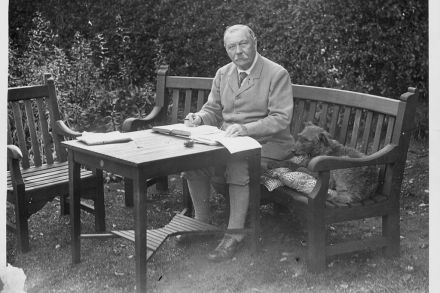
For the first time in almost a century, when Arthur Conan Doyle was buried in a Turkish carpet in his garden, my hometown of Crowborough is in the news.  For those fortunate never to have been, Crowborough is a small place in the Weald of about 20,000 souls. The cadet training camp, where my school pals and I endured a week of army exercises and tinned rations, has been turned into a migrant hostel for more than 500 asylum seekers, sparking a furious reaction from the local residents. I have much sympathy with them – but also for the young men who have been sent to live there.  Kim Bailey,

Are you ‘marred’ or ‘mired’ in scandal?

My husband made a noise which he thinks is like a klaxon but sounds as if he is choking on his whisky. Even though I was in the middle of making a roux, I had to hurry from the kitchen to make sure he wasn’t. The klaxon was to signal that he had found in the paper a cliché that had led to complete nonsense. ‘Sir Tony’s position on the board was marred in uncertainty because of his role in the 2003 invasion of Iraq,’ someone said in the Telegraph. The cliché he was aiming at was mired. But, as clichés are empty of meaning, he hadn’t noticed that marred

invalid

The curious rise of Kamala Harris

48 min listen

This week: Kamala takes charge. Our cover piece discusses the rise of Kamala Harris, who has only one man standing in her way to the most powerful position in the world. Her’s is certainly an unexpected ascent, given Harris’ generally poor public-speaking performances and mixed bag of radical left and right-wing politics. Does she really have what it takes to defeat Trump? Kate Andrews, author of the piece and economics editor at The Spectator, joins the podcast with deputy editor Freddy Gray to discuss. (02:34) Next: Will and Lara go through some of their favourite pieces from the magazine including Damian Thompson’s article on how the upcoming Hollywood film Conclave may be

Why Sir Arthur Conan Doyle believed in fairies

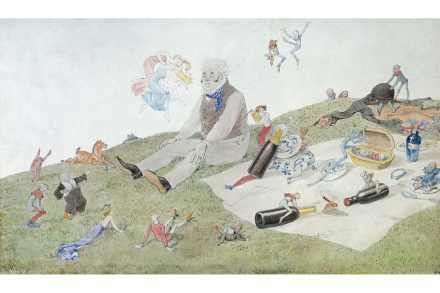
Sherlock Holmes fans will be delighted to know that there is a new play featuring the great man. In it Holmes, 72, bored silly by retirement and bee-keeping in the Sussex Downs, is back living at his old haunt of 221B Baker Street and  reunited with the widowed Watson. The case that lands in Holmes’s lap concerns a reported outbreak of fairies in the Bradford area. Thus we are plunged into the Cottingley saga, a mystery that fascinated the public in the 1920s. The play is by Fiona Maher, a fairy-lore expert, organiser of the Legendary Llangollen Faery Festival (she’s known as Tink) and author of a very well-researched book

Why are crime writers so weird?

What a weird lot crime writers are. I don’t come to this conclusion lightly, since I’m a crime writer myself, but on the evidence of this magisterial but wickedly entertaining book the conclusion is inescapable. As you turn the pages, the evidence mounts up. One crime writer has been considered a serious candidate for sainthood and another has been convicted of murder. Wilkie Collins simultaneously maintained two mistresses and their children but never bothered to marry either. Mary Roberts Rinehart, an early 20th-century queen of American suspense fiction, narrowly escaped being murdered by her chef because she wouldn’t promote him to butler. Agatha Christie famously engineered her own disappearance, and

Plumbing the mysteries of poltergeists

This is a paranormal book — by which I mean it exists in a truly out of the ordinary netherworld of amiable smut and arch silliness not normally associated with titles reviewed in these pages. But hold on, there is a point — which I’ll come to later.‘Perhaps Wakdjunkaga was really Gef the Talking Mongoose.’ I read this amazing sentence and was about to throw the book across the room, but then realised that a flying paperback might, if S.D. Tucker were to see it, be interpreted as evidence for the existence of poltergeists (from the German for ‘noisy spirit’). So I read on resignedly until my wife interrupted me