Art

Sotheby’s latest gamble

On February 1, 2024, Sotheby’s auction house announced a new fee structure that came as something of a surprise to the art world. For decades, Sotheby’s and its competitors have been one-upping each other with respect to the fees charged to buyers and sellers. While these fees have unquestionably increased the profitability of the auction houses themselves, in their complexity they have often bewildered auction participants and market observers alike. In theory at least, that may be about to change. Beginning this spring, Sotheby’s new fees will be both lower and potentially easier for all parties to understand. They apply to sellers consigning lots for auction after April 15, and to buyers beginning on May 20.

Sotheby's

The divine Dalí and his ‘Christ’

I arrived in the city of Figueres early one January morning to visit one of the most popular, and bizarre, art museums in the world, the Teatre-Museu Gala Salvador Dalí. It houses a dreamlike picture that, for the first time since it left over seventy years ago, has made a temporary return journey to Spain. Originally simply titled “The Christ,” the 1951 canvas depicting the giant figure of a man on a cross, shown at an overhead angle hovering over a moody seascape, was painted by the most famous son of Figueres, Salvador Dalí. Through April 30, it forms the centerpiece of a show exploring its creation, history, local connections and symbolism.

Dalí
digital

The digital habit

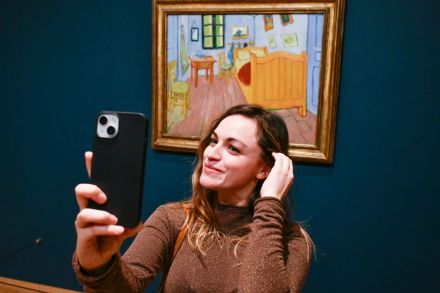
In an era that claims to value the authentic, the direct and the natural, the word "processed" has negative connotations, as in “processed” food. Nevertheless, it describes exactly how perhaps nine-tenths of the human race — including, I imagine, the lost Indian tribes of the Amazonian wilderness — experience reality these days, which is to say processed through electronic media, social media and the oxymoronic smartphone.

The notorious feud between John Ruskin and James Whistler

It was too dark to see, and the painting was upside down. In 1877 John Ruskin, the leading art critic of Victorian England, attended an exhibition that included paintings by the American-born artist James Abbott McNeill Whistler. He hated them — and said so. In print. “I have seen, and heard, much of Cockney impudence before now; but never expected to hear a coxcomb ask two hundred guineas for flinging a pot of paint in the public’s face.” Whistler sued. The following year the argument came to court, on a dark day in a gloomy and gaslit courtroom. The canvases that Ruskin had so disliked were propped up against a wall and barely visible; one was the wrong way up, and another was dropped unceremoniously onto an elderly gentleman’s balding head.

ruskin
art market

How does the global art market move?

Art market reporting tends to be more sensationalist than, say, the news about corn futures. Breathless accounts of high-stakes bidding abound, remarkable discoveries of forgotten treasures in thrift shops get big headlines, and who’s up or down and how much money the fluctuation involves become fodder for salacious gossip. Interesting though these tales undoubtedly are, though, they don’t provide a realistic picture of the art business. While they may be less gossipy, some nuts-and-bolts stories away from the headlines can be just as compelling for those with an interest in the art market, and how what we see displayed in our homes, public spaces and cultural institutions depends upon very practical considerations to get there.

The bold new vision for Edinburgh’s National Galleries of Scotland

What do you generally think of when you hear the words “Scottish art”? There are the usual clichés of course, of large-scale landscape paintings depicting gorse and heather and startled-looking wildlife, or alternatively there are the portraits of various noblemen and worthies, many of whom have the well-fed hue that living high on the hog imbues. If you head to Edinburgh’s National Galleries of Scotland — often simply known as “the National” — and visit the traditional collection in the neoclassical building right in the center of the city, near the castle and major shopping streets, you won’t be disappointed by the eclectic selection of Old Masters and Scottish masterpieces alike.

national
Trumbull

Radical in the Rotunda

In a recent Saturday Night Live sketch, comedian Nate Bargatze portrayed General George Washington addressing his troops around a campfire in 1777, as they ask themselves what the Revolution is for. Washington shares some of his dreams for the new American republic — though he dodges difficult questions about slavery — in an effort to inspire his men to fight on. The writers take full advantage of the fact that a number of peculiarly American things, such as our version of football (in which feet rarely figure) or our complicated system of weights and measures, seem rather odd to the rest of the world. “We will be free to measure liquids in liters and milliliters, but not all liquids,” the general explains. “Only soda, wine and alcohol.

The life of the revolutionary Albrecht Dürer

Great books make genres jump. It happened with W.G. Sebald’s The Rings of Saturn, which looked like a travelogue, claimed to be a novel and felt like neither. Albert and the Whale by Philip Hoare, which recalls and converses with Sebald, is such a work. An antic and original creation, it is not exactly a biography of the revolutionary Renaissance printmaker, painter and theorist of geometry and perspective. For the fuller story of Albrecht Dürer, turn to Erwin Panofsky’s mighty monograph, as Hoare does frequently. Instead, Hoare has made a book as much for Dürer as it is about him. Dürer’s life and art are thrillingly encountered.

Dürer

The value — and worthlessness — of contemporary art

“This is why I hate art.” “Why, because this is pants?” A friend and I were at a contemporary art show, standing before a mixed-media work featuring trite sayings, glittery flowers and a spaniel. A few days earlier I had suggested to her — once rather ominously described to me as an “art philistine” — that a visit to a few local galleries might provide an opportunity to acquire art for the new home that she and her fiancé recently purchased in the area. Somewhat to my surprise she agreed, so one evening we trundled along to some exhibition openings, to see what we might find. Our first venue, housing three exhibition under one roof, was quite crowded when we arrived. The works ran the gamut from installations and video art to painting, drawing and collage.

art

Plants meet Ebony G. Patterson’s sculptures at the New York Botanical Gardens

Nestled in the New York Botanical Gardens in the Bronx are a series of vultures, who lurk, grotesque and yet strangely beautiful, among the greenery.  The birds number in their hundreds, are larger than life and glint with glitter in the sun. They aren’t real, of course, but part of Jamaican artist Ebony G. Patterson’s expansive show, ...things come to thrive... in the shedding... in the molting... Works in the exhibition range from cast-glass leaves and body parts — including severed feet — peeking out from the plants to the imposing sculpture “… fester …”, a ten-foot wall covered with more than 1,500 red gloves on one side and tassels, beads and tapestry on the other.

The demands and joys of contemporary art 

The career of artist Alberto Guerrero has been driven by an overarching desire to look for what is behind everything that we merely, and only dimly, perceive at present. The work of the forty-something Madrid-based Guerrero ranges from abstract, highly textured canvases and three-dimensional images which he calls “spherical paintings” to realistic presentations of daily life — such as his illustrated book Diary of a Quarantine showing life in the Guerrero household during Covid — and deeply reflective images of sacred art. There are few contemporary artists who have such a broad range and vision.

Guerrero

Inside the traditional art revolution

More and more often lately, people are rejecting tired modern art. They often find solace in the art of the past; online accounts admiring “traditional art” have amassed hundreds of thousands of followers, but they act as online repositories for a bittersweet recognition: what once was, no longer is. But the kind of art they seek, involving detail, meaning and skill, still exists, and it is growing. The cultural hegemony of contemporary, abstract art is slowly beginning to crack; through those cracks we can see new art surfacing. As I have become increasingly disillusioned with the state of politics, an observation from Ernst Jünger, the German philosopher and skeptic of the extreme politics of his day, rings true to me.

art revolution Milano Painting Academy

What the Old Masters can teach us about contemporary life

The seventeenth-century Dutch painter Johannes Vermeer is certainly having a moment, thanks to the enormous popularity of the retrospective of his work that concluded at the Rijksmuseum in June. Demand to see the gathering-together of twenty-eight of the thirty-seven currently known paintings by the Old Master far outstripped supply; the show sold out within two days of opening, and scalpers were allegedly reselling tickets online for hundreds, even thousands, of dollars. It’s certainly not difficult to understand why people would flock to see Vermeer’s work, thanks to his beautiful brushwork and sensitively lit compositions.

old masters
carrington

The surreal life of Leonora Carrington

"It’s the belief that nothing is ordinary, that everything in life is extraordinary. And being old is no more, no less, extraordinary than being young.” When the artist and writer Leonora Carrington was asked in 2006 what “Surrealism” meant to her, this was her reply. It was a remarkably frank statement from an artist who had, at other points in her career, declared that she “was never a Surrealist,” even memorably asserting that the Surrealist link between women (the femme-enfant) and the muse was “bullshit.” Perhaps it owes its frankness to the interviewer: sitting across the kitchen in Carrington’s house in Mexico City was her cousin, the journalist and author Joanna Moorhead.

What makes Berthe Morisot’s nudes so unique?

In the years before the French Revolution saw heads roll down the boulevards, revolutionaries murdered in the bath, and endless numbers of fluffy lap dogs forced to fend for themselves after their mamans met their untimely ends, one art critic made his name with his fearless criticism of Paris’s annual art exhibition, the “Salon.” The prominent style in mid- and late-eighteenth century France was Rococo — think impossibly ornate, gold-swirled furniture; paintings of pink, fluffy nymphs in gilt-edged, asymmetrical frames; and portraits of women in dresses so large, and so embellished, that they resemble iced wedding cakes more than human beings. In the face of endless walls of this style of art, the critic Denis Diderot was caustic.

Morisot
museums

What museums can learn from contemporary technology

"I grew up wanting to be an astronaut,” Robert Stein, the National Gallery of Art’s recently appointed chief information officer, tells me. “I studied electrical engineering, and I got a job doing high-performance computing. And then one day, I did a project with an art museum, and I thought, ‘Wait a second, this is an area of the world that needs more technology in order to connect more people together.’ And the rest was kind of downhill from there.” The National Gallery of Art in Washington, DC — the NGA — is now ranked the most popular art museum in America.

vang olsen

Pet portraitist Mimi Vang Olsen marches to the beat of her own drum

Mimi Vang Olsen operates in the West Village equivalent of a goldfish bowl. Every day, the eighty-five-year-old pet portraitist settles in a chair in her studio-cum-storefront on Hudson Street and gets to work, painting dogs, cats and the occasional guinea pig. Tourists stop to peer inside, cooing over a haphazard display of postcards and paintings. Locals tap on the glass to wave hello. During the pandemic, curiosity intensified: Vang Olsen’s shop became an Instagram sensation after she attached a blue mask onto a pug portrait hanging in the window for some much-needed levity. Vang Olsen, however, is nonchalant about the attention. She doesn’t have a cell phone or social media.

Is the New York subway the city’s best gallery?

Milton Glaser was among the most celebrated graphic designers in the world, honored with one-man shows at such glittering institutions as the Museum of Modern Art and the Cooper Hewitt National Design Museum. Glaser was the first graphic designer to receive the National Medal of the Arts award. His “I ♥ New York” logo has been emulated everywhere, and his Push Pin Studios set the standard for graphic design outfits around the world, likely creating more theater posters and magazine covers than any other in New York. But when Glaser pitched one of his “dotty landscape paintings” to the 2017 Metropolitan Transit Authority’s (MTA) call for artists, its Art & Design judges turned him down. Glaser took the rejection in his stride.

subway
Star Wars

Why are there no paintings in Star Wars?

Why are there no paintings in Star Wars movies? The question occurred to me recently, rewatching The Rise of Skywalker. I’m old enough to recall seeing A New Hope in a drive-in in summer 1977, as well as the infamous Star Wars Holiday Special on television in 1978. Over time, my interest in Star Wars has shifted into something akin to nostalgia, so it may not be surprising that this question never struck me before. What is surprising, however, given their glaring omission from the films, is that the man who created the Star Wars universe happens to be a major collector of art — including paintings — and is due to open the Lucas Museum of Narrative Art in Los Angeles by 2025.

Meet Leonardo Bigazzi: the man behind the art in Inside

In the thriller Inside, an art thief named Nemo (Willem Dafoe) breaks into the New York penthouse of a renowned architect and collector. Once there he is all business, liaising with an unseen collaborator via walkie-talkie rather than stopping to admire the art.  It is no accident that the paintings he is there to steal, by the Austrian expressionist Egon Schiele, depict tortured souls, with emaciated frames and paper-thin skin. By the end of the movie Nemo will be a physical manifestation of Schiele’s works: a man living in wretched limbo, psychologically tortured and physically deplete.  Directed by Greek filmmaker Vasilis Katsoupis, Inside is a reworking of the one-man survival drama, at once euphoric and painful to watch.

inside leonardo bigazzi