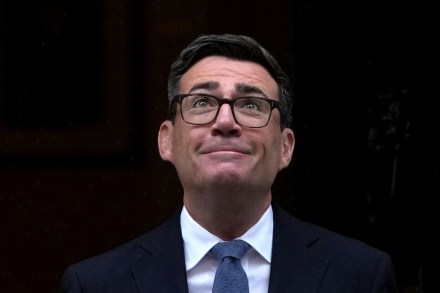
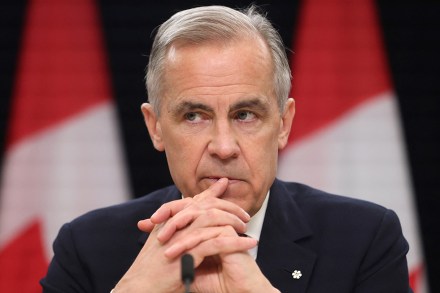
Andy burnham

Burnham’s unwillingness to face the media should worry us all

There are so many hopes invested in Andy Burnham’s premiership that disappointment is inevitable. In some cases, it is also desirable. The member for Makerfield has been co-opted by Labour’s soft left and communitarian right for their respective agendas. To govern will be to choose. But a particularly poisoned chalice has been proffered to the next prime minister, one he should dash from his lips. Of all the figures on the left who made the pilgrimage to Makerfield to campaign, the presence of Hugh Grant was most ominous. Perhaps the actor who played the prime minister in Love Actually with such élan was there to school our would-be premier on how to deal with obstreperous American presidents. But Hugh Grant is not just a more metrosexual Cary Grant.

Reform is right to fear the return of Boris

The man from Reform had barely sat down at our table at the French bistro when he leant forward conspiratorially and asked: ‘What’s Boris up to?’ The suspicion that Boris Johnson, Britain’s 55th premier, must be up to something is a familiar one. For the first time in several years, however, the question is interesting. And the fact that Reform is raising it gives a small insight into the current state of politics. The query came just hours after Johnson had taken to Instagram to mark the tenth anniversary of the Brexit referendum, the defining moment of his career and of our politics since. The 17.4 million voters who backed the Leave campaign were right to do so, he said, before going on to hail the freedoms of Brexit.

Portrait of the week: No. 10 heads north, Stokes retires and earthquakes hit Caracas

Home Andy Burnham, who was expected to become prime minister on 20 July, took off his tie and put on a dark T-shirt for a speech in which he said he would establish a ‘No. 10 North’ in Manchester as the ‘nerve centre of a rewired Britain’. He promised council houses, welfare reform and ‘good growth in every postcode’ by means of ‘Manchesterism’. He took no questions. Sir Keir Starmer, the Prime Minister, presented the delayed defence investment plan, and said that spending would rise by £15 billion by 2030. He landed his successor with £4.7 billion of the sum being left unfunded. The Ministry of Defence would also have to find £10.7 billion in efficiency savings in the next four years.

What kills more: heat or cold?

Absolute mayor Andy Burnham wants more devolution and elected mayors. Do voters want that? – Since 2001 there have been 55 referendums on whether to establish the post of elected mayor. Only in 17 cases was there a majority in favour. – The towns and districts keenest on having an elected mayor were Middlesbrough (84% in favour), Croydon (80%) and Mansfield (70%). – The areas least keen on an elected mayor were Guildford (81% against), Bath (79%) and West Devon (77%). Ratings game Which attracts the biggest TV audience in Britain: Wimbledon or the World Cup? – England’s opening match in this World Cup, vs Croatia, attracted a peak audience of 15.4m. England’s quarter-final defeat to France in 2022 had an audience of 19.4m. – This compares with the 8.

Storm warnings for Burnham from the weathermen of Basel

Reading the annual economic report of the Bank for International Settlements while lying beside a pool with an Aperol spritz in hand is a challenge I accepted on your behalf. Based in Basel as a hub for the world’s central banks, BIS is always careful in its prose for fear of setting cats among global pigeons. But this year’s bulletin is a serious storm warning, based on four factors that in a worst-case combination could trigger market mayhem. First, inflation driven by Middle East conflict has left oil market imbalances that will take ‘several quarters to purge’, with the risk of further volatility; BIS doesn’t actually say ‘If Trump goes batshit crazier’, but that’s the subtext.

Letters: Burnham is a master brand-builder

Telling stories Sir: As a filmmaker by training and a marketer by profession, I couldn’t agree more with your leading article (‘Northern soul’, 27 June) on the absence of narrative in our politics. The appeal of figures such as Burnham and Nigel Farage lies in the storyworld they build around themselves – be it via pints shared down the pub, off-the-cuff honesty, or a Monty Python line landing in the Commons. But the PM who stays the course, as any brand-builder learns the hard way, must know two things: their own story, well enough to tell it plainly; and the people they speak to, well enough for them to make it their own. Aim a dull narrative at everyone and you reach no one; tell a story worth sharing and both left and right will see themselves in it.

Can Burnham resist the siren call of the left?

Power, when it is gained and lost, is transferred in stages: the actual, the visual and the constitutional. The latter took place on Tuesday evening when the prime minister presumptive sent a letter to Antonia Romeo, the Cabinet Secretary, requesting that she commence access talks with his team. Keir Starmer had already given permission for them to proceed, but the propriety and ethics team in the Cabinet Office had told Romeo she could not initiate proceedings. Andy Burnham had to ask first. To all intents and purposes, he is already the vessel from which power flows. At the same time, it became clear that James Purnell, the former Blairite cabinet minister, will lead the transition team and stay on to become chief of staff in 10 Downing Street.

How the right can fight Burnham

Andy Burnham has not yet entered No. 10, but the Conservatives and Reform are already preparing for the possibility of an early general election. Resources are being redeployed, attack lines sharpened and campaign plans drawn up for the aftermath of Labour’s coronation. Nigel Farage wants a snap showdown. Kemi Badenoch insists defence must be properly funded before the country is returned to the polls. The rapid elevation of the MP for Makerfield poses tricky questions for his opponents. Burnham has built a following without a clearly defined ideology or coherent policy programme, leaving strategists in Reform and the Conservative party – like much of Britain – unsure which version of him will walk into No. 10. Yet despite that uncertainty, preparations are being made fast.

How does this week’s heatwave compare with 1976?

Prime numbers It looks as if Britain will just miss out on having seven prime ministers in the space of a decade as nominations for the Labour leadership election will not open until 9 July (David Cameron left office on 13 July 2016). Have we ever had seven PMs in the space of ten years? – After Lord Liverpool left office on 9 April 1827 Britain saw a further eight premierships within the following decade. Two, however, saw the same person returning to office, so we had seven different prime ministers within the space of ten years.

Portrait of the week: Burnham wins, Starmer resigns and a heatwave hits

Home Sir Keir Starmer, the Prime Minister, stood outside 10 Downing Street and said that he would resign as leader of the Labour party. Nominations for a successor would open on 9 July (though he still meant to unveil his defence investment plan in time for the Nato summit on 7 July). His decision to depart followed the convincing victory in the Makerfield by-election of Andy Burnham, bringing him back into parliament. An election for mayor of Greater Manchester in his place would take place on 30 July, with Bev Craig, the leader of Manchester City Council, as Labour’s candidate. Mr Burnham packed a suit and tie into which he changed on the train from Manchester Piccadilly to London. He was sworn in as an MP that afternoon. Mr Burnham had received 24,927 votes (54.

How Burnham can avoid Starmer’s fate

Welcome to the cabaret, Andy Burnham. Last year, the editor of this magazine wrote about ‘Weimar Britain’: the fear that political instability, economic turmoil and rising anti-Semitism was making our country as decadent and dangerous as inter-war Germany. As our sixth prime minister of the post-Brexit decade departs, and our seventh looms into view, we have developed a national addiction to perma-crisis, seemingly trapped in a game of ‘Topple the PM’. We are far from a January 1933 moment. But the joke isn’t funny any more. This turbulence is not inescapable, though. What is needed is a premier able to stay the course, to set out how they want to change Britain and to discover the drive and charisma to bring their party and the country with them.

Can I save Britain from war with Russia?

I t won’t be much of a consolation to Keir Starmer but I too was overwhelmed by the responsibilities of being prime minister. Fortunately for the country, I was only playing the role in a fictional coalition cabinet assembled by Sky TV to wargame the consequences of a Russian attack on the UK. My turn as make-believe premier began with unwarranted overconfidence, moved to fumbling crisis after crisis and ended with me almost alone in a bunker wondering how disaster had come so quickly. So very different from the real world. My cabinet colleagues – Nicola Sturgeon, Penny Mordaunt, Harriet Harman, Jim Murphy and Sayeeda Warsi – all gave a good account of themselves.

The death of two-party politics has been greatly exaggerated

Every twist in the winding road of our politics brings a latest thing to say. These wisdoms usually survive a season or two before succumbing to the new thing to say, which often asserts the opposite. This summer we have ‘Britain is moving into an era of multi-party politics’. Allow me, therefore, to leap ahead with my candidate for its successor: ‘Reports of the death of two-party politics are greatly exaggerated.’ I don’t say our current governing party and principal opposition must always be the two parties in question. Labour may be dying. The Tories may be showing signs of life. In both cases I fervently hope so. But whether or not these remain our two options in elections to come, the tendency will always be for the choice to boil down to two.

Was Brexit worth it – and can Burnham save Britain?

55 min listen

For this week’s Edition, William Moore is joined by the Spectator’s assistant editor Isabel Hardman and the editor of The New Statesman Tom McTague. Plus, in a special episode this week, the Spectator’s economics editor Michael Simmons joins for the first half of the episode, before political editor Tim Shipman jumps in later on. This week: was Brexit worth it? As we approach the tenth anniversary of the vote to leave the European Union, the Spectator’s editor – and former prominent Vote Leave campaigner – Michael Gove makes the case that not only was Britain right to leave, but it has benefitted from leaving. The past decade however has been marked by domestic political chaos, so to what extent was Brexit a symptom or a cause of Britain’s structural problems?

Was Brexit worth it – and can Burnham save Britain?

‘We’re only months away from the first political assassination by drone’

51 min listen

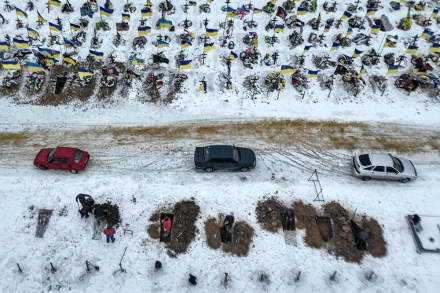
For this week’s Edition, William Moore is joined by the Spectator's commissioning editor Lara Brown, the columnist for the Wall Street Journal’s Free Expression newsletter Louise Perry and the Telegraph journalist and presenter of Ukraine: The Latest Francis Dearnley. This week: Russia’s full-scale invasion of Ukraine has now gone on longer than the first world war and it shares much of the horrors of that war, from attrition warfare to substantial losses on both sides. So, with over half a million Russians estimated to be killed, could Putin and Zelensky be brought to an exhausted peace?

War in Ukraine: 'we're only months away from the first political assassination by drone'

Revealed: Andy Burnham’s reassuringly bland Cambridge years

There appears to be a missing chapter in the story of Andy Burnham. Depending on the whims of voters in Makerfield, Britain could soon have its first prime minister with a degree in English literature and its first Cambridge-educated premier since Stanley Baldwin. And while we have been treated to countless long reads on the so-called King of the North – his political philosophy, his years in Manchester and his apprenticeship in New Labour – his undergraduate years have barely been scrutinised. Burnham is tight-lipped about his Cambridge days (1988-1991). His comments over the years have been mostly limited to saying he had ‘imposter syndrome’ as he struggled to fit in at a university that was dominated, he felt, by private school students.

The battle for Makerfield

9 min listen

James Heale is in Makerfield ahead of one of the most consequential by-elections of all time, where Andy Burnham is hoping to return to Westminster and stop Reform’s Robert Kenyon – the local plumber backed by Nigel Farage. On the ground, James hears from voters split between Labour and Reform, with some hoping Burnham can hold the line and others asking what he has really done for the area. He also sits down with Nigel Farage to discuss Reform’s chances, the party’s NHS policy, Rupert Lowe’s Restore Britain challenge, and why Farage thinks Burnham would be even worse than Starmer in No. 10.

True neoliberalism has never been tried

Friedrich Hayek once argued that if you put the word ‘social’ in front of a noun, the meaning was negated. Social justice wasn’t about due process; social democracies didn’t safeguard freedom. For those on the left, who can never have enough social-isms, there is a more toxic prefix. If you want to damn something, stick a ‘neo’ in front. Nothing is quite as wicked as a neoconservative, but coming dangerously close is a neoliberal. Liberals were once generally supposed to be the squishiest of centrists. But listen to the men and women making the weather in British politics now, and you’d imagine that neoliberals were the horsemen of the apocalypse. Andy Burnham has blamed ‘40 years of neoliberalism’ for the problems faced by workers in Makerfield, and indeed beyond.