Features

How to save American farming

Farm bankruptcies in the US have risen by 50 percent in the past year. Soybean farmers lost an average of $100 per acre in 2025, according to the Department of Agriculture, while corn growers are set to lose $150 per acre this year. Meanwhile, the national beef herd is at its lowest level since 1950 and retail prices have jumped by 40 percent in the past 18 months. Normal businesses would diversify away from corn or soybeans and try to profit from the rising price of beef, as well as goods such as eggs and tomatoes. They would, in other words, react to the changing realities of the market. But American farms are not normal businesses. Most of my fellow farmers are stuck in a world of perverse incentives, from government subsidy and bailouts to financialized capital and farmland.

subsidy

Don’t bet on a blue wave

There are several reasons to think we won’t see a blue wave in this year’s midterm elections. A basic one is that the Democratic party simply isn’t very popular. In late May, Donald Trump’s approval ratings in the RealClear polling aggregate stood around 40 percent, which sounds bad. Yet Trump is more popular than his party – approval of the Republican brand was in the vicinity of 38 percent. And the Democrats’ ratings were even worse – standing, or one might say wilting, at about 36 percent. Those figures are not to be confused with “generic ballot” polling, which asks voters which party they would prefer in the forthcoming election. Democrats have lately enjoyed a lead of some seven points over the GOP in that category.

How to reclaim your life

I stopped charging my phone beside my bed four years ago and have never regretted it. Alarm clocks seemed destined to go the way of the DVD, but I am on a solo mission to restore them to bedside tables around the world. The harsh tone of the alarm is certainly no match for what Spotify can give us, but it’s worth avoiding the 30 minutes of doomscrolling that the phone inevitably causes. Since making the switch from the waking blue-light bath, I have rediscovered those early hours of the morning, with their associated peace and silence, before children and work invade my limited headspace. Carving out that half hour before the noise begins has helped restructure my priorities in life. Every year the Pope chooses a preacher for the Roman Curia’s annual Lenten retreat at the Vatican.

Woke isn’t dead. It’s just getting started

“Woke is officially DEAD,” Donald Trump announced last summer. That has been a common refrain since the 2024 election: the anti-western, anti-white, pro-transgender ideology is over. The excesses of left-wing radicalism have been rejected. Sadly, nothing could be further from the truth. We’re all still living under the yoke of woke. Just look at Chicago. Over the Memorial Day weekend, 38 people were injured by gunfire and two were shot dead. Five police officers were hurt when a car drove into a crowd amid widespread disorder. This happened in a city where the Democratic mayor, Brandon Johnson, promised to defund the police.

The Pope’s AI intervention shames our politicians

I was born into a sternly Presbyterian culture. Politically, I’m more Orange than Donald Trump’s skin tone. But today I am on my knees giving thanks to the Pope. He has produced the most powerful political document of the year, taking on the greatest challenge of our times. His first encyclical, Magnifica Humanitas, deals with the changes which will be wrought to all our lives by artificial intelligence in the months and years ahead. AI will transform our economies and societies massively and irrevocably; it will change what it means to be human; it may even mark the end of humanity itself. If it takes the Pope to alert us to this revolution then perhaps the Reformation wasn’t such a good idea after all.

AI

Will the Supreme Court allow a ‘creed’ to kill America?

Supreme Court Justice Neil Gorsuch’s tour to tout his new children’s book about the Declaration of Independence should have been uneventful. But then Gorsuch decided to talk about what America is. On Fox News, with the New York Times and in the pages of the Wall Street Journal, Gorsuch kept staking out his view on what makes America special: America has no religion, no race, no people at all really, but instead a singular majestic idea. “We’re a creedal nation, right,” Gorsuch told the Times. “I mean, we don’t share a religion, we don’t share a race, we share an idea, OK? And that idea has to be passed down generation to generation through history, as we discussed.

Get ready for a Spencer Pratt Summer

This spring, many Angelenos have reported a strange, wild wind blowing down through the brushy canyons and over the sunbaked asphalt plains and across the urine-soaked beach parking lots of Los Angeles.  There is a whiff of something new wafting into your Tesla sun roof at red lights, and for once it isn't the choking smell of weed or the belching exhaust from junkie-filled RVs idling in alleys. It is hope. And its name is Spencer Pratt. His momentum is real and it's spectacular.

pratt

How Trump got immigration spectacularly right

Parts of the MAGA movement are unhappy with President Trump’s migration strategy. The administration has softened its policy on deportations following a public uproar over the ICE killings in January, it is said. The focus has been on removing only the most violent offenders. “The truth is the first year was not a year of mass deportation,” says Mike Howell of the Mass Deportation Coalition. “A conscious decision was made to go after the worst first, which was, we’ll call it a deviation, from the central campaign promise of mass deportations.” Such criticisms miss the point. The Trump administration has tackled the worst offenders to shore up support for its wider migration crackdown. And that crackdown has been wildly successful.

An eight-wheeled military vehicle patrols near the border wall which is being painted black after an order by US President Donald Trump, according to US Secretary of Homeland Security Kristi Noem, between Santa Teresa, New Mexico and Ciudad Juarez, Chihuahua, Mexico on August 28, 2025. 8 miles of metal barrier are under construction since July 15 in the El Paso Sector. (Photo by Herika Martinez / AFP)

The Romans would tax anything

When Nero committed suicide in AD 68, he left Rome deep in debt after military campaigns, building himself a fabulous “Golden House,” and the great fire of Rome (AD 64). His successor Vespasian, who fought his way to power in late AD 69, set to work at once. A hardworking man of humble origins and simple tastes, Vespasian was well suited to the task: “He got up early, even when it was still dark, and read the letters and the official breviaria” (“reports”; Latin brevis, “brief”). He sold off some imperial estates and nearly doubled provincial taxes, while extending Roman citizenship.

tax

How anti-data center activists are taking on Big Tech – and winning

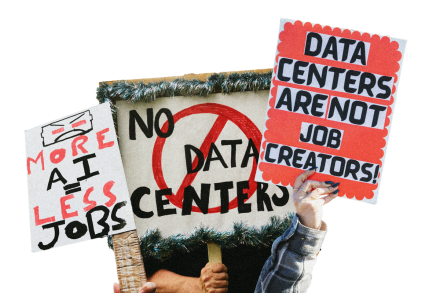
Last December, in a piece called “The Data Center Backlash Is Global,” I reported that residents around the world were rising up against Big Tech just as they have risen up against Big Wind and Big Solar, rejecting applications to use land. Sure, AI may be a world-changing technology, but the rush to build massive new data centers has resulted in dozens of rejections or restrictions on projects from Indianapolis to Dublin, Ireland. People are worried about property values, water usage, electricity costs and what it means for the neighborhood: “quality-of-life impacts,” as a member of the Indianapolis council, who led the opposition to Google’s billion-dollar project, explained.

Data Centers

The return of animism

There is a wave of books asking how social media platforms shape the stories we tell about ourselves and, through that shaping, what new kind of self they are producing. Megan Garber’s Screen People argues that the language and ethos of entertainment have permeated every aspect of life, so that we now see each other as characters in an ongoing show whose continuity we are responsible for maintaining. Kathryn Jezer-Morton’s The Story of Your Life, out in August, makes the related case that algorithmic platforms have disciplined what counts as a shareable experience into what Jia Tolentino’s blurb calls a rigid, optimized, phone-shaped norm. I haven’t read either yet, but I’m willing to bet they’re basically right.

Zombie fillers: the super-rich are plumping themselves up with dead people’s fat

A few years back, I lost a significant amount of weight. It came off entirely by accident following a major unforeseen life crisis that resulted in a prolonged reduction of appetite. Almost overnight I went from being a healthy average-sized middle-aged woman to a thin one. Everyone was very complimentary, of course. But this was in 2022, back when shedding weight still seemed like an accomplishment and evidence of restraint rather than something to be bought and administered via needle and private prescription. I waited for my dress size to rebound to an eight from a four as it had in the past but this time round, for whatever reason, it did not.

zombie fillers
republicans

Why the Republicans are still more focused than the Democrats

The pundits and political professionals of Washington, DC have never had a very good understanding of the Republican party. They hate its conservative and populist elements, and they only know how to evaluate the prospects of those elements using irrelevant criteria, like a chess club judging a basketball team – only it’s the political right that’s more cerebral than the dead center. It doesn’t matter how many times the conventional opinion is dead wrong. The Republican right was supposed to be humiliated, broken and vanquished for good after Barry Goldwater’s landslide loss to Lyndon Johnson in 1964. And then again after Richard Nixon resigned in disgrace a decade later. Donald Trump, of course, was totally unelected in 2016.

rubio

Why I’m Never Rubio

The Atlantic magazine recently announced the People’s Choice for the 2028 Republican presidential nomination. “Trump Voters Like Marco Rubio More and More (And J.D. Vance Less and Less)” the headline proclaimed, a ruling that deserves respect considering that this is the magazine that has spent the past decade ferociously denouncing Trump as a “racist,” “fascist kleptocrat,” “warped,” “corrupted,” an “authoritarian,” a “demagogue,” a “xenophobe” and a “liar.” The piece was written by Sarah Longwell, whose career as a Republican consists almost entirely of loathing Trump, calling him an “incomprehensible lunatic,” “an insane madman,” “corrupt” and an “authoritarian.

benevolence

The benevolence trap

On May 12, the Canadian evolutionary psychologist Gad Saad published a book called Suicidal Empathy: Dying to be Kind. It’s a smart book, immensely pertinent to a time, like ours, that is awash with this diseased form of self-infatuated fellow feeling. Dr. Saad is correct: “Suicidal empathy is a civilization malady that has entered every nook and cranny of our lives.” One of the peculiarities of the malady that Dr. Saad diagnoses is its persistence. Socialism – which is the generic name of this intoxicating and addictive drug – has failed everywhere it has been tried. No matter. The world manufactures new versions of Greta Thunberg, AOC and Bernie Sanders faster than they can be repudiated. Democrats, Dr. Saad observes, are the party of empathy.

europe

Trump, Europe and the power of delusions

German Chancellor Friedrich Merz suggests to a classroom full of youngsters that Donald Trump has been “humiliated” by his war in Iran – and the President cancels deployment of the long-range missile systems around which Germany had planned its defense strategy for the coming decades. Spanish Prime Minister Pedro Sánchez observes a strict neutrality on Iran, declaring his country’s bases out of bounds – and Trump urges Spain be kicked out of NATO. British Prime Minister Keir Starmer hesitates to sacrifice his country’s navy in a war on which he wasn’t consulted – and Trump mocks him in public for a week.

Pope Leo knows what his job is

Pope Leo XIV had a relatively quiet first 11 months on the Chair of St. Peter. Then Mt. Trump erupted in April, with the voluble and volatile POTUS accusing the Chicago-born pontiff of everything from squishiness on crime to squishiness on Iranian nukes. The most absurd presidential claim was that, were it not for Trump, Robert Francis Prevost would not be Pope. The truth of the matter is that, had Cardinal Prevost been primarily thought of as an American papabile a year ago, he would never have been elected, Latin American opposition to a gringo Pope being one of the immutable human dynamics of a papal conclave. Twenty years of missionary work in Peru, and broad experience of the world church (thanks to two terms as prior general of the Order of St.

SLAPP

SLAPP-happy: why Trumpworld keeps suing the press

Donald Trump has had a career-long love-hate relationship with the press. On one hand, he popularized the phrase “fake news” and branded the press “the enemy of the people.” On the other, the President takes phone calls from virtually every reporter with his personal cell and is fixated on cable news and his print media coverage. Trump views journalists as friends, foes and foils, or some combination of the three. But if a story catches him at the wrong moment, the author could find themselves on the receiving end of a Trump-SLAPP. A Strategic Lawsuit Against Public Participation, or SLAPP, is a lawsuit filed with a tactical intent besides disproving a damaging story in a court of law. Usually the suit demands an attention-seekingly large sum in damages.