Features

The myth of human sacrifice

Most of us indulge in mild fortune-telling. We think "If the light changes before I count to five, I’ll get the job" or "If the solitaire hand comes out my tests will be negative’, and so on. We understand prophecy as the ability to foretell the future. But biblically, prophecy was not prediction but castigation. And prophets were those who were inspired by God to describe the present. Dr. King, Malcolm X and Charlie Kirk were modern prophets. Their lives and speech forced the populace to confront the unacceptable and obvious, which is why they were killed. Mass murderers and political assassins are incapable of facing the truth that their fury is not caused by "the other" but by their own mind.

david mamet

A late Congolese ruler with a new following

At the exit of the National Museum in Kinshasa, capital of the Democratic Republic of Congo (DRC), is a whiteboard for visitors to leave their comments. On that whiteboard, full of underlinings and exclamation marks, are messages like this: “Thank you for your life.” “Thank you for our national unity.” “You left behind a glorious historical legacy. We plan to follow in your footsteps.” A giant photograph of the man the messages refer to hangs in the museum’s main hall as part of its new exhibition, a man in dark glasses and leopard-skin toque, smiling down at his people. More than 28 years after fleeing into exile, Mobutu Sese Seko, once known as “The Leopard” and “The Great Helmsman,” is back in the limelight in the DRC.

A chief White House usher of 21 years is the ultimate insider

Gary J. Walters knows where a lot of the bodies are buried in the White House. He was chief usher for 21 years, worked there for 16 years before that, and has served and come to know intimately seven presidents and their families. Now he has written a book about his extraordinary career, White House Memories 1970-2007: Recollections of the Longest-Serving Chief Usher. Think what he must know of the skulduggery (Nixon), the marital strife (the Clintons), the chastising of children (the alcohol-inclined Bush daughters) and the shouting matches (doubtless all of them). As I gently prod Gary for gossip, he smiles mischievously – at 79, he still looks smart and spry enough to be running the White House machine.

Portrait of the year

January For three weeks wildfires raged around Los Angeles. Perhaps 30 people were killed but 200,000 were evacuated, 18,000 homes and structures destroyed and 57,529 acres burnt. Donald Trump was inaugurated as the 47th President. On his first day he issued about 1,500 pardons for people charged in connection with the attack on the Capitol in 2021; he created the Department of Government Efficiency (DoGE), led by Elon Musk; he signed executive orders on gender and immigration and withdrew the United States from the World Health Organization. The state funeral of Jimmy Carter, the 39th president, was held in Washington, DC. Israel and Hamas agreed to a ceasefire and the return of hostages held in Gaza.

Are angels real?

One day while out walking, William Blake saw angels sitting in the trees: “bright angelic wings bespangled every bough like stars.” He was eight years old. His fascination – some have called it an obsession – with angels lasted for the rest of his life. When he sat to have his portrait painted by Thomas Phillips, the two men began to argue about who painted a better angel, Michelangelo or Raphael. Phillips, not unreasonably, suggested that since Blake had never seen even an engraving by Michelangelo, he was not qualified to give an opinion on the matter. “But I speak from the opinion of a friend who could not be mistaken,” replied Blake. “And who may he be, I pray?” asked Phillips. “The Archangel Gabriel, sir.

How Queen Camilla is spreading the joy of reading

Queen Camilla loves a book. Almost any book will do. "There’s something so tactile about a book," she says. "I like the smell of the pages when you open the cover. I like turning the pages and folding down a corner ready for next time…" The Queen, 78, has loved books for as long as she can remember. She says her father, Bruce Shand, inspired this lifelong passion: "He read to us as children. He chose the books, and we listened. He was probably the best-read man I’ve come across anywhere. He devoured books." Bruce Shand was a soldier. His father was a writer, about architecture, food and wine. His father was another writer, who, incidentally, was briefly and secretly engaged to Constance Lloyd, who went on to marry Oscar Wilde. This is a family with literary leanings.

Jung Chang: what the West gets wrong about China

No writer has done more than Jung Chang to bring the horrors of Maoist China to the attention of western readers. In her monumental memoir Wild Swans (1991), she recounted the Chinese Communist Revolution, the Great Famine and the Cultural Revolution through the stories of her grandmother, her mother and herself. Its influence was enormous: Wild Swans sold more than 15 million copies, making it one of the best-selling nonfiction books of all time. In Mao: The Unknown Story (2005), co-written with her husband, the historian Jon Halliday, she blew apart decades of Chinese Communist party propaganda to reevaluate Mao as one of history’s greatest monsters, as bad, if not worse, than Hitler or Stalin.

What’s wrong with the West?

It is 25 years since Theodore Dalrymple published Life at the Bottom: The Worldview that Makes the Underclass. In this now famous set of essays, Dalrymple, who worked as a psychiatrist in British prisons, describes the damage done to the poorest in society by the West’s progressive middle-classes, who encourage criminals to see themselves as victims and cheer on the destruction of the traditions and norms that once guided working-class life. On the other side of the Atlantic – and the other side of the middle-class divide – the writer Rob Henderson came to the same conclusions as Dalrymple.

I want 1989 for Christmas

Here is my list of things I’ve been fantasizing about getting for Christmas, in no particular order: encyclopedia set, piano, record player, landline. In other words, I want 1989 for Christmas. I’m yearning for an analog world. For tactile experiences. Cool piano keys I can stumble over. Encyclopedias I can flip through, getting lost in whatever the pages land on when I open the book. I yearn for the stereo sound of a record when an entire side has played, uninterrupted. I want people to have to reach me on my terms, when I’m home or available, not at any and all times. Growing up in the 1980s and 90s, I spent a lot of time alone with my thoughts, or running around wild with siblings, friends and cousins.

The joy of crossing people off your Christmas card list

It’s that time of the year again, the time when 12 months’ worth of pent-up malevolence comes flooding out, mixing malice, schadenfreude, one-upmanship and virtual punishment beatings. Yup: it’s time to start writing our Christmas cards. Has there ever been an activity better designed to bring out the worst in people than that dedicated to the season of goodwill? We all know that Christmas is a time to celebrate bitter familial enmity, but the Christmas card tradition goes one better and gets the rest of the world in on the act. This came to me as I was efficiently consulting the list of my Christmas card recipients from last year: I landed on a couple who recently canceled on the day of a dinner party for which it had taken my husband and me three days to prepare.

How Garrison Keillor is living at 83

I’ve been having a wonderful year since I turned 83 and decided to lighten up on world affairs and let other people agonize over corruption in high places and the fate of American democracy, which concern me too. But at this age one can only take on so much. Time is running out. Time to leave the problems to the young and energetic and devote myself to writing limericks. Better to do one thing well than wave your hands and yell at a brick wall. One day an old man in ManhattanSaid at the library he sat in,“Enough politics,I’ll write limericks.So light up your pipe and put that in.” A remarkable metamorphosis:One door opens, one closes.What a reliefTo give up that griefAnd happiness is the prognosis.

Queen Camilla’s recommended reading list

As Christmas approaches and we wrack our brains to find something that suits everyone, there is no present quite like a book. Whether it’s an unputdownable novel, a heart-stopping crime series, a thought-provoking biography or a collection of beautiful poetry, a book provides an escape, the perfect antidote to the hurly-burly of everyday life and, above all, hours and hours of pleasure. Here are half a dozen of my favorites, previously recommended on my Queen’s Reading Room, which you might like to add to your Christmas present list… or (if preferred) keep for yourself! The Cazalet Chronicles by Elizabeth Jane Howard This is a series of books that I return to again and again, to reacquaint myself with the irresistibly charming Cazalet family.

Pete Hegseth is a polarizing figure who doesn’t quit

Pete Hegseth’s Saturday begins with personal training. The Secretary of War, @SecWar on your socials, is very fond of working out with the troops – something most defense secretaries have done without someone dutifully filming the experience for Instagram. Then he heads off to the Reagan National Defense Forum, the annual gathering of war hawks, policy nerds and defense contractors in Simi Valley, California. Hegseth, the veteran of the Global War on Terror, is there to fulfill his mission of denouncing the neocons. “Out with idealistic utopianism, in with hard-nosed realism,” he declares, insisting the United States will no longer be “distracted by democracy-building, interventionism, undefined wars, regime change, climate change, woke moralizing and feckless nation-building.

America’s free-speech war on the EU

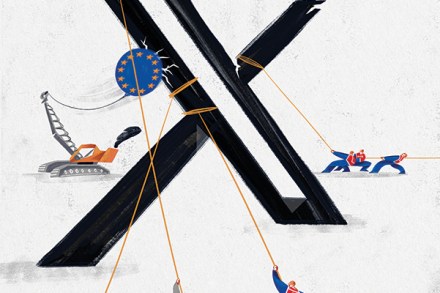
If I were a bookie, I would be making odds now about when the European Union will finally unravel and die. Unless there is an imminent and drastic course correction, the blessed event cannot be far off.  I might need a Doomsday Clock akin to the one publicized by the Bulletin of the Atomic Scientists. Their clock hovers near midnight, which signifies nuclear Armageddon, the minute hand pushed closer or farther away from the blast depending on minatory world events. My clock would measure the EU’s proximity to implosion. Its recent decision to fine Elon Musk and his company X €120 million for “non-compliance with transparency obligations” has me nudging the minute hand closer to midnight. “Non-compliance with transparency obligations.” What do you reckon that means?

Peter Thiel predicts the future

Peter Thiel has been described variously as “America’s leading public intellectual,” the “architect of Silicon Valley’s contemporary ethos” or as an “incoherent and alarmingly super-nationalistic” malevolent force. The PayPal and Palantir founder, a prominent early supporter of Donald Trump, is one of the world’s richest and most influential men. Throughout his career, his principal concern has always been the future, so when The Spectator asked to interview him, he wanted to talk to young people. To that effect, three young members of the editorial team were sent to Los Angeles to meet him. What follows is an edited transcript of their conversation.

Epstein, like Russiagate, damns the elite

As President Trump’s first year back in office drew to a close, his enemies had high hopes they’d hit on a scandal that could do to his second term what the “Russian collusion” story had done to his first. Donald Trump didn’t have to be found guilty of any wrongdoing tied to Jeffrey Epstein’s sleaze. All that was necessary was to stain his reputation indelibly and distract his administration from its work. The Epstein weapon even had an advantage over the Russia allegations of yesteryear – it resonated with much of Trump’s own MAGA base. Trump campaigned in 2024 on releasing the Epstein files, and many in MAGA considered it a betrayal when he resisted doing so once back in the White House.

The pleasure in not knowing

A few years ago, the podcaster Lex Fridman published a list of books that he was hoping to read in the year ahead. It included works by George Orwell, Fyodor Dostoyevsky, Hermann Hesse and others. If he had published this in the world of print media he might have got back some encouraging noises. But because he put the list online – worse, on the platform then still known as Twitter – he received mostly mockery. “Who hasn’t read Animal Farm?” was the general tenor of the blowback, as though a man who had been a researcher at MIT was next to being a Neanderthal.

douglas knowing
roman ranking

How the Roman ranking system actually worked

For otherwise healthy plebs in the Roman world, survival depended on four Fs: farming (the sole source of food and money), fighting, family and friends. Everything else that made life worth living meant having some degree of political control over your own existence, which could be summed up in a fifth F: freedom, or political equality. But the elite had little time for such goodwill towards men. For the plebs, there was the rub. In the 20s BC Livy began writing a history of Rome from its foundation in 753 BC. It was first ruled by a series of seven kings (none actually Roman) who were finally thrown out as tyrants in 509 BC.