Books and Arts

Nature is healing

Ignoring the padlocked gate, my six-year-old son Nicholas and I climbed through a break in the metal fence and pushed into the mesh of undergrowth. This was the site of Ducker, the open-air swimming pool that once belonged to Harrow School in London. Here the young Winston Churchill romped (naked, since trunks were for prefects), as, in his own day, did my dad. When I arrived at Harrow in the 1980s, the pool — far bigger than Tooting Bec Lido, which is now the UK’s largest — had just been abandoned. It was covered with graffiti, the haunt of skateboarders. Returning in 2021, I looked for changes wrought by three decades of neglect. Google Maps showed a J-shaped artificial lake, 98ft by 492ft.

nature
bill evans

Along came Bill Evans

Everybody Digs Bill Evans was the title of one of the great jazz pianist’s early albums, but it wasn’t always clear that he dug himself, at least if you consider his turbulent personal life. There was, first and foremost, the lifelong drug habit, culminating in his death in 1980, which one friend deemed the ‘longest suicide note in history’. There was also the introspective streak that prompted Evans to doubt his own prowess even after he had become famous. But there is also the spellbinding music that casts as powerful a spell as ever. Small wonder that a cluster of purveyors of fine music, including Craft Records, Electric Recording Company and Acoustic Sounds, have rushed to reissue his works on CD and LP.

The soul of Flannery O’Connor

Since the racial riots last summer, Flannery O’Connor has been scrutinized by literary critics and activists for reasons wholly unrelated to her literary artistry and her formidable oeuvre, whose size, though not large, is remarkable for a writer who died at the age of 39 after having been diagnosed in her mid-20s with lupus. The abruptly renewed interest in Miss O’Connor could be said almost to amount to an O’Connor revival were it not focused on a single question: ‘Was Flannery O’Connor a racist, or was she not?’ Attempts to answer it have involved an evaluation of her character based on her novels, stories and voluminous correspondence, and led in one instance to the critical conclusion that she was ‘not a saint’.

O'Connor
Medici

Meet the Medici at the Met

Someone turned up the lights on portraiture in 16th-century Florence. Lyrical poetry went hard rock. Colors became high key. Posers now scowled at the oil-on-canvas flashbulbs, giving attitude, hands on hips, codpieces a-thrusting. Not that they even cared about looking as good as they do. Sure, they got dressed for the occasion, but notice the sprezzatura, the indifference in their eyes to the whole affair. That was the maniera moderna, the new mannerism in art, and no one captured it better than Agnolo Bronzino. Whether it’s the ‘Portrait of a Young Man with a Book’ (mid-1530s), his haughty painting in the collection of the Metropolitan Museum of Art, or ‘Lodovico Capponi’ (1550-55), his side-eye romancer at the Frick Collection, these figures are boys interrupted.

Take a trip with Hawkwind

Fifty years ago this midsummer, a ramshackle convoy of vehicles — cars, minibuses, motorcycles and the odd hippie caravan — could be seen wending its way through the western counties of England in search of a patch of agricultural land near Shepton Mallet called Worthy Farm. There had already been several Sixties-era tribal gatherings in the fields beyond Michael Eavis’s now legendary homestead, but this iteration, widely advertised in the countercultural press, came billed as the very first Glastonbury Festival.

Hawkwind

A film festival fiasco in Narrowsburg, New York

If you’ve been involved in the production of a film, you know how intoxicating it can be. The prospect of seeing your work projected in a theater is reason enough to put up with a nightmare of unrelenting stress — for some people, anyway. Others might struggle to understand how an entire town (Narrowsburg, an admittedly very small town in Upstate New York) could be so easily swindled by a cartoon mobster and a mysterious woman with a French accent who tells people she’s from South Africa or Normandy, or descended from French royalty. Then again, Richard Castellano did appear with Billy Crystal and Robert De Niro in Analyze This, and Jocelyne Castaldo, well, who in America wouldn’t be charmed by such an accent?

Narrowsburg
Cousteau

Cousteau was the boulevardier of the oceans

For a few years in my youth, I tried to be a scuba diver. In the deep pool of the 63rd Street Y, I learned how to clean my goggles and clear my air regulators. In a lake in upstate New York, I earned my certification by swimming around a junked car in 40 feet of murky water. I went on to dive to some cold wrecks in Rhode Island and to swim among the warm sea life of Key Largo. But it wasn’t for me. The bobbing boats and the heavy equipment caused much discomfort. In one dive I banged my head against the tank of my divemate and nearly got knocked out. It was all less elegant, and quite a bit more involved, than I had expected. My inspiration, of course, had been Jacques Cousteau. The French underwater explorer dived the world’s oceans a generation ago as both celebrity and icon.

ahmari

Is Sohrab Ahmari a Satanic ogre?

Sohrab Ahmari is an ogre sent by Satan to annihilate American freedom. At least, that’s the reputation he has with liberals of the more excitable sort. His new book ought to soothe their twitchy nerves. The Unbroken Thread is an easy going, ecumenical, rather cosmopolitan tour of 12 moral questions and select thinkers who responded to each of them. ‘My primary purpose,’ writes our implausible theocrat, is ‘not to offer definitive answers, drawn from any one particular tradition, but to explore the possibility that our contemporary philosophy might be wrong in crucial respects.’ Ahmari has been much vilified for his criticism of Drag Queen Story Hour, an event in which crossdressers introduce themselves to children in public libraries.

berlin

Berlin has always been a Faustian metropolis

Each time I return to Berlin, the wonderful, awful city where I spent the best days of my misspent youth, I pay a sentimental visit to Grolmanstrasse, where my German grandparents used to live. There isn’t much left to look at. Their apartment block was destroyed in 1945 in the Battle of Berlin. The site where it stood is now occupied by a children’s playground. For me, that empty space seems to symbolize the way Berlin has changed — mainly for the better, but at enormous human cost. So much has vanished — not just the buildings, but also the people who inhabited them. For my children’s generation, Berlin is a party town. For me, it’s a city full of ghosts. It is these ghosts that keep bringing me back to Germany’s battered, bombastic capital.

School of hard Knox

Rudy Guede was released from prison this past December. If that name doesn’t ring a bell, it’s because for a long time, the brutal murder he was sentenced for was blamed on Amanda Knox. The 2007 burglary gone wrong made worldwide headlines for years. Knox, a photogenic American student studying abroad in Perugia, and her nerdy Italian boyfriend, Raffaele Sollecito, were found guilty, twice, of murdering Knox’s British roommate Meredith Kercher in what the Italian police called a ‘drug-fueled sex game gone awry’. Everyone, save Knox and those close to her, was shocked to learn four years later that there was no slasher sex game, and, more importantly, there was absolutely no DNA linking Knox and Sollecito to the crime scene that imprisoned them for years.

Amanda Knox

I’m turning Japanese

The history of late-20th-century Japanese pop music can seem like an impenetrable forest to western minds. But stare past the trees and there is light from a parallel universe. The Japanese Group Sounds records of the mid-Sixties (the Spiders, the Tempters and er, the Mops) were heavily influenced by the original moptops’ Budokan Temple show of 1966 and surf bands such as the Ventures. The university campus hard rock of Tokyo’s late-Sixties freak scene — Les Rallizes Dénudés, Flower Travellin’ Band, Speed, Glue and Shinki — and the lysergic rock soundtracks to Shuji Terayama’s revolutionary theater plays by the great J.A.

japanese
sensational

Read all over

In the 1880s a new group of women was entering newsrooms. Not content to write society sketches or cover the fashionable hats of the season, they went for bold reporting — often going undercover or participating in other dramatic ‘stunts’. The antic that launched Nellie Bly’s career in 1887 was getting admitted as a patient on Blackwell’s Island in New York, then an insane asylum for women. She had told the editor of the New York World she would do anything fora job on the paper, and this was what she was assigned. She went to a boarding house under an assumed name, pretended to be unhinged and was duly committed. Rescued after 10 days by a representative from the World, her exposé of the indignities suffered by patients in the asylum was a sensation.

Dark knight of cool

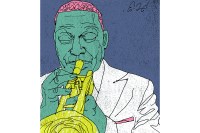
‘When the legend becomes fact, print the legend,’ Maxwell Scott announces in The Man Who Shot Liberty Valance. Something like this seems to have occurred with the jazz trumpeter Chet Baker. Other members of the West Coast jazz scene such as the great saxophonist Art Pepper were often in dire straits, but Baker has come to personify the romantic figure of the tragically doomed jazz artist. Once heralded as the ‘prince of cool’, Baker’s self-destruction was lucidly chronicled by Bruce Weber in the 1988 documentary Let’s Get Lost. Even his album covers, where he gazes broodingly at the viewer, underscore his vulnerability. His meditative, halting solos formed the antithesis of the frenetic bebop movement emanating from jazz haunts on the East Coast.

chet baker
grassi

Pictures at an exhibition

Deeply learned and with a style all his own, Marco Grassi is as at home with Duccio as with Norton Simon; Bronzino as with Bernard Berenson; a painting on his desk as with a ‘Last Supper’ in Florence’s Basilica of Santa Croce. In the Kitchen of Art presents Grassi’s most memorable essays over a span of nearly 20 years. Beginning with a previously unpublished memoir of his Florentine upbringing, and continuing with in-depth critical discussions of the greats of Italian art along with recollections of the grandest collectors of the 20th century, this book shows the art world in the round.

sundance

Sundance memories

In 1969 Robert Redford purchased 5,000 acres of land in the mountains of Utah and built a ski resort. In 1981 he founded the nonprofit Sundance Institute to cultivate new voices in American independent film through annual directing and screenwriting labs (alumni include Quentin Tarantino and Paul Thomas Anderson) and to provide financial support for select projects. In 1985 Redford took over the US Film Festival, based in nearby Park City, and brought it under the Sundance umbrella. In 1989, the festival had its breakthrough with Sex, Lies, and Videotape. Sundance became a film-industry fixture for talent scouts, acquisitions executives and journalists, particularly those inclined to go skiing in their downtime.

Ever the Twain

Mark Twain’s work contains in itself pretty much all of 19th-century America. This is America as she was when still, geographically and socially, more a frontier society than not; before she became heavily industrialized, urbanized and suburbanized: increasingly convergent upon the European societies from which she was descended. Twain’s America is, in short, America when she remained a unique place; even as she was evolving with lightning speed from her earlier self into something approaching her present one. Mark Twain made an international reputation for himself with the publication in 1869 of The Innocents Abroad, a travelogue that recounts a trip of many months through Europe and the Middle East.

twain
habsburg

Radetzky marches on

‘The Radetzky March’ was composed by Johann Strauss the Elder as a tribute to Field Marshal Joseph Radetzky von Radetz. An aristocrat of Czech origin, he was one of the fiercely conservative soldiers who gave the Habsburg Empire its bad name. First performed in 1848, the year of revolt in Europe, the ‘March’ was an immediate success. Austrian bands men were playing it at the battle of Königgraetz in 1866, fought against the Prussian Kaiser. For the first time, the Prussians had machine guns, and their rapid fire bloodied the white uniforms of the Austrians. Prussian victory condemned Austria to be the lesser of the two German-speaking nations, and on the losing side in the two world wars.

Comfortably numb: Sam Harris on meditation

Sam Harris has been in several tangles in his busy career. This is to be expected from a leader of the New Atheist movement, a vocal critic of Islam (he called the term ‘Islamophobia’ a ‘pernicious meme’), a member of the Men’s Movement (shocker: some non-men found it anti-woman), and a gleeful saboteur of the notion of free will. But for years now, Harris has been using his background in neuroscience and meditation to help people untangle their minds through his podcast Making Sense. It’s hard to find a podcast about meditation that is not made by or for quasi-spiritual, anti-vaxxer yoga moms. Making Sense is for the more serious inquiring mind. Harris, dry and wry, discusses not only meditation but philosophy, science, politics and ethics.

sam harris

Picking Apple

Would you sign up for a screening streaming service that only had a dozen movies? A handful of series, and no classics? You might pause and ask if it’s worth it, compared to the range of options on other streaming providers. But if you’re like many of us, you might decide to pony up — after all, it’s only $5. Of course, I’m describing Apple TV+. It’s cheaper than Netflix or Hulu. But what you get, at least for now, is pretty limited. That’s not to say what they have isn’t good: they’ve pumped in a massive budget to lure creators like Oprah and Werner Herzog to this enterprise. Their movies have major stars. There just aren’t many of them. But they could have gone the other way.

apple