Theatre

Those behind this fabulous new comedy are destined for big things

Rhinoceros by Eugene Ionesco is a period piece from 1959. It opens with the invasion of a French village by a herd of rhinoceroses. This paranormal event is never explained. In Act Two, the villagers start to imagine that they’ve become rhinoceroses and changed species. But one plucky sceptic, who defies conformity, refuses to swap his human character for an animal alternative. That’s it. Ionesco is offering the same arguments about peer-group pressure that Arthur Miller made with far more grace, artistry and psychological penetration in The Crucible. The show can’t decide what register to aim for and the cast are dressed in a mishmash of cheap costumes. Some wear white coats like asylum orderlies and some are in Primark expendables.

A horribly intriguing dramatic portrait of Raoul Moat

Robert Icke’s new play examines one of the least appetising characters in British criminal history. Raoul Moat went on a shooting spree in July 2010 that left his wife injured, a cop blinded and an innocent man dead. This superb piece of reportage offers us a glimpse into the mind of a damaged brute. Moat had a rough childhood, like a lot of kids. His dad was absent, his mother was mentally unstable and when he was seven, she set fire to all his toys. Very traumatic, no doubt, but kids have survived worse. He grew into a 17st bully who felt cheated by the system and blamed everyone else for his woes. Part of the tragedy is that he had talent. He was energetic and ambitious. He worked as a bouncer, as a scrap-metal dealer, and as a tree surgeon with the tradename ‘Mr Trimmit’.

Visit the King’s Head Theatre for one of the greatest theatrical surprises of the year

Amanda Abbington’s new show is heavily indebted to Noël Coward’s Hay Fever.Coward’s early play follows the tribulations of the superficial Bliss family and at first it was rejected by producers because it lacked action or incident. The oddly titled show, (This is not a) Happy Room, opens on the eve of a family wedding. Disaster strikes when the groom dies in a car cash and the nuptials are hastily transformed into a funeral. (Don’t ask how the dead body was released for burial so quickly.) Abbington plays Esther Henderson, a careless matriarch, who walked out on her children when they were small and left her firstborn, Laura, in charge of the parenting duties. Laura struggled to raise the youngsters properly and she now feels responsible for their wonky personalities.

I wish someone would kill or eat useless Totoro 

My Neighbour Totoro is a hugely successful show based on a Japanese movie made in 1988. The setting is a haunted house occupied by two little girls who encounter various creatures rendered on stage by puppets. The story has no action, danger or jeopardy so it’s likely to bore small boys and their dads. Perhaps mums and daughters will appreciate it more. The big selling point is the puppetry whose quality varies. The naturalistic animals are done well. Cute yapping dogs, fluffy chickens scampering about, mischievous goats that steal maize from unguarded fields. The silliest creature is an orange latex cat equipped with 12 spindly legs that don’t work. It looks like a cross between a bed bug and a crippled tiger.

Irresistible: Clueless, at the Trafalgar Theatre, reviewed

Cher Horowitz, the central character in Clueless, is one of the most irritating heroines in the history of movies. She’s a rich, slim, beautiful Beverly Hills princess obsessed with parties, boys and clothing brands. According to her, the world’s problems can easily be settled by using the solutions she applied to the seating plan at her dad’s birthday dinner. But Cher is also a creation of genius because she draws us into her life and makes us understand the raw, damaged reality that lies behind her superficial perfection. She’s not a privileged brat. She’s all of us. At the start of this musical remake, Cher takes us on a tour of her luxury home. ‘The Greek columns date all the way back to 1975,’ she says.

A treat for nostalgic wrinklies: Punk Off!, at the Dominion Theatre, reviewed

Punk rock, packaged, parcelled, and boxed up as a treat for nostalgic wrinklies. That’s the deal with Punk Off!, a touring show that recently completed a lap of the country at the Dominion Theatre. Most of the audience were there to recall their rebellious heyday. ‘It’s about to get really, really loud,’ announced the compère, Kevin Kennedy, as the four-piece band hammered out ‘Sheena Is A Punk Rocker’ ‘and ‘If the Kids Are United’. Both hits sounded eerily unfamiliar. Why? Those raucous, pulsing rhythms can’t be turned into elevator jingles or a background drone at a shopping mall – so we rarely hear them. Just as well. Kennedy rattled through the major turning points in the movement’s history.

Brian Cox’s Bach has to be heading for Broadway

The Score is a fine example of meat-and-potatoes theatre. Simple plotting, big characters, terrific speeches and a happy ending. The protagonist, J.S. Bach, receives a mysterious summons from Frederick the Great of Prussia. The long first act takes us through Bach’s professional woes and his physical infirmities. His weak vision is being treated by an English oculist, John Taylor, who tours Europe in a scarlet coach decorated with eyes. For unexplained reasons, Taylor decides to taste Bach’s urine, which is excessively sugary – a symptom of diabetes. When Bach reaches Frederick’s court in Potsdam he finds the atmosphere oppressive and alienating. Enter Voltaire. ‘Prussia is not a state in possession of an army,’ he says in a comedy French accent.

Shakespeare as cruise-ship entertainment: Jamie Lloyd’s Much Ado About Nothing reviewed

Nicholas Hytner’s Richard II is a high-calibre version of a fascinating story. A king reluctantly yields his crown to a usurper who wants his violent revolt to seem like a peaceful transfer of authority. This delicate, complex narrative is presented as a boardroom power struggle in corporate Britain. Snappy suits for the dukes and princes. Commando uniforms when they take to the battlefield. Jonathan Bailey (Richard) starts as a swaggering, coke-snorting yuppie who dreams of extending his realm overseas with someone’s else money. Disaster strikes, the crown slips. Calamity sharpens his awareness and he becomes a lyrical philosopher who laments the bewitchments and pitfalls of power.

Tedious and threadbare: Unicorn, at the Garrick Theatre, reviewed

Unicorn, Mike Bartlett’s new play, involves some characters in chairs discussing a sexual threesome. That’s the entire show. Polly (Nicola Walker) is a drunken crosspatch who wants to spice up her loveless marriage to Dr Nick (Stephen Mangan) by bringing a blonde lesbian into the bedroom. Nick, a dithering twerp, doesn’t care if it happens or not and he lets his gobby wife talk him into it. She’s desperate for a bit of girl-on-girl action because she detests straight men (apart from Nick) and she dated women before she got married. It’s not clear why Nick puts up with this charmless windbag who treats him like a naughty spaniel and pouts angrily whenever he speaks. Polly tracks down a gormless poetry student, Kate, and persuades her to join their triangular orgy.

If you have two hours to spare, spend it anywhere but here: The Years reviewed

The Years is a monologue spoken by a handful of actresses, some young, some old enough to carry bus passes. They stand in black costumes on a white stage explaining to us the significance of memory, history and feelings. Then the story begins. The narrator is a precocious chatterbox born in France during the war who has no aim in life other than sensual gratification. She’s not a human being, just a cluster of nerves, like a taste bud, that registers nice or nasty, sweet or bitter. And that’s it. She has no morality. She doesn’t develop personally because her nature isn’t capable of emotional growth. Yet the audience is expected to admire everything she says about her experiences. Sex is her obsession. As a teen, she brings herself to orgasm on the corner of a table.

Stylish facsimile of Carol Reed’s film: Oliver!, at the Gielgud Theatre, reviewed

Oliver! directed by Matthew Bourne is billed as a ‘fully reconceived’ version of Lionel Bart’s musical. Very little seems to have been reconceived. This stylish and dynamic show develops like an unblemished copy of Carol Reed’s film. Fair enough. Punters want comfort, not novelty when they go to see a 65-year-old musical. Billy Jenkins, as the Artful Dodger, captures every heart in the auditorium. But of course he does. It’s no slur on Jenkins to point out that the ‘Dodger’ is one of the greatest acting gigs in all musical theatre. Has it ever been done badly? The Oliver I saw, Raphael Korniets (one of three sharing the role), is a slender youngster with a huge singing voice.

An excellent sixth-form drama project: Santi & Naz, at Soho Theatre, reviewed 

Santi & Naz is a drama set in the Punjab in 1947 that uses an ancient and thrilling storyline about domestic violence. The main characters are a pair of young lesbians who plot to kill Naz’s bridegroom, Nadim, on the eve of the wedding. They discuss stabbing or poisoning him and eventually they decide to drown him in the village lake. This is a strange play. It wants to teach us about Indian society in the 1940s while assuming we’re experts There are many motives for this murder. Santi and Naz hate men. They detest the custom of marriage which forces women to endure painful sexual couplings. And Santi fears that Naz will be unsafe in her marital home because ‘Muslim husbands beat their wives’.

Pious bilge: Kyoto, at @sohoplace, reviewed

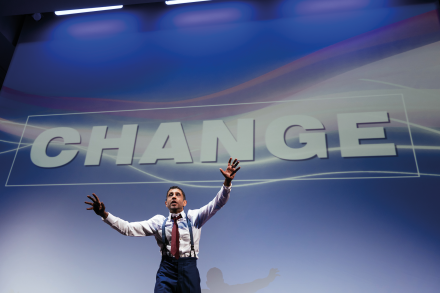
The West End’s new political show, Kyoto, can’t be classed as a drama. A drama involves a main character engaged in a transformative personal journey. This is a secretarial round-up of various environmental summits, or ‘Cop’ meetings, held during the late 1980s and 1990s. If you remove the private jets, a Cop summit is a sort of parish council seminar about the probable weather during the summer fête. The material is extremely dull and yet it’s possible to turn dross into a gripping story if you hire a dramatist. So Big Oil has been torching the planet for 66 years and yet the West End hasn’t been burned to ashes The authors, Joe Robertson and Joe Murphy, aren’t up to the job and their script is a blank list of speeches and events read out by soulless busybodies.

Cheerless and fussy: The Tempest, at Theatre Royal Drury Lane, reviewed

The Tempest is Shakespeare’s farewell, his final masterpiece or, if you’re being cynical, the play that made him jack it all in. Some actors admit that it can be hard to stage and dull to perform. What is it exactly? A children’s fairy tale and a soppy romance with snatches of drunken farce and political intrigue. Quite a muddle. The setting is famously eccentric. Shakespeare whisks the audience away from reality and drops them in a magical kingdom where a sanctimonious wizard rules over a population of goblins and fairies. The overbearing soundtrack keeps coming up with new ways to irritate your eardrums Some directors try to correct the Bard by turning Prospero’s island into an even weirder and less familiar realm.

Exquisite: Tom Stoppard’s The Invention of Love, at Hampstead Theatre, reviewed

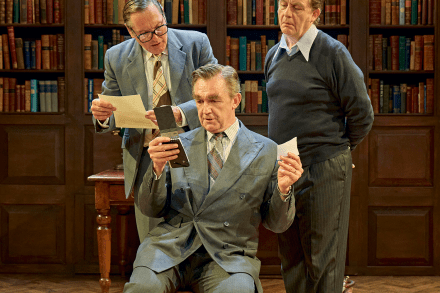
The Invention of Love opens with death. Tom Stoppard’s play about A.E. Housman starts on the banks of the Styx, where the recently deceased poet is waiting for Charon, the boatman, to ferry him across the water. Charon has been told to pick up ‘a scholar and a poet’ and he’s expecting two souls, not one. Houseman explains that he pursued both careers and is therefore a solo passenger. The play’s storyline emerges slowly and with immaculate taste. Stoppard is not one for cheap tricks This takes place in 1936, the year of Housman’s death, and we then flip back to Oxford in the 1870s. The river Styx becomes the Cherwell, where Housman and two chums are paddling upstream while discussing a flamboyant young intellectual, Oscar Wilde.

Brutal and brilliant portrait of Bette Davis and Joan Crawford

The Last Days of Liz Truss? is a one-woman show about the brief interregnum between Boris Johnson and Rishi Sunak. We first meet the future prime minister at a nursery school in Paisley where she orders the teachers to call her Elizabeth and not to use her first name, Mary. This establishes her combative, self-righteous nature and her utter dislike of authority. Truss is like the smell of gas indoors. Even a tiny amount is too much She left Oxford with a PPE degree and became a political activist while setting her sights firmly on parliament. (By researching the CVs of every sitting member, she had discovered that one in 30 of them held a degree in PPE from Oxford.) She was on her way.

A miracle at the RSC: genuinely funny Shakespeare

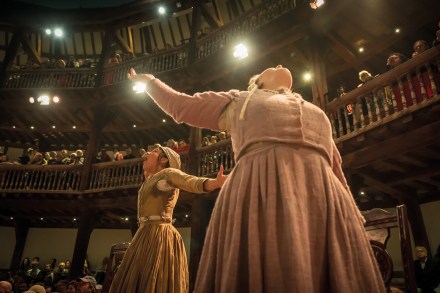
Dost thou think, because thou art virtuous, there shall be no more cakes and ale? Most subsidised theatres hanker for political relevance. Even so, when the Royal Shakespeare Company planned its new production of Twelfth Night, they can hardly have expected that by Christmas 2024 we’d have Malvolio as prime minister. The curious thing is that, as portrayed by Samuel West, Shakespeare’s eternal killjoy cuts rather a sympathetic figure. He’s elegant in dress and carriage, with a shadow of a northern brogue to suggest that this is a man who has strived hard for his status and sees himself as upholding values that have a real, and higher, worth.

Elton John’s The Devil Wears Prada is sumptuous but unmemorable

The Devil Wears Prada is a fairy tale about an aspiring female novelist, Andy, who receives a job offer from Runway, the nastiest and most influential fashion magazine in America. Miranda, the editor, is a Botoxed uber-bitch who doesn’t really want to hire Andy, but does anyway. And Andy doesn’t really want to work in fashion, but does anyway. Slightly odd. Visually, the show is a sumptuous treat that offers Olympic-standard costumes, set and lighting designs Andy is like Paul Pennyfeather in Decline and Fall, a bland but trustworthy cipher who bears witness to a fascinating world of excess and corruption. She’s barely a character, more a device. The best lines are delivered by others. Miranda (Vanessa Williams) specialises in toxic putdowns.

This Muslim playwright believes Yorkshire is headed for civil war

Expendable, at the Royal Court, is an urgent bulletin from the front line of the grooming gang scandal in the north of England. The setting is a kitchen in Yorkshire where Zara is trying to keep her family together after her son, Raheel, was outed as a rape suspect by a national newspaper. White thugs dump parcels of excrement on their porch and Zara cowers under the kitchen table, too scared to answer the door. The racists have mounted a mass demonstration, supported by the cops, which causes local bus services to be cancelled. Every Muslim in town is terrified of a white vigilante gang who recently targeted a blameless Yemeni pensioner and kicked him to death. It gets worse.

Wonderful comedy of manners: Kiln Theatre’s The Purists reviewed

A slice of the ghetto arrives at the Kiln Theatre in Kilburn. The Purists is set on the stoop of a crumbling block in Queens, New York, and the show declares its urban credentials as a boombox slams out a hip-hop rhythm and Mr Bugz, a DJ, enters, mike in hand. He urges the audience to commit arson and murder using a chant inspired by the theatre’s location. ‘Kill! Burn!’ he screams. ‘Kill! Burn!’ He invites the crowd to join in his riotous incantation. ‘Kill! Burn!’ they shout back with blood-curdling obedience. After this homicidal overture, the play settles down and turns into a surprisingly genteel comedy of manners. Mr Bugz makes friends with an Anglophile neighbour, Gerry Brinsler, who adores musical theatre and has a soft spot for her late Majesty.