Television

Victory to the vicar

My prize for the best thing on TV this year goes to the comedy Rev (BBC2, Thursdays). I know Simon Hoggart disagrees with me on this  — he finds it all a bit predictable. But in the spirit of Christmas I should like to point out that Simon is a wine-soaked pinko Guardianista who hasn’t a clue what he’s talking about, whereas I am world-famous for being right about everything, so there. Why is Rev so good? Let us count the ways. Its alpha and omega — as with all the best sitcoms — is character. Apart from Perry and Croft’s various masterpieces and The Simpsons, I’m hard pushed to think of any other TV comedy with quite so extensive a cast of well-drawn, plausible, compelling major and minor characters.
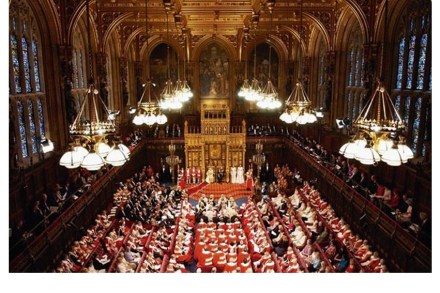
Disappearing lords

‘I don’t like him looking daft,’ growls Alastair Campbell to the camera as Bafta-winning documentary film-maker Molly Dineen shadows Tony Blair for the 1997 party election broadcast. The warning is clear. Forty hours of footage became a mere ten minutes of spin, but it’s testament to Dineen’s rapport with the member for Sedgefield that despite its brevity the film was described by the late New Labour strategist Philip Gould as ‘probably our most effective broadcast’. Twenty-five years after her acclaimed debut Home from the Hill, Dineen’s collected works now fill three double DVDs.

Sage advice

To the Manor Reborn (BBC1, Thursday) is undoubtedly one of the most brilliant programmes in the history of television. But then I’m biased for the Rat is in it, and what a splendid, handsome and talented young fellow he has turned out to be. If you looked very carefully about halfway through episode one, you’ll have caught him standing facing interior designer Russell Sage, holding a sheet of wallpaper or something. And then later, you’ll have caught him again being told by Sage to remember something he’d forgotten. Superb! The boy is a natural, he’ll go far, and as his proud stepfather I shall accept nothing less than the highest offers for his services.

Out of kilter

Can a critic simply be wrong, in the way that a mathematician who said that 3x3=10 would be wrong? I’m beginning to wonder, since I am the only person I’ve read who thought Ricky Gervais’s Life’s Too Short was not vile but terrific and The Killing II (BBC4, Saturday) all right, though far from the work of genius others believe. I never quite caught the first series of The Killing on BBC4, though I have tried. I do have the box set, and one day I might even watch it. Mind you, suspicions were aroused when the main talking point seemed to be the heroine’s knitwear. ‘Say what you like about the plot moving like an arthritic snail, but that Faroe Islands sweater really caught the eye!

A girdle too far

Fact: in 1963, air travel was so new and exciting that the awed gasps of the passengers as the plane took flight frequently drowned out the noise of the jet engines. Fact: in 1963, air travel was so comfortable that passengers emerged from long-haul flights even more refreshed, relaxed and cheerful than when they boarded the plane. Instead of taking their suits to the dry cleaners, canny travellers of the day would often just take a plane journey instead, knowing that their clothes would emerge at the end more pressed and immaculate than before. Fact: in 1963, every woman looked and dressed like Jackie Kennedy, especially air stewardesses, all of whom could have doubled as models because they were just so hot.

Ritual humiliation

Ricky Gervais’s latest sitcom, Life’s Too Short (BBC2, Thursday), is really a series of sketches on his favourite themes — failure, rejection, self-delusion and humiliation. I gather from friends of friends that at UCL he was often teased, not always pleasantly, for not fitting in with the right gang. Exclusion of one kind or another and the desperate need to fit in is another constant topic. You may remember the scene in Extras in which he and his friends are turfed out of the VIP area in a club to make way for David Bowie, who then makes things more horrible by improvising a song about what a pathetic and useless person Gervais’s character is.

Padding out

One of the useful things about having teen and near-teenage kids is discovering what the vulgar masses watch. Last week, for example, during half-term, I got to see two hugely popular programmes which I would probably never have bothered watching on my own: Undercover Boss USA (Channel 4, Wednesday) and The X Factor (ITV, Saturday, Sunday). Yes, I suppose it is a terrible indictment of my lackadaisical attitude that it has taken me till now to watch a full episode of the most talked about programme on TV. Thing is, though, I’ve been right all along. The X Factor just isn’t as good as University Challenge. Or The Simpsons. Or South Park. Or even, frankly, Downton Abbey.

Et tu, Hugh?

Hugh Fearnley-Whittingstall thinks it’s time we all went veggie (River Cottage Veg; Channel 4, Sunday). Coming from a man whose favourite dish is human placenta marinaded in fruit-bat extract, who slaughters his own pigs with a pocket knife and dances naked in their gore as he turns them into 2,058 varieties of artisanal black pudding, and who recently confessed he wouldn’t mind eating the odd puppy if push came to shove, I suppose this is something we should take quite seriously. Personally, I feel betrayed. As betrayed as I felt all those years ago when my most heavy-duty smoking friend Ewen gave up fags, which was so unfair because I’d been relying on him to die of lung cancer, not me. ‘Et tu, Hugh?’ it made me think. Because I like my meat, an awful lot.

Care in the community

‘We all need to rendezvous every week. It keeps us all as a community,’ said Jane Copsey on the In Touch anniversary programme (produced by Cheryl Gabriel). The Radio 4 magazine for the blind and partially sighted has been around for 50 years dispensing advice and encouragement, hope and cheer. Nowadays it’s been cut to just 20 minutes, but at least it’s still in its Tuesday-evening slot, where it’s been scheduled for decades. Copsey was arguing for the survival of the programme, even though there’s now an online equivalent, called Ouch!

Critics’ choice

I caught an intriguing session at the Cheltenham literary festival, titled ‘Secrets of the TV Critics’. As it happened, the main secret seemed to be that some of them liked a drink while they watched the box. In the distant days before advance DVDs and internet previews, one critic of the Daily Express used to sit in front of an entire evening’s television with a bottle of whisky. At 10.45 he would phone the copytakers and dictate what he thought. At least he was duplicating the experience of most viewers, which is more than we critics do now.

Nice Mr Fry

Whenever I find myself dreaming about how awful things would be under a red/green dictatorship — increasingly often, these days — the one person who gives me a glimmer of hope that I might get out of the hell alive is Stephen Fry. He’s a leftie, of course — but, like Frank Field and Kate Hoey, he’s the right kind of leftie. Even when appointed Minister for Culture in the new regime, as he inevitably would be, you just know that he wouldn’t indulge in either the gloating triumphalism or bullying sadism of his fellow Nomenklatura. It would be more a case of: ‘Yes, my dear, dear chap. How perfectly awful for you to be caught on the wrong side of history.

Tale of the unexpected | 1 October 2011

I imagine there is software that helps you write biopics for television. First you pick the childhood from a drop-down menu, selecting [poor but respectable] [very poor] [so poor that all your belongings will fit into a single wheelbarrow which your mother pushes from a grim slum to the nearby hell-hole]. Father deserts family [yes] [no]. Star is determined to make it big but [is sent from one agent to another with mocking laughter in their ears] [meets an impresario who is sceptical at first then turns incredulously to accompanist and says, ‘My God, she’s got something!’]. Then there are the other staples which must be included by law. The trip to the Glasgow Empire, where the previous act has had fruit thrown at them.

How to behave

‘I don’t suppose the war will leave any of us alone by the time it’s done,’ prophesied one of the characters in the new series of Downton Abbey. Oh, dear, I’m sure she’s right. So I wonder which will be the character who comes back with shellshock, which one with no legs, and which one a hero. For the last, I’m guessing Matthew Crawley, the worthy but slightly dull heir to the worthy but slightly dull Earldom of Grantham. That would be nice: then, after many travails and obstacles, cold, aloof (but really quite hot) Lady Mary will get to realise in the final episode that, yes, of course, he was the man for her all along. At the big wedding the redoubtable Dowager Countess (Maggie Smith) will say something very funny and acerbic.

Rebellious Prommers

The Promenaders have excelled themselves this year. I thought initially they were slightly more docile and slightly less dotty than usual, but no. Not only at the Last Night, but also at the Israel Philharmonic Prom on 1 September, they found their voice — so strongly that the BBC actually suspended the broadcast of the latter. One Prommer told me the atmosphere that night was verging on the violent. The members of the Israel Philharmonic must have wondered what had hit them. With this concert they were concluding a lengthy worldwide tour, which had passed without a murmur. Suddenly, in the Albert Hall, every piece they played was interrupted with raucous singing, the Webern Passacaglia, for example, with the ‘Ode to Joy’.

Out of sight

There are some things television can do which no other medium can manage. Take one of those little-noticed programmes, Hidden Paintings on BBC4. It’s presented by Laurence Llewelyn-Bowen, the chap with the King Charles spaniel hair, who used to do Changing Rooms, in which people found parts of their house redecorated while they were away, causing them to fly into a rage. The theme is fine works of art which for various reasons aren’t on public view. This week LLB considered David Inshaw, still with us, whose two best-known paintings are both hidden. One, ‘Our Days Were a Joy’, shows an enigmatic young woman in a graveyard. The technique is a beguiling cross between pointillism and photography.

Money for nothing

When future historians sift through the wreckage of Western Civilisation to try to find out where it all went wrong, I do hope they chance upon at least one episode of The World’s Strictest Parents (BBC3) and one of Deal or No Deal (Channel 4). The World’s Strictest Parents is another TV variant on the Lad’s Army/Wife Swap theme. Unruly, selfish, vile teenagers are sent from their grotesquely overindulging middle-class British homes to far-flungplaces, there to spend two weeks under the kind of old-fashioned parenting regimes where they still uphold traditions like family meals, respect, discipline and a strict moratorium on dope, booze and the wearing of nipple rings. They return transformed.

The odd couple | 3 September 2011

Years ago I did some charity gig with Will Self, a sort of Desert Island Books. He had chosen a Raymond Chandler, and I remarked on the similarities between Chandler and P.G. Wodehouse. Both were educated at Dulwich College, both were wonderfully stylish and stylised writers, both were masters of the dazzlingly witty, totally unexpected metaphor. Will Self favoured me with the de haut en bas curled lip familiar from television. There was no comparison, he said. Wodehouse wrote about a discredited imperialist age; Chandler by contrast tackled the gritty reality of life on the mean streets of LA — or words to that effect. He was wrong.

Edge of darkness

I’ve got this idea for a book, when I get the time, called Everything You Know Is Wrong. Its job will be to attack all the idiot received ideas of our age — what my father-in-law calls ‘notions’. High on the list of candidates, most definitely, is the commonly held belief (especially among stand-up comics) that Bill Hicks was the greatest comedian who ever lived. I’ve got this idea for a book, when I get the time, called Everything You Know Is Wrong. Its job will be to attack all the idiot received ideas of our age — what my father-in-law calls ‘notions’. High on the list of candidates, most definitely, is the commonly held belief (especially among stand-up comics) that Bill Hicks was the greatest comedian who ever lived.

Let them eat cake

Prince Charles turned up on TV again this week, in Britain’s Hidden Heritage (BBC1, Sunday), wandering round a country house in Scotland that he had helped to restore. Prince Charles turned up on TV again this week, in Britain’s Hidden Heritage (BBC1, Sunday), wandering round a country house in Scotland that he had helped to restore. He was interviewed by Paul Martin, best known as the presenter of Flog It!, in which he gets aerated by an auction for a Georgian silver salt cellar, or a set of cigarette cards. For some reason, presenters who would sink their fangs into a politician, no matter how important, are reduced to quivering lapdogs by royalty.

Simon Hoggart: Chilean Miners

Angus Macqueen is a film-maker whose CV includes The Death of Yugoslavia, Gulag, Cocaine and a slightly odd period commissioning the likes of The Secret Millionaire as Channel 4’s head of documentaries. These days, happily, he’s back making his own stuff — and BBC2’s Chilean Miners: 17 Days Buried Alive was another gem. Commentary was kept to a minimum and the reconstructions were nicely restrained, leaving the heart of Friday’s programme filled by gripping interviews with six of the miners themselves. These proved to be a varied lot, from Mario ‘Perry’ Sepúlveda, a family-loving Jehovah’s Witness, to Samuel Ávalos, a cheerfully foul-mouthed former street-kid, who praised mining as the best way to sweat off a hangover.