Portrait of the week

Portrait of the week: Sue Gray resigns and the Chagos Islands are handed back 

Home Sue Gray resigned as chief of staff to Sir Keir Starmer, the Prime Minister. She will become Sir Keir’s envoy for the nations and regions of the United Kingdom. She was replaced by Morgan McSweeney, 47. James Lyons, a former political journalist who has more recently worked for the NHS and TikTok, was brought in to take charge of strategic communications. Sir Keir paid back more than £6,000 for gifts and hospitality, including six Taylor Swift tickets, four tickets to the races and a clothing rental agreement with his wife. More people in the United Kingdom died than were born in the year to mid-2023, according to the Office for National Statistics. Nonetheless, the population grew by 1 per cent to 68.3 million, because net migration was 677,300.

Portrait of the week: Iran fires missiles into Israel, Rosie Duffield resigns and Mount Everest gets taller

Home The Conservatives at their party conference examined the four surviving candidates for leader – Robert Jenrick, Kemi Badenoch, James Cleverly and Tom Tugendhat – with the prospect of two being thrown out of the ballot by MPs next week and the other two being put to the party membership on 2 November. Rishi Sunak, the last Conservative prime minister, urged the conference optimistically: ‘We must end the division, the backbiting, the squabbling.’ Jeremy Hunt, the former chancellor, said: ‘One of the biggest lies we’ve had since Labour came to office is this nonsense about having the worst economic inheritance since the second world war.

Portrait of the week: Starmer’s sausages slip-up, Israel’s strikes on Lebanon and Amazon staff summoned back to office

Home Sir Keir Starmer, the Prime Minister, in his speech to the Labour party conference in Liverpool, said that ‘if we take tough long-term decisions now’ Britain would much more quickly reach the ‘light at the end of this tunnel’. He was cheered when he promised to return the railways to public ownership and restore workplace rights to unions and workers. But he insisted that ‘if we want cheaper electricity, we need new pylons over ground otherwise the burden on taxpayers is too much’. He recovered from a fluff when, talking of Gaza, he called ‘for the return of the sausages – the hostages’. Sir Keir hoped to counteract recent difficulties.

Portrait of the week: Keir Starmer’s free clothes, Huw Edwards sentenced and Tupperware faces bankruptcy

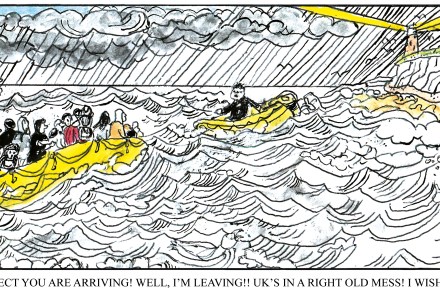
Home Sir Keir Starmer met Giorgia Meloni, the Prime Minister of Italy, in Rome and said that sending funds to Tunisia and Libya ‘appears to have had quite a profound effect’ in cutting the number of migrants arriving in Italy. In the seven days to 16 September, 1,158 migrants arrived in England in small boats; eight drowned off France. Sir Keir made a late declaration of gifts from Lord Alli, a Labour donor, including clothes for Lady Starmer. David Lammy, the Foreign Secretary, defended the practice, saying that prime ministers ‘do rely on donations, political donations, so they can look their best’. Sir Keir’s hair was observed to be greyer than before.

Portrait of the week: State pension to rise, prisoners released early and a new owner for The Spectator

Home The government won by 348 to 228 a Commons vote on limiting the winter fuel allowance for pensioners to those who qualified by poverty: 52 Labour MPs didn’t vote, one voted with the opposition; five MPs suspended from the Labour party also voted with the opposition. Three million people who began receiving the ‘new’ state pension after 2016 will be given £460 a year more from April 2025, in line with wage growth of 4 per cent. A bill was published to exclude the 92 hereditary peers from the House of Lords.

Portrait of the week: UK cancels Israel exports, Grenfell fire report released and AfD victory in Germany

Home The government cancelled 30 out of 350 export licences for arms to Israel on items that it said could be used by Israel for ‘offensive purposes’ in Gaza. Israel Katz, the Israeli foreign minister, said: ‘A step like the one taken by the UK now sends a very problematic message to the Hamas terrorist organisation and its backers in Iran.’ Nine offshore wind farm contracts were awarded by the government; last year there were no bidders. The previous government had increased the maximum guaranteed price from £44 to £73 per MWh. The headquarters of GB Energy, a new UK government-backed energy company, will be in Aberdeen.

Portrait of the week: Sir Keir’s tax warning, Russian air attacks and another prisons crisis

Home Sir Keir Starmer, the Prime Minister, speaking in the garden of 10 Downing Street, warned that the Budget in October is ‘going to be painful’, and that ‘things will get worse before they get better’. ‘I didn’t want to means-test the winter fuel payment, but it was a choice we had to make,’ he said. ‘A garden and a building that were once used for lockdown parties are now back in your service.’ Meanwhile, it was discovered, a pass to Downing Street had been given to Lord Alli, the Labour peer and party fundraiser, who gave £10,000 to the Beckenham and Penge constituency party; the seat was won by Liam Conlon, the son of Sue Gray, Sir Keir’s chief of staff.

Portrait of the week: prisoners are freed, Ted Baker closes and train drivers announce strikes 

Home Emergency measures, known as Operation Early Dawn, were brought in to ease prison overcrowding. Defendants would be summoned to a magistrates’ court only when a space in prison was ready for them, the government said, and would be kept in police holding cells or released on bail while they awaited trial. The measures at first affected the north and the Midlands. By the beginning of the week, 472 people had been charged with offences arising from the recent public disorder; 300 had appeared in court in the preceding week. Donna Conniff, aged 40, the mother of six children, was jailed for two years for throwing a brick at police during a disturbance in Hartlepool.

Portrait of the week: riot justice, Olympic success and Ukraine’s Russian advance

Home Riots subsided after 7 August, a night when many were expected but only empty streets or demonstrations against riots eventuated. By 12 August there had been 975 arrests and 546 charges in 36 of the 43 police force areas in England and Wales. Rioters could be released from jail after serving 40 per cent of their sentence, as part of the early release scheme to ease prison overcrowding, Downing Street said. Ricky Jones, a councillor for Dartford, now suspended from the Labour party, was remanded in custody after being charged with encouraging violent disorder in Walthamstow.

Portrait of the week: riots and Russia’s prisoner swap

Home A week of riots, with violence against the police, threats to Muslims, burning of vehicles and looting (Greggs, Shoezone, Sainsbury’s Local) broke out in Liverpool, Sunderland, London, Hartlepool, Manchester, Hull, Aldershot, Stoke-on-Trent, Bristol, Bolton, Tamworth, Portsmouth, Weymouth, Leeds, Rotherham, Middlesbrough, Nottingham, Blackpool, Plymouth and Belfast. The Northern Ireland Assembly was recalled. Rioters attacked hotels where asylum-seekers were living. They threw fencing, beer kegs, glass bottles and furniture at police, wounding scores. Activity was coordinated on social media. The anger of most rioters was directed against Muslims in general and hotels housing asylum-seekers. ‘Save our children’ was one of the chants.

Portrait of the week: Stabbings in Southport, a £22bn ‘black hole’ and Tory leadership nominations

Home Rachel Reeves, the Chancellor of the Exchequer, said she had found a £21.9 billion hole, and a black one at that, ‘covered up’ by the Tories in the finances Labour inherited. ‘The biggest single cause of the £22 billion fiscal hole was Reeves’s decision to give inflation-busting pay rises to public sector workers,’ the Financial Times reported. Junior doctors were offered an average rise of 22 per cent over two years. The Chancellor told the Commons that the government was cancelling: the universal winter fuel payment; the cap on the amount people must spend on funding their social care; A-level reforms; and a tunnel near Stonehenge. Jeremy Hunt, the former chancellor, noted that estimates had been ‘signed off by senior civil servant accounting officers’.

Portrait of the week: IT meltdown, riots in Leeds and the wrong kind of pandemic

Home Britain enjoyed its share of the worldwide failure of 8.5 million computers reliant on Microsoft, through a faulty update of the CrowdStrike antivirus software. On the first day, 167 air departures were cancelled in the United Kingdom – 5.4 per cent of those scheduled. (Worldwide it was 5,078 – 4.6 per cent of those scheduled.) Doctors’ appointment systems stopped working and customers at Gail’s bakery could not pay for their pains au chocolat. BT was fined £17.5 million for a ‘catastrophic failure’ on 25 June last year that led to 14,000 999 calls not being connected. National debt, which fell from 251.7 per cent of GDP in 1946 to 21.6 per cent in 1990, had risen by June this year to 99.5 per cent.

Portrait of the week: King’s Speech, Trump shot and Rouen cathedral in flames

Home The government funnelled three dozen bills into the King’s Speech, highlighting one to make a specific offence of spiking a drink, which is already illegal. But backbenchers and Labour in Scotland failed in efforts to remove the cap of two children for the payment of child benefit. A new state-owned energy company would be set up and railways nationalised. Landlords’ rights to evict tenants would be reduced. Police were to be given more powers against gangs smuggling migrants in small boats. Between 10 and 15 July, 701 migrants crossed the Channel in small boats.

Portrait of the Week: Starmer’s first steps, Biden’s wobble and Australia’s egg shortage

Home Sir Keir Starmer, the Prime Minister, appointed several ministers who are not MPs, but will be created life peers. Most cabinet posts went to MPs who had shadowed the portfolios, but as Attorney General he appointed Richard Hermer KC, a human rights lawyer, instead of Emily Thornberry, who said she was ‘very sorry and surprised’. James Timpson, the shoe-repair businessman and prison reformer, was made prisons minister. Sir Patrick Vallance was made science minister. The former home secretary Jacqui Smith became higher education minister; Ellie Reeves, the sister of the Chancellor of the Exchequer, Rachel Reeves, became minister without portfolio. The government dropped the phrase ‘levelling up’.

Portrait of the week: an election looms, Joe Biden crashes and England wins

Home A general election shook the nation’s political snowglobe. Sir Ed Davey, the Liberal Democrat leader, was able to stop stunts for the camera after making a bungee jump at Eastbourne. Before the election, Rishi Sunak, the Prime Minister for the time being, commented on Channel 4 footage of a Reform UK supporter talking of him in racially abusive language: ‘My two daughters have to see and hear Reform people who campaign for Nigel Farage calling me an effing Paki. It hurts and it makes me angry.’ Reform UK made an official complaint against Channel 4 to the Electoral Commission, claiming that the supporter filmed was an actor.

Portrait of the week: gambling politicians, gender rows and a free Julian Assange 

Home The Conservative party withdrew its support from two parliamentary candidates, Craig Williams (who was parliamentary private secretary to the Prime Minister) and Laura Saunders, both of whom the Gambling Commission had been investigating after allegations that bets had been placed on the date of the election. Two Conservative party workers and six policemen were also alleged to have been involved, one of the policemen being under criminal investigation. Others remained under investigation. Labour suspended a parliamentary candidate of its own, Kevin Craig, after being told the Gambling Commission was investigating him betting on failing to win the seat, which he now might. The candidates’ names would still appear on ballots as standing for their parties.

Portrait of the Week: Supermajorities, falling inflation and rammed cows

Home The electorate mulled over the words of Grant Shapps, the Defence Secretary: ‘You don’t want to have somebody receive a supermajority.’ A question that lodged in the election campaign was put by Beth Rigby of Sky News to Sir Keir Starmer, the Labour leader, asking whether he had meant it when he said his predecessor, Jeremy Corbyn, would make a great prime minister; he replied: ‘I was certain we would lose the 2019 election.’ A few days later, Sir Keir told a phone-in questioner that serving in a Corbyn administration ‘didn’t cross my mind because I didn’t think we would win’. He evaded questions on council tax, taxing pensions and VAT on schools. A dishevelled Boris Johnson made some short videos endorsing Conservative candidates.

Portrait of the Week: Sunak’s D-Day misstep, Michael Mosley’s death and Macron’s snap election

Home The Conservatives promised to reduce National Insurance from 8 per cent to 6 per cent (and abolish it for most of the self-employed by 2029) in their 76-page election manifesto. Despite other tax cuts already announced, the tax burden would continue to rise steadily. The Tories also promised to halve migration. In its manifesto, Labour decided after all not to reinstate the lifetime limit on tax-free pension savings, but it was tempted by capital gains tax. Labour promised 100,000 extra childcare places, with nurseries set up in classrooms expected to be empty because of falling numbers of primary school children; the costs would be met by VAT on private schools. Douglas Ross announced that he would resign as leader of the Scottish Conservatives after the election.

Portrait of the Week: Farage returns, Abbott reselected and Trump guilty 

Home Nigel Farage took over leadership of the Reform party from Richard Tice and is standing for parliament in Clacton. This came as news on Monday to Tice, and to Reform’s candidate for Clacton, Tony Mack. Outside the Wetherspoons pub where he launched his campaign, Farage had a McDonald’s banana milkshake thrown over him. Farage proposed net-zero immigration. The Conservatives then said they would ask the independent Migration Advisory Committee for a recommended level for an annual cap on visas, and put that to a parliamentary vote. Invasive Asian hornets, which can eat 50 bees a day, were found to have survived a British winter and might stay permanently.

Portrait of the Week: Sunak’s downpour, national service and the ‘triple lock plus’

Home Parliament was dissolved, leaving no MPs until the general election on 4 July. With hours to go, Diane Abbott had the Labour whip restored to her, and Lucy Allan MP was suspended from the Conservative party for endorsing the Reform UK candidate for Telford. Among bills that were lost was one prohibiting the sale of cigarettes to anyone born after 31 December 2008. Rishi Sunak, the Prime Minister, had provided an abiding memory by announcing the election standing in heavy rain in Downing Street and making a speech as though it weren’t raining. The Conservatives suddenly said that everyone should do a form of national service at the age of 18. The Tories proposed adding to the triple lock for state pensions a promise that they would never incur income tax.