Pop

Electrifying: Annie & the Caldwells, at Ronnie Scott’s, reviewed

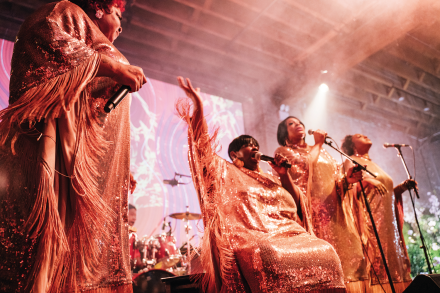
Annie & the Caldwells are a long-running family gospel ensemble from West Point, Mississippi – father and sons playing guitar, bass and drums, mother and daughters singing. The chaps offer a sinewy, stripped-down funk redolent of the late 1970s: dad, Willie J. Caldwell Sr, is a fantastic guitarist, and mother and daughters tear the roof off the place. They came to attention when David Byrne put out a record on his Luaka Bop label, and suddenly they were no longer just a local gospel group. Except they are. In an early show at Ronnie Scott’s, Annie – seated centre-stage in what looked like a black leather housecoat – was there to save souls. She refused to be discouraged by only three hands rising when she asked who believed in Jesus.

Who stuck the great Emmylou Harris in a sports hall?

Somebody obviously thought it a good idea that Emmylou Harris play her last ever Scottish show in a soulless sports hall in the east end of Glasgow. Built for the 2014 Commonwealth Games, the feel of the Emirates Arena on a chilly January night was less Sweet Home Alabama, more Home Counties Ikea. As well as kicking off this year’s Celtic Connections, the city’s annual festival of roots music, Harris was also kickstarting her farewell tour of Europe. She plays her final UK shows in May, including one at the Royal Albert Hall, which seems a more fitting setting for a regal adieu than a pimped-up cycling track. Presumably, the choice of venue was a numbers game. Whatever the reason, it was a poor one.

Why I will always have time for Bernard Butler

Bernard Butler has popped up a couple of times in this column, but not alone – once, with two fellow songwriter-guitarists as Butler, Blake & Grant; but also writing and performing with Jessie Buckley, to sublime effect. Over 30 years Butler has become one of pop’s great enablers. He’s worked on hit records, miss records and records that were never intended to be hits. He’s played with everyone, but has seldom sought much of a spotlight himself. Like Johnny Marr, he stepped away from a generational band – Suede – at the height of the mania for them. Like Marr – and unlike most others who step away from stardom and seek the shadows – he continued working, but always on his own terms.

Zach Bryan is no Springsteen

There would, on the surface, appear to be little common ground between the wife of stuffy old Malcolm Muggeridge and the latest bard of blue-collar America. Yet the unlikely ascendancy of Zach Bryan brings to mind Kitty Muggeridge’s killer putdown of David Frost as the superstar who ‘rose without a trace’. You may be surprised to learn that Bryan, a 29-year-old US Navy veteran from Oklahoma, will headline two concerts later this year at Tottenham Hotspur’s stadium, as well as perform to 60,000 people each night in Edinburgh and Liverpool. He now ranks alongside Bon Jovi and Bruno Mars as a gold-star draw on the 2026 summer show circuit.

Johnny Rotten’s still got it

Robert Plant and John Lydon were fixed in the public mind at the age of 20. Plant, a golden-haired lad who had grown up in Worcestershire, became the leonine singer of Led Zeppelin in 1968, a self-proclaimed ‘golden god’. Lydon, a scrawny kid from Holloway, who had been hospitalised for a year with meningitis as a child, became Johnny Rotten, and in 1976 helped deliver ‘the filth and the fury’ – as the Daily Mirror put it – on the nation’s TV screens as a quarter of the Sex Pistols. Both, it would be fair to say, have ambivalent relationships with their pasts. After Zeppelin’s demise in 1980, Plant spent a couple of decades being active, but without much direction.

What links Jeffrey Dahmer to the Spice Girls?

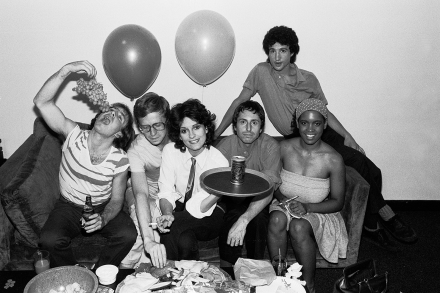
The path that links the Spice Girls to Jeffrey Dahmer – necrophile mass murderer of at least 17 men – is a circuitous and unusual one. It involves the establishment of Mothercare and Harold Wilson’s Chancellor of the Duchy of Lancaster and the New York underground of the early 1980s. The thread that joins the ends is a 76-year-old Ohioan called Chris Butler. Butler was part of that art underground in 1981. He was – and is – a musician. Back home in Akron he’d started several bands – the wonderful art rock group 15-60-75 (aka the Numbers Band), and Tin Huey – and he’d brought the newest of them, the Waitresses, to New York. They were signed to ZE Records, an extraordinarily hip label run by a Frenchman, Michel Esteban, and an Englishman, Michael Zilkha.

Thom Yorke reminds me of David Brent: Radiohead reviewed

There were times watching Radiohead’s first UK show for seven years when Ricky Gervais came to mind. As Thom Yorke dad-danced around the circular stage in the middle of the arena, his bandmates all hunched over their equipment – which made it resemble a server room of a call centre – I felt as though I was witnessing David Brent doing the samba around the office. I have to confess that there are large chunks of Radiohead I simply don’t understand.

The tedium of softboi rap

A male British rapper who is unafraid to show tenderness and vulnerability is not a particularly new phenomenon: Dave, Stormzy, Headie One and Kano have all walked this path in recent times. None, however, has made emotional fragility his USP to quite the same extent as Loyle Carner, who writes about his children, his masculine role models, mental health, race and inherited trauma in an unthreatening sing-song style which has made him both a pop star and a bit of a poster boy for Feeling Things. His tour is named after his fourth and most recent album, hopefully!. To his credit, he has put his money where his rhymes are. Carner has preached about knife crime from the stage at Glastonbury. He was talking about his ADHD before it became the topic du jour for celebrity over-sharers.

The rise of psychedelia

On YouTube – and I urge you to look it up – there is a magnificent piece of footage from German TV, in which big band leader James Last leads his orchestra into a medley of hard rock hits, opening with Hawkwind’s deathless space-rock drone ‘Silver Machine’. And damn it if they don’t nail it. The members of the band with electric instruments play it just as Hawkwind did: the whooshing synth, the thudding bass, the fuzzing guitar. But instead of Lemmy growling out the topline melody, there is a huge rush of brass from the band, the brightness cutting unexpectedly through the murk. It is, unironically, brilliant. I have no desire to investigate much else of Last’s colossal oeuvre, but I can watch those few minutes over and over again.

No band should play Ally Pally

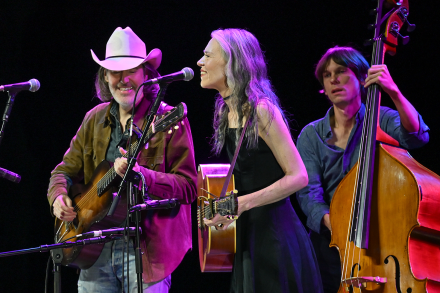
The last time Gillian Welch and David Rawlings played in London it was a different world: the world of David Cameron and Barack Obama and a Manchester United at the top of the Premier League. Welch and Rawlings have changed, too: Welch is silver rather than red, and Rawlings as grizzled as a bear. Welch was in brown floor-length dress and Rawlings in suede jacket and cowboy hat. With a rather younger upright-bass-player, Paul Kowert, the trio looked like farmers trying to save their land from The Man in some Taylor Sheridan TV series. And then they started singing. Welch and Rawlings have released records under their own names and as a pairing.

Fionn Regan has gone method Worzel Gummidge

Watching the Mercury Music Prize on television last week, I remembered that Fionn Regan’s debut album, The End Of History, was nominated for the award back in 2007. Proof were it needed that the prize is rarely a shortcut to superstardom for most of those it spotlights. The Irish singer-songwriter has never quite replicated the mainstream acclaim he gained for his debut – when, for a solid five minutes, he was the latest in a long line of ‘new Bob Dylans’. He has, however, carved out an interesting and worthwhile career across five further albums, expanding his core skill set of folk guitar and knottily poetic wordplay with experimental touches of electronica and orchestration.

In defence of Mick Hucknall

Before Simply Red came on stage at the Greenwich peninsula’s enormodome, the screens showed a clip of a very young Mick Hucknall being interviewed. What he wanted, he said, was to be a great singer. Usually, that’s the cue for a gag about fate having other plans. Not this time. He’s 65 now, and he truly is a great singer as he showed for the best part of two hours. He knows it, too. A couple of songs in, he benignly told his audience at the first of two nights at the O2 that he liked it when they sang along with the choruses, but maybe leave the verses to him. The person next to you, he explained, had come to hear him sing, not you. But not just hear – Hucknall is worth watching as well. Seeing him was like witnessing one of the great standards singers of the 1950s.

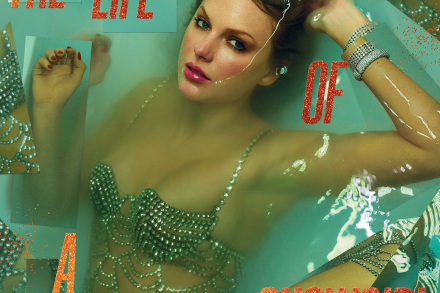
Has Taylor Swift been reading The Spectator?

The Last Dinner Party received quite the critical backlash when they arrived amid much fanfare in 2023. Posh, precocious and theatrical, armed with lofty ideas that matched their station as four young women who had benefited from very expensive educations, the band encountered widespread suspicion that they were industry ‘plants’, or had somehow bought their way to instant recognition. Happily, their debut album, Prelude To Ecstasy, proved sufficiently accomplished to repel these waves of hostility (strange how the success of privileged young women tends to attract far greater opprobrium than that of privileged young men). In any case, the excellence of the follow-up should settle the matter.

Like Gabor Mate set to club beats: Lady Gaga, at the O2, reviewed

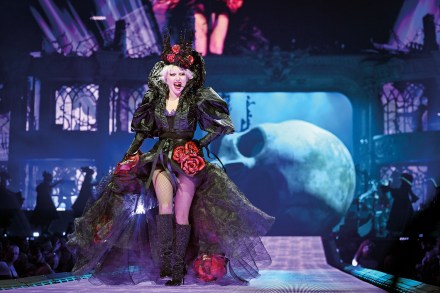
Lady Gaga’s show was to begin at 7.30  prompt, we were told. No opening act. And at 7.30 something did happen: the big screen over the stage started showing a film of Ms Gaga, clad in scarlet finery, writing on a scroll with a peacock-feather quill, while the PA played opera’s greatest hits. For more than an hour the film ran, an impassive Gaga doing nothing but writing. An hour. It was nearly as dull as a Paul Thomas Anderson film, and it’s a miracle it took 45 minutes for the handclaps to start ringing around the arena. Was she about to do a Madonna – who had to keep cutting short her O2 shows because she was about to break their curfew? In the end, no. Gaga just managed to end in time, but it was tight. And she won back her crowd.

Uplift from an odd couple: James Yorkston & Nina Persson reviewed

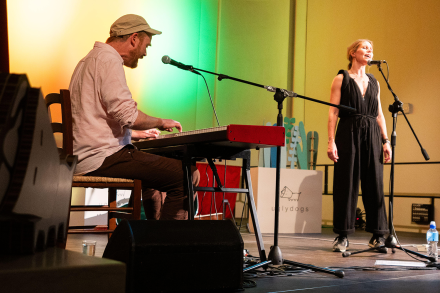
Let’s hear it for the odd couples of popular music: Bowie and Bing. Shaggy and Sting. Metallica and Lou Reed. Nick Cave and Kylie. U2 and Pavarotti. The ongoing collaboration between James Yorkston and Nina Persson isn’t quite so wildly unlikely as any of these but still seems intrinsically counter-intuitive; until, that is, the realisation dawns that each has a stakehold in the other’s natural territory. Yorkston is a fifty-something Scottish folkie with the honed melodic instincts of a pop aficionada. Persson is a former rock star from Sweden whose voice has the controlled command found in the best traditional singers. Which perhaps explains why a pairing that makes little sense on paper makes perfectly imperfect sense in the flesh.

Suede turn their fine new record to mush at the Southbank

I think a lot about Wishbone Ash. A disproportionate amount. Partly because I have had to listen to them for around ten hours while researching a book. Partly because when I was a kid, I always found it curious that Wishbone Ash were advertised in the weekly music press but never reviewed. Back then, broadsheets barely covered rock, so there was no room for their gigs and albums there. But they were never on Top of the Pops or The Tube or even Whistle Test  either. Perhaps Tommy Vance occasionally gave them a spin on the Friday Rock Show, but other than that they were not on Radio 1. They existed entirely outside of what I perceived of as the world of rock. At that point Wishbone Ash were 15 years on from their first album. Suede are 32 years on from theirs.

The problem with Chappell Roan

There is a downside to being fast-tracked into the position of this season’s newest pop sensation, and it became more and more obvious the longer Chappell Roan’s self-proclaimed ‘biggest ever show’ went on. A freshly risen pop star promoting their debut album should, by law, be performing a 40-minute hit-and-run set in a sweaty club, showcasing the absolute cream of their catalogue. Bang, bang, bang. Over and out. But the fast-track these days moves at positively breakneck speed. Barely a year after her first hit, Roan found herself playing to an audience of some 100,000 fans, convening over two nights on an ugly plot of land adjacent to an airport as part of the Edinburgh Summer Sessions series, whose fervour demanded the full event experience.

Britain’s loveliest, most thoughtful festival

The last weekend of August is my favourite of the year. That’s when I pootle down to Cranborne Chase to the loveliest, most thoughtful festival in the UK. End of the Road is a festival for those who look at TV coverage of Glastonbury and see only the size and the heaving crowds and come out in a cold sweat. It’s lovely because it’s small – around 15,000 people. You can walk from the furthest campsite to the furthest part of the festival area in 25 minutes or so. If you’re not enjoying what you’re watching, you’ll be able to find something else within five minutes’ walk, via an array of bars without punishing queues.

Shambolic, spontaneously chaotic and combustible: the Lemonheads at SWG3 Galvanizers reviewed

I enjoyed watching the Lemonheads fall apart on stage more than perhaps I should have Nowadays, when the default setting for live music is ruthlessly choreographed efficiency, there is a queasy kind of thrill in watching a performance forever teetering on the edge of pure unprofessional pandemonium. Which is to say, I enjoyed watching the Lemonheads fall apart on stage more than perhaps I should have.  The Lemonheads are and always were Evan Dando fronting whatever revolving cast of associates are willing to put up with him. This is both the band’s great superpower and its eternal Achilles’ heel. Dando is a fine and heartful singer, songwriter and interpreter. He is also the loosest of loose cannons.

In defence of Notting Hill Carnival

This isn’t going to be a piece celebrating the rich cultural tapestry of London’s Afro-Caribbean community, sombrely expressing the importance of preserving its heritage and history. I just like going to Carnival. I see it as an opportunity to make the most of the last dregs of the summer. I’ll meet my friends, dance to a grizzled Rasta’s tunes with a Magnum or two (a syrupy, 16.5 per cent alcohol, Jamaican tonic wine), watch the steel drums and befeathered dancers, before decamping with a box of jerk chicken and fried plantain. There’s no £499 VIP Platinum wristband you can buy to have the premium Carnie experience I spent the first decade or so of my life in London, and returning here as an adult is a disillusioning experience.