Pop

Why pop music should be righteous

If you have been reading this column for several years, you may have noticed that Kevin Rowland and Dexys Midnight Runners have cropped up a couple of times before. Rowland fascinates me, and rereading Julian Cope’s memoirs the other week made me think of that extraordinary generation of cult stars who were left on the shore as the tide of punk receded: Cope, Ian McCulloch, Morrissey, Rowland, Pete Wylie and perhaps a few others. They shared many characteristics, a lot of them very unattractive, but one was the belief that popular music mattered, that it could change lives, that it should strive to be – in a word Cope used constantly – righteous. I know a bunch of people reading this will, perfectly reasonably, mock such infantile pretension, but I have a lot of sympathy for it.


I wish I could be nicer about James Blunt’s new album

On the one hand, we should all have James Blunt’s problems. The man has sold 25 million records. He’s loaded, is widely lauded as the Oscar Wilde of X, and enjoyed a rich and varied romantic life before settling into marriage and fatherhood in a mansion in Ibiza. As a scion of the Blount (with an ‘o’) clan, one of England’s most distinguished military families, he served with distinction as a British Army Captain; Bl(o)unt, the legend runs, more or less singlehandedly prevented World War III by refusing a US order to engage with Russian troops at Pristina airport in the aftermath of the conflict in Kosovo.

The thrill of Madra Salach

Madra Salach did a good chunk of my work for me at the Electric Ballroom. I’d been wondering how I was going to avoid mentioning the Pogues, since it does seem a lazy point of comparison for any young Irish folk group that’s a bit different, especially as Madra Salach’s drone folk appears to have very little in common with their fierce melodicism. Then their singer Paul Banks, a burly young man with a charming line in cocky self-deprecation, started talking about how much they loved the Pogues, and introduced a cover of the one Pogues song that suits their style, ‘Turkish Song of the Damned’. No circumlocution required.

The problem with the Beatles

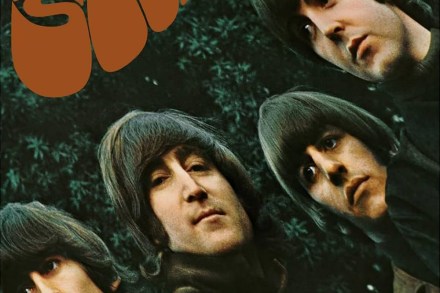
It’s become hard to imagine that there was once a time when the Beatles were more or less just another 1960s group. For most of the 1970s and 1980s, the Fabs were neither overly fêted nor weirdly fetishised. Writer and filmmaker Grant McPhee recently posted a fascinating Substack detailing how sidelined they became in Liverpool during this period. McPhee recounts Roger Eagle, co-owner of the pivotal punk club Eric’s, expressly telling young musicians such as Ian McCulloch not to listen to them. Reverence was thin on the ground. Sgt. Pepper’s Lonely Hearts Club Band and Revolver had not yet been dully canonised as the Best Albums Ever Made; the Red and Blue compilations, released in 1973, were about as much Beatles as most people really needed.

Status Quo are a much better band than people think

Some years ago a concert promoter called Alan Day explained to me how he had revived the touring fortunes of sundry long-in-the-tooth acts. He had explained to them, gently, that they were no longer rock’n’roll bands playing to rock’n’roll audiences in rock’n’roll clubs. The people who were coming to see them, he pointed out, were the same age as them, and probably didn’t want to spend a long evening on their feet, being cramped and jostled. Try theatres instead, he suggested. Nice seats, nice toilets, everyone happy. Once he started booking these bands into theatres only, fans started flocking back. He took Marillion from scuzzy rock rooms like the Forum in Kentish Town to two nights at the Albert Hall.

A rough and exhilarating ride with Bill Callahan

It’s as difficult to pin down exactly what Bill Callahan does as it is to explain what makes it so compelling. Now 60, Callahan has been releasing music since the early 1990s, first as Smog and more recently under his own name, which has been variously categorised as indie-folk, lo-fi, alt-country and Americana. Really, he’s just an idiosyncratic singer-songwriter with a deeply cool voice and an unusual way around a song. That voice is Lou Reed by way of Death Valley. A wobbly conversational baritone, by turns comedic, moving and unsettling, it’s the perfect vehicle for his series of unreliable narrators. Callahan writes like Randy Newman exiled to a dude ranch, his lyrics a potent mix of soul clichés – ‘Gabriel, come blow your horn!’; ‘Yes, I am your lover man!

Ian McCulloch’s still got it

No one ever joined a rock band because they didn’t want to be recognised. Being adored matters to stars, sometimes too much, but that only makes those who love them care even more. That could be heard in the cries of ‘We love you, Mac!’ at a glorious night in Regent’s Park. Echo & The Bunnymen’s singer Ian McCulloch – who was once famous for pronouncing on how much better his band was than any other – has not had an easy time of it in recent years. Unlike his peers in the Cure and U2, he’s not playing to 50,000 people at a time, though his band were regarded as every bit their equals – perhaps their betters – in the early 1980s.

Farewell to Saint Etienne

There are many ways for an established act or artist to call it a day. Some implode mid-tour in a fireball of drugs, ego and flying guitars. Others drift quietly out of sight unannounced. Some take their cue from those annoying people at parties who bid everyone a fulsome farewell and then just keep coming back. Most, as we know, don’t manage to say goodbye at all. As ardent scholars of pop history, Sarah Cracknell, Pete Wiggs and Bob Stanley are more aware than most of all the pitfalls and indignities involved. They have duly planned Saint Etienne’s exit from the scene with obvious care and attention. Like those annoyingly reasonable couples who throw divorce parties, the trio have pitched their retirement as a celebration. This is conscious dethroupling, indie-pop style.

What a great band Geese are

It’s a measure of Geese’s rise – their flight? – that, on Thursday night, the social media accounts of End of the Road were receiving requests for refunds from ticket-holders stuck in traffic somewhere near Shaftesbury who feared missing the first-night headliner. For many the four-day event would have been rendered meaningless without a glimpse of the New York quartet. For those who didn’t make it, well, you missed a treat. I entered a Geese-sceptic. I really enjoyed their first album from 2018, but they had become a completely different band in the intervening years. Their debut had been a charming, youthful indie-pop record made by actual kids in their mid-teens.

Billy Strings’s extraordinary and exhilarating new album

It’s easy to get the wrong idea about bluegrass – to imagine that this flinty shard of American traditional music is baked centuries deep into the soil of Appalachia. In fact it developed in the 1940s, pioneered by Kentucky maestro Bill Monroe, and only truly flourished during the American folk revival of the 1960s. Bluegrass was one of the few places where the hippies and good ol’ boys found communion; the Grateful Dead’s Jerry Garcia was a devotee. The style has evolved, generation upon generation, via exponents such as Lester Flatt, Earl Scruggs and Del McCoury. The latest bluegrass star is William Lee Apostol, aka Billy Strings, a 33-year-old guitarist, singer and songwriter from Michigan, whose backstory reads like some grisly American gothic melodrama.

Festivals are destroying London’s great parks

You could have been forgiven for mistaking Hackney for the site of an El Alamein reunion the other Sunday. Victoria Park was cloaked in a cloud of dust. Tens of thousands of feet had scrubbed the grass clear during All Points East festival and were pounding the scorched earth. People were covering as much of their faces as they could with masks, pulled right up to their eyes, sunglasses blocking the remaining skin. I saw a couple of enterprising chaps wearing pilot’s goggles – and given the state of my eyes as I tried to move around the site, I don’t blame them. The Californian band Deftones were headlining the park as part of an event called Outbreak, in turn part of a multi-weekend series of events under the All Points East banner.

When did the Cure become universally beloved?

My, how other so-called legacy acts must envy the Cure. There are plenty of bands of 40 or 50 years standing where the original fanbase brings along their offspring to concerts– but very few where so many tribes seem to gather so willingly under their own steam. From post-punk survivors to domesticated millennials, Gen Xers and Zeders, pop kids, neo-goths and sundry alternative types, the Cure seem to say something specific and urgent to each constituency. Perhaps it’s something about their songs speaking to the child in the adult, and the adult in the child. In any case, there we all were, on the outskirts of Edinburgh, on a warm summer Sunday, rising and falling to the music as the planes came and went at the airport next door.

The joy of Toto’s ‘Africa’

There comes a point in most bands’ lives at which their appeal has become too selective for them to sell out the venues they feel befit their status. The stadium band slips down to the arenas, the arena band to theatres, the theatre band to clubs. If you depend on the roar of thousands of people for validation, that creates some problems: if a power chord is played in an arena, and no one is there to hear it, does it even exist? The answer is the package tour. Pull together two or three bands (both these shows had a third, complimentary act on the bill) and sell tickets to different fan bases.

A joyous opening to Edinburgh

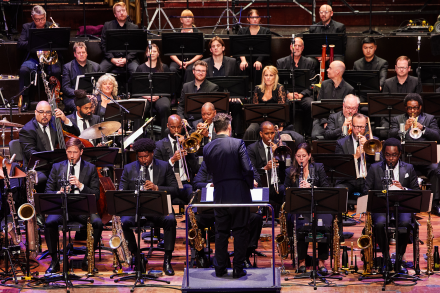
The title of the opening concert of the Edinburgh International Festival is also the thesis statement for this year’s entire EIF programme. All Rise is intended to be a celebration of integration, pluralism and collective acceptance, ‘togetherness and ascendance’, at a time when such notions could hardly be less in vogue. It takes a big work to live up to the billing. Jazz trumpeter Wynton Marsalis’s 12-part symphony, which premièred in New York in 1999, certainly doesn’t lack scale or ambition. For this mammoth hybrid composition for jazz ensemble, symphony orchestra and choir, Marsalis and his Jazz At Lincoln Center Orchestra were joined at the Usher Hall by the Royal Scottish National Orchestra, the Edinburgh Festival Chorus and the Jason Max Ferdinand Singers.

The court music of the ruling class

It would be difficult to do certain shows in the courtyard of Somerset House. One can’t really host anything too confrontational in a Georgian quadrangle: the clash of surroundings and sound would be too jarring. So instead the annual Summer Series tends to gravitate towards the feelgood or the inspiring, which is perfectly fine. However, if you go to more than one of the shows, it can feel as though you are watching some variant of the same performance. Flaming Lips and Black Country, New Road are very different bands at a surface level. The former – a psychedelic band formed in the early 1980s in Oklahoma City who, somehow, after nearly 20 years, catapulted to success at the end of the 1990s – come from outside the pop industry.

Is this really the best Charli XCX can do?

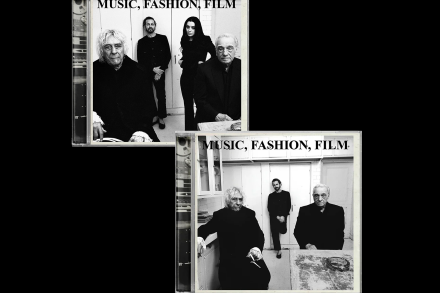
Of the three creative pursuits that give Charli XCX’s eighth album its title, the English pop star seems least interested in the first. She admits as much on ‘Camera’, the best song on Music, Fashion, Film, which makes clear her obsession with acting and a desire to pursue it more fully. ‘Do I want to make music?’ she asks herself. ‘Am I being fucking stupid if I try to be a girl on the screen and I’m turning 34?’ Even without this clue – which, like much of the album, is presented via the singer throwing out rhetorical spiel more or less unexpurgated – it is no great stretch to surmise that the pursuit of making music is struggling to fully hold her attention.

Wet Leg have become a proper rock band

Everyone uses the word ‘indie’ to describe a style of music. And Pulp and Wet Leg are two bands that fit squarely into that rubric. But remember what the word originally meant. An abbreviation of independent, ‘indie’ was music recorded, manufactured and distributed outside the major label system. It began as an economic necessity: the only way the music that the majors were not interested in could reach a public. But it quickly became a belief system: DIY at all costs to avoid the corruption of filthy lucre. And eventually it came to mean a certain kind of music. Pulp’s show was part of a weekend of events at the Southbank Centre celebrating the 50th anniversary of Rough Trade, the label that began as a record shop.

Confessions II gets thrillingly close to vintage Madonna

There comes a point in the career of any established artist when looking backwards seems to be the only possible way to move forwards. Madonna was a great pop star until she wasn’t. Confessions on a Dance Floor, released in 2005, was her last really successful record; ‘Hung Up’, from that album, her last truly unforgettable single. Ever since she has been chasing musical trends with increasingly diminishing returns, the heavy-handed concepts and contrived personae – Madame X, anyone? – no longer supported by anything approaching a properly decent song. Ms Ciccone seems to have belatedly remembered that Madonna is, and always has been, the concept So Confessions II is an act of both commercial and creative necessity. Its reclamation of the past is twofold.

The slipperiness of Harry Styles

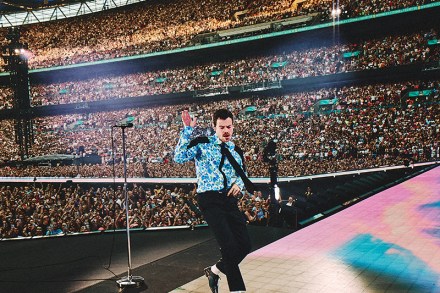
For the first time at a gig, I spent much of Harry Styles’s show thinking about the maths. He’s cunningly doing his 68 shows in seven cities, with 12 of them at Wembley Stadium, which means he has transferred a significant amount of the costs of touring to the fans. In other ways fans are rewarded. As is common when stars play stadiums, Styles spent little time on the main stage. Instead he peddled his wares from a series of walkways – around 350 yards of them, apparently – stretching way out into the crowd, along which he remained in near-constant movement. That meant an awful lot of people got to be at the barrier. At an estimate there were maybe 20,000 people who got within a few feet of Styles. That’s as many people as fit in the whole O2. Clever.

It’s impossible not to be impressed by Metallica

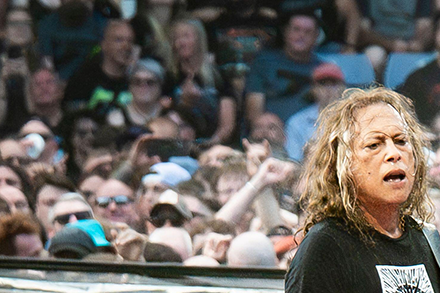
The intensely ritualised choreography of the standard summer stadium show has one inbuilt structural issue, which is especially obvious when occurring this far north – and it is the fact that it takes place mostly during the hours of daylight. This is of perhaps minor significance for a breezy pop concert, when the powder-puff skies align more closely to the music. When it’s Metallica, however, and the first two songs in the set are called ‘Creeping Death’ and ‘For Whom the Bell Tolls’, the lack of an appropriately lowering mise-en-scène threatens to suck much of the (melo)drama from proceedings. In the event, on a warm Thursday night in Glasgow, it’s fair to say that Metallica managed to circumnavigate this natural handicap.