Food

Returning to what makes us happy: Brasserie Zedel reviewed

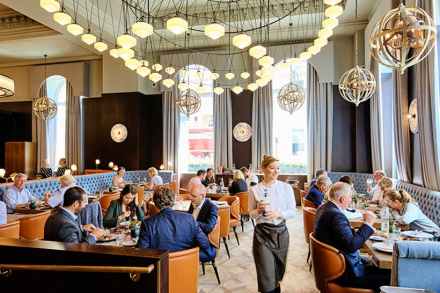
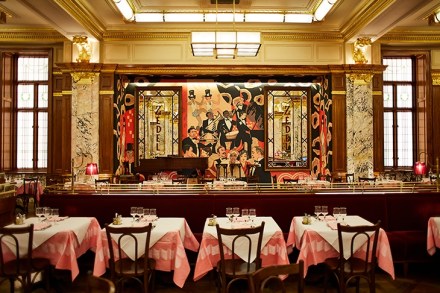
Brasserie Zédel is a grand salon under Piccadilly Circus and the only place I desired when lockdown (or lock-in) ceased and I was allowed to visit London. It is, for me — and everyone is different in their yearnings — everything a restaurant should be: very beautiful; well run (by Corbin & King of the Wolseley and the Delaunay); not insultingly priced; and, as it is windowless, pleasingly unreal: an enchanted basement, if you will — a depository for dreams. I arrive early on the first night, walking through silent London, resisting the urge to lie down in the road. This used to be the Regent Palace Hotel, the grand hotel of Soho. The restaurant was its dining room: Edwardiana at its most gilded and absurd.
Can a chef teach me to cook over Zoom?

We cannot bear more drive-through or take-out or near-fatal snack. I am convinced of the boredom of my female ancestors, which is another truth pandemic threw out, and eventually all gags run out to dust. I am happy to leave my review of Penzance McDonald’s where it belongs, which is unwritten. Food is love after all; or it should be. So I email Ollie Dabbous, formerly of Dabbous, now of Michelin-starred Hide and the most gifted chef working in Britain today. His food looks exquisite but — and this is unusual — it tastes better than it looks. He says he will give me a cooking lesson on Zoom from the kitchens at Hide. He sends over menus.

More drug than nutrient: KFC drive-through reviewed

Drive-through restaurants were invented so Americans could spend more time in their cars. I don’t blame them. American cars are wonderful if you like cars with fins; so, in theory, is fast food, which is more accurately called fast death, even if they did not know that in 1947. There is a contradiction to the drive-through method of collecting food, a puzzle: if you drive, you have time to wait. But such things are not designed to be sensible. I wonder what other services could be made drive-through: lawyers and podiatrists, but my preference is for libraries and, possibly, sex. These restaurants have thrived in pandemic, which again contradicts the Twitter craze for slow food and banana bread, which I think is a media invention, like the PM.

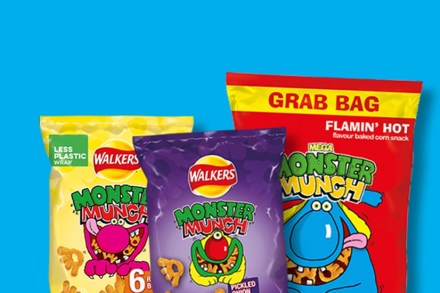
Repulsive, depraved and oddly political: Monster Munch crisps reviewed

Now that I have considered Monster Munch I decide to eat one mindfully. I put it in my mouth, and it is as if I can taste it for the first time. It is repulsive, and I feel cheated. This is, then, an intervention. My husband wrote in these pages that I am always watching Spooks and eating Monster Munch. It was a giggle that went on for 400 words but is eating Monster Munch really so depraved? Doesn’t Jay Rayner eat Skips in the darkness when he is alone? Didn’t A.A. Gill eat Frazzles? I know I do, but only when I am depressed — which is quite often these days — and then I wish I hadn’t. I could say I eat Monster Munch for the metaphor. I will do almost anything for metaphor I could say I do it for the metaphor.

The horror of socially distanced restaurants

What does a critic do when her genre collapses? Mostly I panic. I speak to restaurateurs who believe that without government help into 2022, many British restaurants will close. Most restaurants rent their premises; even if landlords defer collection, the debt will be unpayable. Most restaurants operate on slender margins; they cannot secure finance even in happy times. It is a scandal that the government has excluded monies from the service charge ‘tronc fund’ from the 80 per cent calculations in the Job Retention Scheme, even though it has received National Insurance contributions on it for years, and many restaurant staff are getting only 40 per cent of their earnings. Restaurants predict a summer slaughter. What will survive?

Hope in a takeaway bag: Mackerel Sky reviewed

You don’t dine in the age of pandemic: you scuttle about in the wreckage. If you can afford food, and you aren’t afraid of your neighbours, who don’t understand the government strategy and believe that if they stay indoors for eight years they will survive, and so should you, you can eat out; or rather you can collect takeaway in the comforting dusk. It is not because I want the food. My husband, with whom I re-enact Sunset Boulevard in lockdown, each taking it in turns to be crazy Norma or Max the butler, is a superb cook. It is that I want local restaurants to survive. It is my version of painting a rainbow in a window and calling it political activism, which it isn’t. It is praying with crayons.

Fare game: life as The Spectator’s restaurant critic

A fictional Spectator restaurant critic called Forbes McAllister appeared on Knowing Me, Knowing You with Alan Partridge. He was played by Patrick Marber and was obviously based on Keith Waterhouse — bow tie, mad eyes — even if Waterhouse was never the restaurant critic at this magazine. McAllister was on TV to show off Lord Byron’s duelling pistols ‘and a lock of his stupid hair’. He bought them to annoy Michael Winner, then restaurant critic at the Sunday Times. ‘Are you entirely motivated by hatred?’ Partridge asked McAllister. It was his best ever question. ‘Yes, I think I am,’ said McAllister. ‘Rather perceptive of you. I hate you.’ Partridge then shot McAllister with a duelling pistol, and he died.

Much of it is pointless, but that only adds to its charm: Fortnum & Mason hampers reviewed

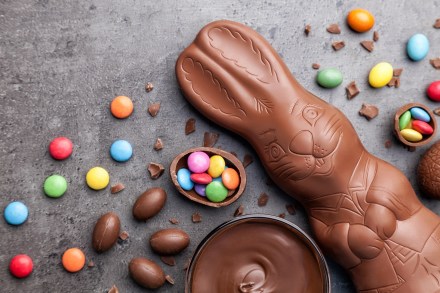
Stop the clocks: Fortnum & Mason is still delivering hampers. I am not surprised, because this shop — or rather this myth disguised as a shop — sold condiments to the Empire, and it wouldn’t let a global pandemic thwart the consumption of those condiments. It was among the earliest fans of globalisation, which is now something I have to explain to my son. He doesn’t understand globalisation, although he knows some dogs come from abroad. He does understand a Fortnum & Mason hamper though; he knows it is a consolation, although he wouldn’t call it that. As soon as the lockdown began, I ordered an Easter basket and an Easter egg.

Dining in the time of pandemic: takeaways reviewed

I love eating while watching bad films like Battleship, so I love takeaway food from local restaurants. I am not rich enough to like the idea of takeaway from Simpson’s in the Strand and a plastic lid does not have the drama of a silver-plated dome. But eating takeaway food while watching Battleship is not my job, or at least it wasn’t until now, in the era of pandemic. The fine restaurants shuttered swiftly but the local restaurants offered takeaway, and I supported them. It is not indolence to order takeaway in the time of pandemic and, if you don’t, when this is over there will only be either Simpson’s in the Strand or KFC and Domino’s Pizza, and that is not a world anyone would wish to live in.

A tax on intellectuals: Terrace Cafe at the British Library reviewed

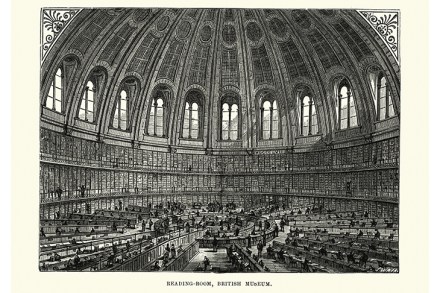
The British Library is the national library of the United Kingdom, and it sits like a red-brick crab on the Euston Road, on the site of an old goods yard between St Pancras and Euston. The older British Museum Library, whose collection was founded on the books of George III, Sir Hans Soane, Robert Harley and Sir Robert Cotton, was in the British Museum, but that gorgeous reading room is now a glass atrium with overpriced cafés and shops selling historical tat for children: cultural vandalism, then, and incitement to migraine. Instead we have the red-brick crab. It was opened by the Queen in 1998 and it is Grade I-listed, so, unless there is a war, we are stuck with it. Perhaps architects don’t read books. When I look at this library, I wonder if they have eyes.

I have always liked angry food: Ugly Butterfly reviewed

Ugly Butterfly is a zero-waste restaurant and champagne bar on the King’s Road, Chelsea. The ‘champagne bar’ addition is so awful as to be pantomime villainous — I think of zero-waste diamonds and zero-waste wars — but perhaps they need this kind of duplicity to seduce the punters, who move so slowly towards wisdom? ‘Zero-waste’ isn’t an advertising catchphrase designed for Chelsea and its constituent tractors and immaculate blondes, unless they are very drunk. It is from Adam Handling, who has six venues, including the Frog in Hoxton and the sustainable deli Bean & Wheat in Old Street. Ugly Butterfly is pretty, because anything ugly in Chelsea would shrivel through lack of identification.

Criminally good food: The Yard at Great Scotland Yard reviewed

The Yard is a defiantly themed restaurant in Hyatt’s new Great Scotland Yard Hotel, an Edwardian red-brick block which once housed the Central Detective Unit of the Metropolitan Police and its constituent darkness. You have to work hard to dispel that kind of horror, and Hyatt tries: the hotel is extraordinarily lush and over-styled, even for these mad days. The lobby, for instance, features a chair that is half rhinoceros but, in dreaming up the rhinoceros chair, Hyatt has invented a piece of furniture only a rhinoceros could appreciate or reach. The sofa opposite has three sequential cushions, which when placed together create a picture of a dachshund, and I can’t imagine anything more pointless.

The food is almost too superb: Wild Honey reviewed

Wild Honey is a ludicrous name for this restaurant: there is nothing wild about it, and I do not think that is even its intention. Rather, it is a cloistered, almost sombre restaurant in the grandest part of the West End, almost opposite the Athenaeum Club, whose goddess, I fancy, is weeping metal tears. I depend on old maps of London. They offer perspective and consolation, and I know this part was once marshland from the River Tyburn on its way from Hampstead to Westminster. Now it is Pall Mall and Wild Honey lives in one of its palest, grandest buildings: it glows like a slightly restrained Versailles, signifying power and brickwork. It was once home to the royal printers, a bank, and what became, in its pomp, Aviva insurance.

Fairy food for fairy wives: Julie’s Restaurant reviewed

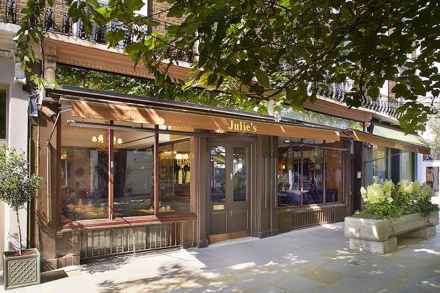
Julie’s is a 50-year-old restaurant in Holland Park, London, newly emerged from three years of closure as plushly renovated as its customers. The website calls it ‘a Holland Park favourite, neighbourhood classic and hangout for the Hollywood set, high society and rock stars since 1969’. Whenever I hear the words ‘high society’ I reach for my water pistol, as Hermann Goring didn’t say, but I do remember a birthday party at Julie’s 20 years ago when it seemed pleasingly decadent. It was designed by the owner, Julie Hodgess, the designer of the Biba boutique. I remember a series of deeply coloured rooms and dusty curtains and a faint and thrilling sense of mystery.

This food needs a little less grandeur, and a little more love: Simpson’s in the Strand reviewed

Simpson’s in the Strand stopped serving breakfast in 2017, after it had been renovated to stop it smelling of cabbage. Fat men wept, but worse things have happened here. Simpson’s is built on the site of John of Gaunt’s Savoy Palace, in which Geoffrey Chaucer, Gaunt’s brother-in-law, wrote part of The Canterbury Tales. The palace was destroyed during the Peasants’ Revolt of 1381; it is all detailed in Anya Seton’s romance novel Katherine. Of the palace’s successor, Henry VII’s Savoy Hospital, only a small chapel remains. It looks deeply oppressed. Instead we have the Savoy hotel, created by Richard D’Oyly Carte.

Sumptuous, remote – and forgettable: Locket’s reviewed

Locket’s is a new café from the owners of Wiltons in Jermyn Street. Wiltons is the restaurant that dukes visit when they have fallen out with White’s. It has a sign featuring a lobster that looks like Benjamin Disraeli wearing a top hat. When a bomb fell nearby in 1942, its anxious owner immediately sold it to the banker Olaf Hambro, who was sitting at the bar, by adding the price of the restaurant to his bill. It appeared, thinly disguised, in Jeffrey Archer’s First Among Equals as Walton’s, in which a fictional Tory minister plots the seduction of a woman called Amanda. I like Wiltons, even if the female staff are dressed as Edwardian housemaids, which is the second worst uniform in existence after hessian smocks.

Nauseating, but I like the garlic bread: Legoland Windsor reviewed

The theme music to Legoland in Berkshire is the theme music to The Exorcist. It appears from speakers hidden in the grass. I hear it as I wander out of some un-enchanted wood filled with Lego: we have lost our ancient woods and need new ones. These ones smell slightly of drains. The Exorcist music is a joke for parents; or perhaps an acknowledgment that there is something demonic at Legoland. You can, from the fake hills — everything is fake here, and that is both bewitching and awful — see Windsor Castle, which probably means that from Windsor Castle you can see Legoland. I wonder if Legoland will outlive the monarchy; if Legoland and the monarchy have a lot in common.

Back in the Babington Triangle: Roth Bar & Grill reviewed

The Roth Bar & Grill exists on an art-farm called Durslade in Bruton, Somerset, which is also the country outpost of the Hauser & Wirth gallery, which is the silliest art gallery in Britain. It specialises in decapitated gnomes. It is only 13 miles from Babington House, Soho House’s monstrous country house with its playrooms for adults and giant fish-finger sandwiches. This is a world of electric Agas, black Range Rovers and pink wellington boots; and it is, almost by itself, the reason why country dwellers despise town dwellers. If people live in homage to what they read in Sunday newspaper supplements, they deserve to be despised. When I visited it three years ago, it was both abuzz and the silliest restaurant I had ever seen.

Stringfellows for the sex robot age: Bob Bob Cité reviewed

Bob Bob Cité is a restaurant dangling like testicles from the underside of the Leadenhall Building in the City of London. It is shaped like a series of yellow train carriages, for a voyage no one will ever make; the building above it manages, in the way of the age, to be both absurd and frightening. People call the Leadenhall Building the cheese--grater, but it does not make me think of kitchens. Kitchens are human and intimate; from the atrium, which is guarded by security men, this building looks like the innards of something vast and inhuman. This is the sequel to Bob Bob Ricard, a Soho restaurant for rich men with anxiety disorders, hollow legs, and nervous thumbs.

An enemy of the people? Or an above-average sandwich chain? Pret A Manger reviewed

The sandwich restaurant Pret A Manger is accused of harbouring centrists. Those are words I never thought I would type, but these are mad days. A Corbyn supporter called Aaron Bastani, the author of a book called Fully Automated Luxury Communism — or, as wags call it, Luxury Space Robot Communism — has accused Rory Stewart of being unfit to be mayor of London because he likes Pret A Manger. It is, in Bastani’s mind, a sandwich-themed agent of evil, indicating a deeper evil which may or may not have something to do with wizards. I did not know that Pret A Manger’s smoked salmon sandwiches (they are quite good, but I am a bourgeoise, so what do I know?) and mediocre coffee could be so perilous to civilisation, but I can safely be ignored.