Columns

Why Labour’s tax attacks on the Tories are working

This week tens of millions of workers will receive their pay slips for the month of January and with them a tax cut. National Insurance is going down, so take-home pay is rising. Polls show that voters think Labour is more likely to cut tax than the Tories, a surprise weapon for Starmer The NI tax cut is meant to signal a ‘gear shift’ – as the Prime Minister told this magazine last month – when it comes to taxation. Rishi Sunak and Jeremy Hunt have hinted that more cuts may follow in the spring Budget. Will voters be grateful? In the past, the governing party has benefitted from pre-election tax cuts. Ahead of the Tories’ surprise victory in 1992, Norman Lamont introduced a 20p income tax rate.
Starmer has got the culture war all wrong

I’ve decided that I would like President Trump to win the next American presidential election, solely because it will disappoint Hugo Rifkind. I realise that such a statement could only possibly come from a shallow, petty-minded individual and that what should concern all of us is the, uh, stewardship of the free world. But there will be plenty of columnists suffused with gravitas and import to argue those odds one way or the other, leaving me to plough my own rancorous and spiteful furrow. Hugo wrote a very Rifkindy piece for the Times about whether it was necessary, or otherwise, to report the US elections in an honest, truthful and unbiased manner, seeing as Donald Trump was ghastly. He spent 950 or so words justifying not doing so and then, in the final ten, sort of changed his mind.

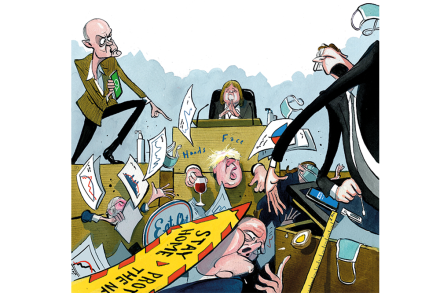
The one question the Covid Inquiry must ask

The Covid Inquiry grinds on. The process is ‘too focused on office tittle-tattle’ says one former minister in my newspaper this morning. Possibly – though it may also be that the warped focus consists in the media reports filtering out the worthier but more boring stuff. The inquiry (say others) is too focused on the speed or otherwise with which Britain locked down, rather than whether we should ever have locked down as we did in the first place. Others too complain that the inquisition is overly focused on ‘gotcha’ headlines when better results would flow from a sober review that accepted that everyone was doing their best. There’s truth in each of these complaints but I don’t think they get to the heart of it. I have a different view.

The long-overdue banning of Hizb ut-Tahrir

Well, better late than never, I suppose. This week the Home Secretary James Cleverly announced that the government has finally decided to ban the Islamic extremist group Hizb ut-Tahrir. For some readers this may sound like a familiar story. In the aftermath of the 7 July 2005 terror attacks in London, the then prime minister Tony Blair declared that ‘the rules of the game are changing’. One of his most ardent promises was that he would ban Hizb ut-Tahrir, a group which was already banned in many Islamic countries that might be said to have a wiser attitude towards the extremists in their midst than we do. It is hard to convey to anyone in a position of power in the UK just how weak our police have made us look But Blair’s promise faded away.

The West must stop playing Mr Nice Guy

Iwas intrigued to learn from our Defence Secretary, Grant Shapps, that we are now in a ‘pre-war’ phase and that there is an almost inevitability of eventual conflict with one or two of the world’s superpowers. I read his comments on the same day that the German newspaper Das Bild reported that Russia was planning to invade western Europe within 18 months. This is all very worrying, not least because Grant Shapps is our Defence Secretary. I don’t think I’d trust Grant to provide military back-up for a whelk stall, but then I suspect that his likely successor, John Healey, will be no more effective. The problem both men have is the problem which afflicts the West – we are incapable of being properly aggressive and can only really manage passive aggression.

Regicide is in the air for the Tories

An election year, a tired government accused of being in power too long, and a bickering party. This was the backdrop to the coup against Gordon Brown in 2010 when Geoff Hoon – the defence secretary under Tony Blair – and his fellow ex-minister Patricia Hewitt called for a secret ballot. The coup was a miserable failure and became an example of how not to do it. Hoon conceded in less than 24 hours that they had failed and it was ‘over’. What went wrong? At the time it was attributed to a combination of bad timing, half-hearted plotters and the failure of the most credible candidate (David Miliband) to come forward.

The US opioid crisis has come to Britain

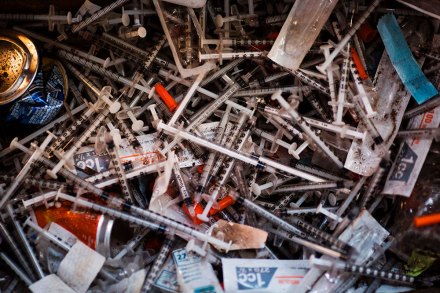
‘Never do drugs, you’ll be hooked instantly,’ my mother used to say, and though I nodded, I never even considered paying attention. So I don’t expect my young cousins or my godchildren or my pill-popping friends to take a blind bit of notice when I tell them the same, but I mean it: don’t do drugs. It’s not worth it. Not any more. One of the reasons not to do drugs back in the day was: ‘You never know what you’re taking.’ The trouble now is not so much that you don’t know, but that you do. The way things are going, pretty soon most street drugs will be made of the same synthetic Chinese-made poison, and it’s lethal. Look online at the videos of zombie-addicts in San Francisco twitching and lolling in the streets, and look at the stats.

Why aren’t the super-rich braver?

A lot of people dream of having what is known as ‘screw you’ money. In my observation, this is not simply in order to be able to live in a castle or own Ferraris or Van Dycks, or whatever is your wont. It is in order to be able to say those fine, demotic words to whomever you like. It should be noted that most people dream of saying the words to someone who is perceived to be above them: someone to whom they might once have been subservient in some way. A boss, for instance. Yet one of the strangest things about the mega-rich is that they do not actually say ‘screw you’ when they ought to.

Sunak’s caution could cost him the election

On the first day back after Christmas, Tory MPs were invited for welcome drinks in the Prime Minister’s parliamentary office. Rishi Sunak – a teetotaller – was not there. Instead, his Chief Whip hosted. Simon Hart told those present that drinks would be held fortnightly since ‘we are one big family, not a series of families’. He was referring to Mark Francois’s eyebrow-raising claim last month that groups of MPs (New Conservatives, the European Research Group, etc.) were the ‘five families’ of a Tory mafia. The Rwanda Bill will return to the Commons next week, so there will be plenty of opportunity for blood feuds to resurface. But despite his gag, Hart didn’t spend much time trying to rally the party around the common aim of stopping the boats.

My wish for Ed Davey

Has Ed Davey resigned yet? Being a man of great decency and honour, I assume he has, leaving the party to be led by Velma from Scooby-Doo. If he hasn’t yet resigned – and from his statements at time of writing it doesn’t look as if he has that intention – then I hope he is hounded on every step of the electoral trail this year by furious postmasters and mistresses. May they ambush every photo op, like a tribe of incandescent hobbits. Yes, there were at least ten other government ministers, from all three major parties, who should feel some sense of culpability, but Davey’s tenure as Post Office minister came at a fairly crucial time in the proceedings, between 2010 and 2012.

Britain must commit to Ukraine – or admit we don’t care enough

I have never been one of those late-middle-aged right-wing men who, at night, hunkers down over the computer to pleasure himself while staring at photographs of Vladimir Putin. He doesn’t do it for me – not even that picture of him riding a horse semi-naked through a river with a very resolute expression on his stern Asiatic face. This may put me in a minority among people of my age and gender, for I understand that Vlad has legions of admirers among my peers. It is an admiration which tends to speak its name only after a few drinks have been taken and stems largely from Putin’s commendable detestation of what the West, especially the USA and UK, has become.

Algeria has proved a revelation

‘Please accept coffee without payment. You are visitors.’ So said the manager of the retro-chic little Café Auber in downtown Algiers, where we’d paused on a stroll down to the harbour after Christmas. We’d considered the city just a stop on our way into the Sahara. Instead it proved a revelation. Were you to arrive at Algiers on one of the regular overnight ferries from Marseille, you would be greeted by a waterfront of magnificent, ornate, turn-of-the-19th-centurymansion blocks: Parisian-style, cream and white, embroidered with palm trees.

Hell hath no fury like the left scorned

Over a leg of lamb, I joined five other expat Americans for Christmas. Our topic du jour was which faction in our homeland we were most afraid of. Revisiting that boisterous conversation appeals, because in this re-enactment, I’m the only one who gets to talk. With forbidding rapidity, one armchair assertion has gone from audacious augury to trite truism: that whichever party wins the presidency, a substantial proportion of the losers will not accept the result as legitimate. Imagine, then, that it is Wednesday 6 November 2024, and a presidential victor has been declared. Whose indignation would pose the greater threat to American civic order – the left’s or the right’s?

Why I’m considering a life of crime

Some people may have noticed the happy new guidance released between Christmas and New Year by the National Police Chief’s Council. This guidance to police in England and Wales was that police officers ought to try to go to properties that have been burgled. Even better, they should try to do so within an hour of the burglary being reported. This seems to me to be an eminently sensible piece of advice. After all, if you get to the scene of a robbery within an hour, you might be able to track down the stolen goods, log evidence while the crime scene is fresh, or even – imagine – find a burglar. You might wonder why this guidance needed to be given in the first case. After all, there are more than 1,000 break-ins every day in this country.

In search of a second epiphany

When I go home to America next week for Christmas, I’ll go to church – the one my family and I used to attend every Sunday, a few towns over. I visit intermittently throughout the year when I’m back home, but I always go on Christmas Eve. The routine is the same: I sit quietly in the pews, sing along to the carols, and hope to have a second epiphany.   I had my first epiphany – that God exists – when I was a child. This, I’m sure, is the result of having two religious parents who raised me in the church. When I tell my British friends that I was brought up a Methodist, they tend to flash me a nervous look. I must assume that going to a Methodist church in the UK means something different than it does in liberal Connecticut.

Brace yourselves for the Great American Election Freak-Out of 2024

‘If Trump wasn’t running,’ said Joe Biden last week, ‘I’m not sure I’d be running.’ That’s a curiously uninspiring remark for an American leader seeking re-election to make. Yet ever since 2019, Biden’s pitch for the presidency has been essentially negative: if you don’t support me, you’ll get him. The trouble for Joe is that, as we approach the start of another election year, it’s beginning to look as if he can’t stop Trump. Brace yourselves, then, for the Great Election Freak-Out of 2024. For Democrats, the numbers are alarming. Biden’s job-approval rating has just dipped below 40 per cent again; in December 2019, at the same stage in his presidency, Trump was on 43 per cent.

Good riddance to neoliberalism

I listened to a fascinating debate on the BBC’s The World This Weekend about the ideological origins of that thing, populism. The agreeably thuggish Javier Milei had just taken the reins of Argentina and, perhaps a little late in the day, the TW2 (as it is known in BBC circles) production team had noticed that almost every election held anywhere these days – except perhaps Australia and here – tends to result in a win for a party which is either overtly populist, as in Argentina, or is called populist by its opponents and the BBC. What the hell is going on, they wondered, only ten years too late. Who did they choose to ‘debate’ the issue? Prince Harry and Wolf from Gladiators? The suave game-show presenter Ben Shephard and Herbie the Skateboarding Duck?

The unfashionable truth about motherhood

At The Spectator’s Parliamentarian of the Year awards, ‘Speech of the year’ went to Theo Clarke MP for her account to the House of Commons of the birth trauma which almost killed her. Credit to her, of course, for confronting her pain. But childbirth and early motherhood has always been traumatic and difficult. What has changed is that it is now deeply unfashionable to say anything too enthusiastic about motherhood. Discussions have shifted from the apple-pie good to the nappy-bin bad or even the fourth-degree-tear ugly. In national newspapers, women write about losing their identity after having children. The staggering cost of childcare is well-documented, as are fears about babies being bad for the planet.