Ancient and modern

Friends – or foes?

As the breeze of popular opinion — popularis aura — blows sweetly over the much-loved Corbyn-McDonnell Old Labour tribute act, the Tory party is faced with a dilemma: how to counteract it. This dilemma seems to centre on Mrs May’s leadership, and if that is the case, those ambitious to displace her need to consider what leadership entails. The word for ambition in ancient Greek was philotimia, ‘love of high esteem in the eyes of others’. This was considered a virtue in a society in which competition was endemic and winning meant everything. The problem was the tension between the desire to win and the desire to be liked at the same time: vaulting ambition which o’erleapt itself could soon turn into naked aggression, which won no friends.
A matter of life and death | 7 September 2017

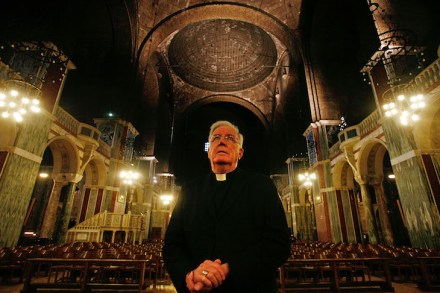
Before he died, the former Archbishop of Westminster, Cardinal Cormac Murphy-O’Connor, reassured his diocese that he was ‘at peace and [has] no fear of what is to come’. But surely, as a sinner facing a god of judgment, he should have been terrified out of his wits? In ancient literature, it was only cowards or second-raters who were terrified of death. Philosophers had no qualms. As Socrates (5th C bc) said: ‘To fear death is to think oneself wise when one is not; for it is to think one knows what one does not know.

Reading Latin doesn’t require a trigger warning

Last week, Brendan O’Neill described in this magazine how students regulate ‘unacceptable’ political views with ‘no platform’ policies, safe spaces and trigger warnings. Two weeks ago a student Latin course (Reading Latin, P. Jones and K. Sidwell) was ‘outed’ by an American PhD student, because the text featured three goddesses, each confidently stripping off, determined to win the golden apple from Paris, and two rapes. Such ‘offensive’ choices, she said, did not help the cause of Latin, ‘or make the historically racist and classist discipline of classics any more accessible’. Both rapes featured in a foundation myth of early Roman history.

The big business of teaching

As expected, the prospect of charging £9,000 (and rising) per annum, per student has universities abandoning any pretence to maintaining standards in favour of piling ’em high. Ancient ‘universities’ knew all about it. Ancient education was private. A city might pay a ‘lecturer’ a small retainer, but he made his money through the fees he charged. But since all lecturers taught the same thing — rhetoric, with a view to a career in politics and law — each was in a constant, often literal, battle to attract students and stop them defecting. We hear of lecturers urging their students to waylay ‘freshers’ as they arrived in port and drag them to their classes. Libanius (c.

Trump and his empire

All the news emerging from the White House seems to suggest that the USA is in that state so beloved by journalists — ‘total chaos’. But is the White House the USA? One could ask the same of the relationship between the Roman Empire and the emperor during much of the third century AD. Between 235 and 285 AD, the Roman Empire, under severe assault from Germanic tribes and the Persian Empire, was wracked by civil strife. In that period, at least 51 men, legitimately or not, were hailed as ‘emperor’. Some of these lasted a matter of days, some months, and the longest 15 years. But if the empire creaked, it did not fall apart; and the period from Diocletian (emperor 284–305) to Constantine (d. 337) saw the whole structure restabilised.

Beauty and the beasts | 3 August 2017

Doctors have analysed how the mucus of a certain type of slug gives it protection against its being levered off a surface. From this, they have developed a new water-based gel for surgical repairs and wound healing. Aristotle would have been punching the air, had he not been too busy inventing logic, literary critical theory and almost everything else — in this case, biology. In the introduction to his On the Parts of Animals, Aristotle (384-322 bc) contrasted the study of the heavens, which the ancients regarded as imperishable and eternal, with that of the earth. The former, he said, however scanty the evidence, gave most pleasure, in the same way that just half a glimpse of the person you loved was more delightful than a complete overview of anything else.

Health and personal choice

Public health specialist Sir Michael Marmot has blamed ‘the cuts’ for the rise in dementia among the elderly, resulting in a decline in the rising rate of life expectancy. But parroting ‘the cuts’ does nothing to treat the cause. If Sir Michael wants to tackle that problem, the ancients can tell him how. It has to do with lifestyle. Ancient medicine, like ancient Gaul, was divided into three parts: drugs, surgery and lifestyle. This last part permeated every aspect of life. Food and exercise were taken to be the most important, but sleep, sex, bathing, massage, mental activity, and so on — even clothing — could all come into the equation.

Death and childhood

Charlie Gard is incurably brain-damaged, blind, deaf, cannot cry, and cannot move or breathe without help. At the request of his parents, he has been kept alive in hope of a minimal improvement. Ancients did not feel about babies as we do. About one in three died within a month, and about half by the age of five. Putting disabled babies out to die was probably common. There are about 55,000 inscriptions on tombstones referring to ages at death, yet only a handful relate to those under six months. Few ancient authors describe babies behaving like babies; indeed, Latin had no specific word for ‘baby’. Cicero remarked that nature granted life on the same terms as one accepted a loan, and nature would call that loan in whenever it felt like it.

Property’s not theft

Sir Trevor Nunn is directing a play called ‘Dessert’. It seems to be a virtue-signalling riff on the evil of possessions. Doubtless Cicero and Aratus will not feature. On the face of it, the Roman statesman Cicero (1st c bc) was a passionate upholder of property rights. He said ‘it is the proper function of the state and its citizens to ensure for everyone the free and undisturbed guardianship of their possessions’. But that did not mean ownership of property overrode the state’s central purpose and therefore duty — the maintenance of social cohesion and so social harmony, that concordia to which Cicero returned again and again.

Age need not weary them

Prime Minister May is aged 60, the Labour cult-personality Jeremy Corbyn 68, and putative Lib-Dem leader Sir Vince Cable 74. All too old? The biographer and philosopher Plutarch (2nd century ad) wrote an essay entitled ‘Whether the Older Man Should Serve in Government’, and came to the view that he should — on certain conditions. First, he said, there was no greater honour (and therefore, to an ancient Greek, no greater reward) than serving both the community and the state in a legal and democratic government. If one had been doing that all one’s life, it was disgraceful to abandon it, allowing one’s hard-earned standing to wither away in favour of household affairs, money-making and self-indulgence.

Prince Harry’s sense of duty

Asked about the monarchy, Prince Harry said his aim was to ‘modernise’ it. Not that any royal wanted to be king or queen, he said, but they would ‘carry out [their] duties at the right time. We are not doing this for ourselves but for the greater good of the people.’ It sounds as if he thinks he is doing us a favour. The question of one’s communal obligations was first raised in the West in Homer’s Iliad (8th century bc). In a dangerous assault on the Greek camp, King Sarpedon, an ally of the Trojans from Lycia (S.E. Turkey), explained to his cousin Glaucus the reason for risking their lives in this way. He began by asking the crucial question: why in Lycia were they looked up to as gods, and given the best of everything?

Corbyn’s youth vote

Whether the youth vote had any serious impact on the result of the general election or not, Jeremy Corbyn knew how to exploit it in a way both Plato and Aristotle would have understood. In his Republic, Plato argued that democracy resulted in rulers behaving like subjects and subjects like rulers, with teachers pandering to the young, and the young in turn despising them. As a result, youths make ‘every conversation or action into a trial of strength with their elders’, while their elders ‘patronise them, exuding bonhomie and a sense of fun, and imitate them, because they do not want to appear disagreeable or despotic’: Corbyn rapping with assorted ‘grime artists’ to a T.

The post-truth is out there

In a political ‘post-truth’ world, currently the subject of a slew of books, emotions and personal belief are said to shape opinion more than ‘objective’ fact. But as Aristotle pointed out in his Art of Rhetoric (4th century bc), there are facts only about the present and past; about the future, politics’ main concern, there are only interests and aspirations.

The Nero in Trump

Donald Trump, whose word no one can believe and actions no one can anticipate, looks to blame anyone but himself for the chaos of his administration. The result is an inability to attract staff and a deep paranoia among those already in White House trying to work under him. But how to withdraw from serving such a man without recriminations? Seneca, the philosopher and adviser to Nero, took the view that entering politics was honourable as long as there was no good reason not to, and suggested that no state could be so bad that a man could not serve it at some level or other. But when the Trump in Nero emerged, no one had the remotest idea what he would do next or whether what he said was true or false.

Power and the middle class

The Labour party’s tagline for the forthcoming general election is: ‘For the many, not the few.’ Aristotle, who understood this as ‘For the poor, not the rich’, thought this a recipe for conflict and proposed a solution of which Mrs May would approve. Suspicious of monarchy, Aristotle favoured two styles of constitution: oligarchy and democracy. The problem was that both systems ran the risk of creating an inherently unstable state. In a democracy, the poor would be in control by sheer weight of numbers; in an oligarchy, the rich would gain control (presumably) by sheer weight of influence.

Corbyn vs Socrates

Jeremy Corbyn said: ‘It is the job of leadership to hold open the space for dissent, new thinking and fit-for-purpose policy… I have always believed in standing firm and in empowering others to make up their minds and come on board when they are ready.’ This is a rum definition of leadership. But then his parliamentary experience of it was nil. According to the essayist Xenophon, Socrates once crossed paths with one Euthydemus who, having read lots of books by poets and intellectuals, considered himself to be the cleverest young man of his generation and therefore fully prepared to take the lead in developing policy in the people’s Assembly.

The cult of the prima doctor

Ian Paterson, a ‘charming’ breast surgeon with a ‘God complex’, has been found guilty of intentionally wounding patients by carrying out ‘extensive, life-changing operations for no medically justifiable reason’, probably to enrich himself. It raises a long-standing question. The brilliant Greek doctor Galen (129-216 ad) was the most famous doctor in the Roman Empire. In all, he may have written c. 500 medical treatises, of which more than 120 (c. three million words) survive. His influence on medical practice was to last into the 17th century.

Friends, Romans and Russians

President Vladimir Putin, who still supports Bashar al-Assad in Syria, needs help if he wishes to be seen as a member of the civilised world. Rome might provide it. From 509 bc Rome had been a republic, controlled by a senate, consuls and people’s assemblies, all (it was argued) balancing each other out. During that period Rome mastered all Italy, defeated the powerful state of Carthage, and brought much of North Africa, France (Gaul), Spain, Greece and the Levant under its control. It did so not primarily because it was an aggressive, warlike state: so was every other state it faced in that dog-eats-dog ancient Mediterranean world. For all its triumphs, Rome suffered 90 military defeats in that time; the Celts (390 bc) and Hannibal (218-202 bc) nearly brought it to its knees.

Cicero, the lagomaniac

A year ago, the Danes reached into their groaning cracker barrel and pulled out ‘hygge’ as their own solution to the world’s problems. That was bad enough, but now it is the Swedes’ turn, offering up ‘lagom’ as the shrine before which all must now grovel in untimely worship. Yet what are both of these but replays of two hoary classical injunctions? ‘Hygge’ ultimately stems from the philosopher Epicurus (d. 271 bc): ‘He who needs tomorrow least will approach it with the most pleasure.’ In his take on the subject, the poet Horace (d. 8 bc) urged Leuconoe to ‘trust as little as possible in tomorrow’ and instead carpe diem, usually translated ‘seize the day’.

Osborne and the Athenians

As a result of George Osborne taking up five jobs on top of his role as MP for Tatton, an ethics watchdog wants to know what the public thinks about MPs having other jobs. One problem is that people’s low opinion of MPs makes balanced judgment difficult. The same was true in the ancient world. There were no ‘parties’ with ‘policies’ in democratic Athens, only ‘speakers’ (the equivalent of our ‘politicians’) at the weekly Assemblies, often holding some office, and attempting to persuade the listening citizens to vote for their solution to whatever problem the Assembly was facing.