Politics

Read about the latest political news, views and analysis

Full text: Putin on Wagner coup

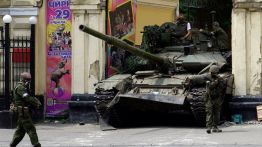
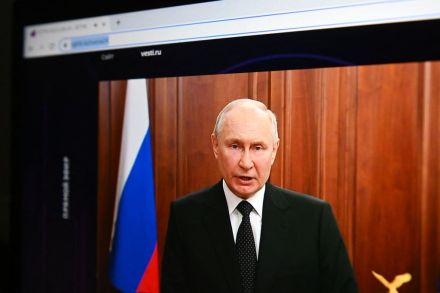
Vladimir Putin has just released a speech to Russians after the Wagner mercenary group took over Russian military headquarters in the south of the country in what is described by the Kremlin as an attempted coup. Full text below. ‘We are fighting for the life and security of our people, for our sovereignty and independence, for the right to be and remain Russian: a state with a 1,000-year history. This battle, when the fate of our people is being decided, requires the cohesion of all forces: unity, consolidation and responsibility. We must throw aside everything that weakens us, any strife that our external enemies can and will use to undermine
Japan’s dark history of forced sterilisation

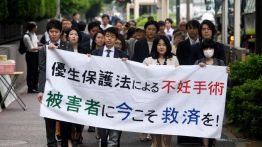
A Japanese government report has revealed that over a 50-year period, under a policy of forced sterilisation, 16,500 people were operated on without their consent. The youngest, a boy and a girl, were just nine. Another 8,000 apparently gave their consent, though under what sort of pressure is unclear. A further 60,000 women had abortions due to hereditary illnesses. This was all done under a eugenics law enacted in 1948 and not repealed until the 1990s. Victims of the policy, often young girls spirited away to clinics for mysterious operations they didn’t understand, have been campaigning for compensation for decades. Last year a court awarded damages of 27million yen (£150,000)

Prigozhin leaves Rostov

Yevgeny Prigozhin, the leader of the Wagner mercenary group, has left Rostov-on-Don and ended the armed insurrection against Vladimir Putin. After one of the most extraordinary days in Russian history, he said he marched within 125 miles of Moscow but said he decided to go no further to avoid bloodshed. Putin, who had ordered his army to crush Prigozhin and imprison his men, has agreed to drop all charges. After a Belarus-brokered peace deal, Prigozhin will self-exile in Minsk, according to the Kremlin. Footage emerged showing him being bid farewell by cheering crowds in Rostov and winding down his window to greet them. A few hours earlier, he released the

Could the election herald the rise of the small party?

These are heady times for Britain’s smaller political parties. Seldom has there been as much interest from voters in breaking away from the stale embrace of the entity known to many as the ‘LibLabCon’. On the left, the Greens keep growing – though their addiction to identity politics in general and the militant trans movement in particular puts a ceiling on their potential progress. In the muscular centre, there is a revival of the SDP making steady progress. The party, which these day is stoutly pro-Brexit and leans to the left on economics and the right on culture, won a second seat on Leeds City Council from Labour in May.

Russia’s nuclear blackmail

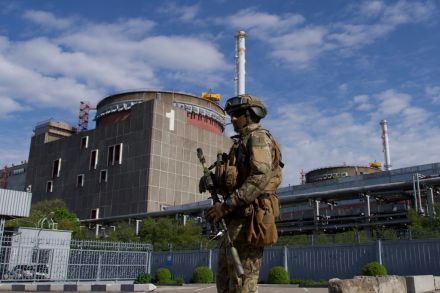
‘Dear Ukrainians! And all people of the world: everyone! I emphasise this,’ Volodymyr Zelensky said in a televised speech yesterday. Russia, he said, is planning a ‘terrorist attack’ using radiation leakage at the Zaporizhzhia nuclear power plant – Europe’s largest. Ukrainian intelligence repeatedly warned that Russian forces have sown mines in the plant, as it appears that they did with the Nova-Kakhovka dam. Ukrainians are gripped by an unsettling sense of déjà vu, fearing that the nuclear plant, which is under Russian control, will inevitably suffer the same fate. The Zaporizhzhia plant has been under Russian control since last March and has served as a safe facility for weapons and ammunition storage.

The SNP needs a clean break from Sturgeon if it wants to survive

The SNP meets in Dundee this weekend for a special conference on independence. Four months since Nicola Sturgeon resigned as leader and three months since Humza Yousaf narrowly became leader and the police investigation into party finances began, it’s fair to say that the party is in a confused state. The mood is febrile. Some think that normalcy will return; others that the independence project can triumph in the near-future by some miracle fix. Many cling to the wreckage of Sturgeon, while a few still yearn for the return of the emperor over the water Alex Salmond. What is missing is an honest assessment and understanding of where the SNP is, the deep hole it occupies (much of

Do Brits regret Brexit?

11 min listen

Today is the seven years’ anniversary of the Brexit referendum, and new polls find that a majority of Brits would prefer a closer relationship with the EU, or rejoining the European Union altogether. Can Labour capitalise on this? Cindy Yu talks to James Heale and Fraser Nelson. Produced by Cindy Yu.

How Winnie Ewing transformed Scottish politics

Icon. Legend. Pioneer. None of the descriptions we have heard since the news of her passing are fitting for Winnie Ewing. She was an iconic figure in Scottish nationalism, to be sure – her victory in the 1967 Hamilton by-election heralding a new political consciousness north of the border. She did take on a legendary quality, not least after she was dubbed ‘Madame Ecosse’ and became a symbol for an outward-looking Scottish Europeanism. She was a pioneer, the first female SNP MP at a time when both her party and parliament were the domain of men.  Yet Ewing’s foremost contributions were not symbolic but tangible and practical. In five decades

France shouldn’t lecture anyone

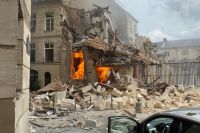
Numerous heads of state from the third world are in Paris for a summit hosted by President Macron. The aim of the conference – or the Summit for a New Global Financing Pact to give it its full lofty name – is to ‘address the needs of developing countries in the fight against poverty.’ Is France, or indeed the rest of the West, in a position to dish out advice to developing nations?   The days of Europe being able to lecture developing countries about efficiency, integrity and prosperity are long gone. It was bleakly ironic that on the eve of the summit Paris was rocked by a huge gas

Scotland’s newest pro-indy media outlet launches

You might have thought that the National had successfully cornered the fiction market among SNP devotees. But now Mr S has discovered the existence of another pro-independence media outlet keen to shake up Scotland’s media landscape. ‘Skotia’ claims it will divert from the ‘obsessive hysteria of Scotland’s political class’ by making ‘life difficult for the architects of Scotland’s political consensus’ and maintaining a ‘constant vigilance on those who sow hate and inhumanity’. Noble stuff. Its launch video features the outlet’s new editor, Coll McCail, an earnest redhead, who proclaims: While the British state looks out for its own, the Scottish establishment is too comfortable. It’s too cosy with the people and institutions

Listen: Lib Dem by-election candidate’s car crash interview

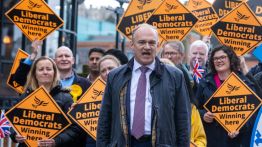
David Warburton surprised nobody in Westminster by standing down on Saturday, fourteen months after losing the Tory whip. For more than a year it’s been clear that a by-election was looming in Somerton and Frome. Yet you wouldn’t know it judging from the quality of the local Lib Dem candidate there, Sarah Dyke. She has given a car crash interview to the Guardian politics podcast – hardly the most challenging of outlets. Asked by the amiable John Harris about deprivation in the area she replied that she had drunk her coffee a bit too fast, before asking: What do you want to know? Something that’s a subject I don’t know

Shock as interest rates hiked to 5 per cent

11 min listen

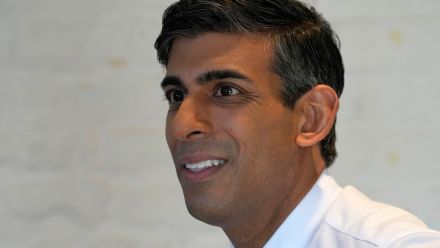
James Heale speaks to Isabel Hardman and Kate Andrews as the Bank of England announced it has hiked interest rates to 5 per cent. Faced with inflation, a looming mortgage crisis and personal debt, Rishi Sunak said today he is ‘100 per cent on it’. But can he turn things around? Produced by Natasha Feroze. 

Home truths: the crushing reality of the mortgage crisis

38 min listen

This week: First up: for the cover piece, The Spectator’s economics editor Kate Andrews has written about Britain’s mortgage timebomb, as the UK faces the sharpest interest rate hike since the 80s. In the year leading up to the general election, can the Conservatives come back from this? Kate joins us along with Liam Halligan, economics editor of GB News, Telegraph columnist and author of Home Truths – the UK’s chronic housing shortage.  Next: Spectator journalist Toby Young has written about ‘furries’ – children identifying as animals at school. He joins us now, along with Miriam Cates MP who sits on the education select committee. (17:11) Finally: in the arts leader this week, Robert Jackman

Gary Neville’s Saudi hypocrisy

Oh dear. Gary Neville is at it again.The left-wing right-back has waded into the latest trend in British football: superannuated superstars ending their playing days in Saudi Arabia. Neville – a man who has never met a camera he didn’t like – is calling on the Premier League to stop the transfer of players to the oil rich nation until ‘it is certain the integrity of its competition is not being put at risk’. Saudi Arabis’s Public Investment Fund (PIF), which owns Newcastle United, declared in June that it was taking over four leading clubs in the country, including Al-Nassr, who signed Cristiano Ronaldo in December. Questions have been asked

Shock as interest rates hiked to 5 per cent

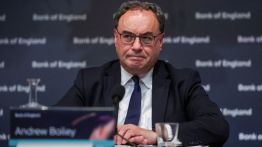
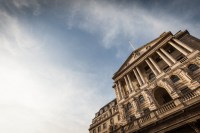
The Monetary Policy Committee has voted seven to two to take interest rates to 5 per cent, a 0.5 point increase. Its thirteenth rise in a row takes rates to their highest level in 15 years, and is being described as a ‘shock’ increase, brought in as a response to the rise in core inflation on the year in May, which has hit 7.1 per cent. The horror of inflation is that it gobbles up your income and your savings After this week’s dire inflation update, the question wasn’t whether the Monetary Policy Committee would raise interest rates, but by how much. After last week’s labour market update, which saw nominal wages

Joe Biden is wrong to roll out the red carpet for Narendra Modi

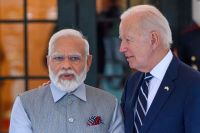
On taking office, Joe Biden promised a new approach to foreign policy based on prioritising democratic values and human rights. The US president spoke of ‘the battle between democracy and autocracy’ as the defining struggle of the time, effectively dividing the world into two clear and opposing camps. Now Biden is having to eat his own words by playing host to Narendra Modi, the prime minister of India. It would be a stretch to describe Modi as a standard bearer for human rights or Western democratic values.  Even so, Modi is being given the red carpet treatment in Washington, including the honour of making an address to a joint session

Is Labour bluffing on Lords reform?

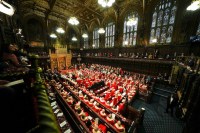
Is Labour really going to reform the House of Lords? The party has ended up in a bit of a pickle over abolishing a chamber that it also wants to stuff with its own peers. The party’s spokesman yesterday told journalists that there was still a plan to create a Labour majority in the Lords because it was ‘essential’ for the party to be able to get its business through the Upper Chamber. The party’s leader in the Lords, Angela Smith, also told Times Radio that ‘there are 90 more Conservatives than Labour. The priority for Keir will be ensuring he gets the Labour programme through.’ It isn’t mutually exclusive

What Avi Shlaim gets wrong about the persecution of Jews in Iraq

In his Spectator review of Avi Shlaim’s memoir Three Worlds, Justin Marozzi refers to the author’s claims about the 1950-51 terrorist bombings of Jewish targets in Baghdad: ‘Shlaim’s bombshell is to uncover what he terms “undeniable proof of Zionist involvement in the terrorist attacks”, which helped terminate the millennial presence of Jews in Babylon’. Marozzi calls these claims ‘controversial’ but he doesn’t delve into just how controversial. The charge is that Zionists attacked Iraqi Jews in order to encourage them to flee to Israel.  There are several problems with this theory. As the investigative journalist David Collier has argued, ‘these explosions did not cause the exodus…the Iraqi Jews were persecuted, were offered a window to leave, and despite the fact they had to