Politics

Read about the latest political news, views and analysis

Steve Baker’s warning for No. 10 points to the next Tory battle

As government ministers avoid putting a date on an easing of restrictions, let alone an end to them, scientific advisers have stepped in to fill the silence. Deputy Chief Medical Officer Jonathan Van-Tam has suggested the lockdown could remain in place well into spring while Professor Neil Ferguson – who briefly stood down from his role last year for breaking lockdown rules – has suggested measures could be in place until the autumn. This, however, is not going down well with the Tory MPs who make up the lockdown-sceptic Covid Recovery Group. As the Sun reports, Steve Baker has issued a rallying call to his fellow members over the situation.

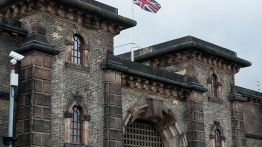
Jabs for jailbirds: why prisoners should skip the vaccine queue

Labour MP Zarah Sultana has caused a bit of a stir by proposing that prisoners be allowed to skip the queue for the Covid-19 vaccine. She’s even been Steerpiked, a rite of passage for any aspiring 'Loony Left' Labour MP. If anything, her compassion for lags marks a welcome development in someone who six years ago was pledging to celebrate the deaths of Tony Blair and Benjamin Netanyahu.  Sultana asked vaccines minister Nadhim Zahawi at the science and technology select committee yesterday whether the government had considered ‘prioritising vaccinating detainees as well as those who work in prisons’.  Despite the backlash to Sultana's suggestion, the problem is that there’s evidence to back up her argument.

Fisheries minister was too busy at nativity to read Brexit bill

Oh dear. There are some things in life it's probably best not to admit. Government minister Victoria Prentis found that out the hard way yesterday, when she confessed to a Lords select committee that she hadn’t bothered to read the era-defining Brexit deal which was agreed with the European Union in December. Among other things, the deal concerned the rights of European fishermen to access the UK’s waters. So it was not exactly ideal that Prentis hadn’t found time to read the text, considering she is the, err, fisheries minister. Asked by the committee if her jaw had dropped when the deal was released on Christmas Eve, Prentis explained that ‘No, the agreement came when we were all very busy on Christmas Eve, in my case organising the local nativity trail.

Tories should start taking Starmer’s new Labour seriously

The shadow chancellor Anneliese Dodds's speech last night has received little attention. But it would be a big mistake for the Tories to ignore what Dodds had to say on the new direction she hopes to steer the Labour party in. Don't laugh, but in years to come, last night could be seen as a significant turning point for Keir Starmer's party. For a start, the lecture was entirely free of sanctimony, which in and of itself marks a huge break with recent Labour history. Gone were blank attacks on 'austerity' or weepy complaints about the Tories being heartless; instead, Dodds put forward a case for why a social democratic approach to the economy would work in clear, clinical terms.

A tighter lockdown risks being a less effective one

When lockdown was first proposed in March, one of the many arguments against it was that people would tolerate being deprived of their liberty only for a few weeks. The idea of criminalising basic community behaviour — welcoming a guest into your home, educating children, going to church to pray — was viewed as an extreme measure with a short shelf-life. One of the big surprises of the pandemic is to see that lockdowns, in fact, are popular in large quarters. People have complied for far longer than was ever envisaged. But it’s a careful balance — and examples of overzealous policing risk upsetting that balance. It does not help that the rules change regularly, with even government ministers saying (in private) that they have given up trying to keep track of them.

Mandelson’s story could have been so very different

Matt Forde, the stand-up comedian and presenter of his regular Political Party Podcast, has hit on an overlooked technique for getting the most out of big-name interviewees. He pretends to know nothing. Wide-eyed and star-struck (actually he is neither), Forde puts them at their ease in conversation with an apparent fanboy ingénue. ‘Do keep up, Matt,’ said Peter Mandelson, affectionately, as in his Christmas holiday interview Forde claimed to be unaware of some half-forgotten political turbulence that Lord Mandelson, his star interviewee, once encountered. It worked a treat. Lord Mandelson is normally a wary interviewee, but with Forde I have never heard him so unguarded: more confessional even than in his own autobiography. I listened partly out of curiosity.

We’re starting to see a new foreign policy for Brexit Britain

What will Brexit Britain do differently? This is going to be the most important question in our politics for the next decade. If the answer is that nothing much will change, it would be hard to argue that the disruption of the past four and a half years has been worth it. But if Brexit means the country becomes quicker at adapting to changing circumstances, then the electorate’s decision in 2016 will have been vindicated. The quick decision to remove VAT from tampons and sanitary towels is a small, early sign of how Brexit enables parliament to respond more directly to public pressure. The decision not to join the EU’s vaccine procurement programme let us move faster with immunisation: the UK has currently vaccinated more people than France, Italy and Germany put together.

The dos and don’ts of the inauguration outfit

Given recent events on the inauguration scaffolding, Jill Biden may do well to wear a bullet-proof vest to watch her husband become the 46th President of the United States and be done with it. But Inauguration Day calls for some serious sartorial politicking and it seems unlikely Dr B will want to miss out. Long before Michelle sashayed her way to the 2013 ceremony in that Thom Browne coat, Thomas Carlyle spoke of the power of clothes in his 1834 Sartor Resartus: “Society is founded upon cloth” he said simply, and most women in the world would agree with him.

Donald Trump is impeached again – what now?

Tonight Donald Trump became the first president in the history of the United States to be impeached twice. He was first impeached in 2019, accused of pressuring the President of Ukraine to provide information on his political challenger Joe Biden. This evening, Trump was impeached again on the grounds of 'incitement of an insurrection' last Wednesday, when his address at a rally led to a violent mob storming the Capitol building to try to stop Biden's formal confirmation as president.  While the vote in the House of Representatives was mostly split along party lines, ten Republicans broke from the party to support Trump's impeachment, including Rep. Liz Cheney — the third-highest ranking Republican in the House.

Can Labour win back trust on the economy?

What's the Labour party's biggest weakness at the ballot box? After the last election, Brexit and Corbyn were credited by Tory MPs with helping them win the biggest Conservative majority since Margaret Thatcher. But now the UK is out of the EU and Keir Starmer in charge, there's an argument that it's now the economy that is their biggest weakness.  A YouGov poll over the summer found that while Starmer's personal approval ratings are promising, only 19 per cent of voters believe that Labour to be best at handling the economy, compared with 37 per cent who say the Tories are. Given that six in ten voters view the economy as their biggest priority, that's not an encouraging sign for Labour.

What we learnt from the PM’s Liaison Committee hearing

Boris Johnson has previously enjoyed Liaison Committee hearings rather too much, trying to get through the long session with select committee chairs using humour and optimism. Both were in rather short supply on Wednesday, as you might expect given the UK's current predicament in the pandemic. The Prime Minister covered a lot of ground, and not just when it came to coronavirus. On the pandemic, he warned that the 'risk is very substantial' that hospital intensive care capacity is 'overtopped'. He also said that the government did not know whether the vaccines stop transmission of the virus as well as reduce the severity for each person, or indeed whether the South African and Brazilian variants of the virus were vaccine resistant.

Starmer is yet to learn the art of PMQs

Where to begin? That was one of most absorbing PMQs of recent times. Three top moments: the Speaker rebuked the PM for improper language. The Labour leader was humiliated by one of his own backbenchers. And Ian Blackford asked a good question. That’s right. It finally happened. The SNP leader in the House of Commons — the great windbag of the Western Isles — made history by raising a sensible point. The Scottish shellfish industry, he said, has been shafted by Brexit. The problem? Red-tape. Last Monday a hapless trawlerman had to watch while his £40,000 haul turned rotten on the dockside as a posse of EU form-fiddlers fretted over their paperwork. Scottish lobstermen now prefer to steam across the North Sea and land their pink crustaceans in Denmark.

Alan Rusbridger’s curious Russia Today appearance

Alan Rusbridger's book 'News and how to use it' is intended as a guide of 'what to believe in a fake news world'. Which makes the former Guardian editor's appearance on Russia Today (RT) somewhat curious.  RT is the Kremlin's state-controlled TV network. It has a history of downplaying stories that paint Russia in a bad light. It also has a habit of reporting with relish stories that make western countries look bad. In 2019, RT was fined £200,000 by Ofcom after an investigation found that the channel had failed to preserve due impartiality in seven news and current affairs programmes. According to David Remnick, editor of the New Yorker: ‘RT is darkly, nastily brilliant, so much more sophisticated than Soviet propaganda.

No. 10’s approach to new restrictions

Cappuccino lovers beware. As ministers pressure Boris Johnson to consider tightening up the current lockdown, tougher messaging are emerging as the more likely option. Although Keir Starmer used the first Prime Minister's Questions of 2021 to try and get on the front foot arguing that it was clear that tougher restrictions than the ones currently on offer were required — asking why, if the infection rate was higher than in March, the restrictions to tackle it were looser – Johnson responded by going on the attack. He replied that if Starmer had had his way the country would have been in a 12 month continuous lockdown. Johnson said that he would not — and had not — ruled out tighter rules.

Watch: Lindsay Hoyle ticks off Boris Johnson

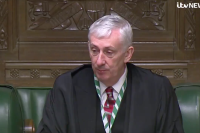
A feisty exchange took place at Prime Minister’s Questions today, on the subject of free school meals, after widely-shared images showed children being provided with substandard food packages. Keir Starmer went on the attack, and suggested that the meagre meals were in line with the government’s current guidance. But it was Boris Johnson who provoked the ire of the Speaker Lindsay Hoyle, after the PM suggested that Starmer’s stance on the matter was hypocritical. The remark led to the visibly angry Speaker giving Johnson a dressing down, with Hoyle calling on the PM to withdraw the remark. Watch here: https://twitter.com/itvnews/status/1349332819374432256?

Watch: Labour MP pushes for prisoners to skip the vaccine queue

Who should get the vaccine first? Those most likely to die from Covid, you would have thought. Luckily the Corbynite twenty-something Zarah Sultana was on hand to question such ill thought out assumptions.  During a science and technology select committee hearing earlier this morning, the Coventry South MP quizzed the vaccines minister Nadhim Zahawi over the government's decision to prioritise the old and infirm. Instead, the government, according to the socialist MP, should consider doing the 'humane' thing by prioritising 'disenfranchised' prisoners as it would be 'good for public health'.  Zahawi politely suggested that it was perhaps best to stick to the current plan, vaccinating those most at risk of, you know, dying...

Wanted: a broadcast producer for The Spectator

The Spectator is growing - and hiring. In the last few months we have launched SpectatorTV which sits with our suite of podcasts. With 1.5m downloads and a growing audience for our videos, we're looking to expand. So far all of our videos and podcasts are produced by two people: Cindy Yu and Max Jeffery. We're looking for a third person. You will be working with The Spectator's team of about two dozen journalists in our offices in 22 Old Queen St. We're looking for someone who knows current affairs well enough to suggest interviewees and who can pick out the interesting nuances in a news story that make for good conversation. We're looking for smart, original ideas for social media promotion and other ways of growing our audience.

Hancock’s power trip

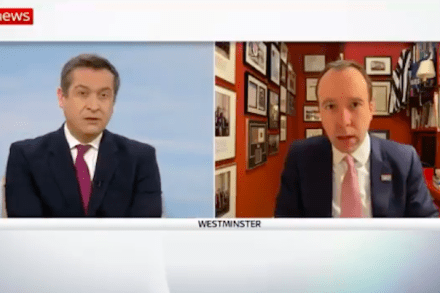
When will the lockdown end? That's a question of increasing concern to Tory MPs with Mark Harper of the Covid Recovery Group pushing for restrictions to be lifted from 8 March – three weeks after the deadline to vaccinate the most vulnerable. However, Mr S would caution against planning any socialising for that week.  In this morning's media round, Matt Hancock did not take kindly to suggestions restrictions could be eased by this point. When Sky News presenter Niall Paterson asked the Health Secretary what the timescale was for lifting restrictions, he replied that he had not given one. When Paterson said that some of Hancock's parliamentary colleagues had, he replied: 'Well great, but I’m the health secretary.