Politics

Read about the latest political news, views and analysis

Gary Neville’s political football

Gary Neville was a fine footballer but he is a confused pundit. He keeps trying to get political when talking about football — and it’s boring. During England’s Euro 2020 semi-final game this summer, he obnoxiously suggested Gareth Southgate, the England manager, had shown more leadership than the Prime Minister. It was an irritating and unnecessary moment of politics in what should have been a moment of celebration. Now, he’s at it again. In an interview with the Times, Neville has been talking about politics: ‘I’d love half an hour across from Boris Johnson at the despatch box. I’d be angry with myself if I didn’t tear him to shreds just on basic principles of behaviour.

Who are the energy companies going bust?

The ongoing energy crisis has now seen seven companies go bust in recent months. On Wednesday, Avro Energy and Green Supplier Limited became the two largest companies to collapse. The industry is seeing high wholesale natural gas prices reach record levels, with firms unable to significantly raise their prices due to the government’s price cap. In the interest of transparency, Steerpike thought he would look at some of these companies in question, amid calls in certain quarters for government-backed bailouts. To begin with, it seems ludicrously easy to become an energy supplier, with a licence from Ofgem costing £450 for electricity and between £350 to £450 for gas.

How Labour wins

Labour can win the next election. The winds that blew apart their electoral coalition in 2019 can change in their favour; Brexit has destroyed old certainties but also made anything possible. The party needs first to analyse honestly what went wrong and then conjure up a new, yet old-fashioned progressivism to fix it. The most popular narrative is that Labour was undone by a mix of Jeremy Corbyn and Brexit: Corbyn was too radical and inept; Brexit drove the patriotic working-class into the arms of BoJo and the populist Right.  At this week’s conference, this story will be endorsed by several factions.

Feted abroad, dismissed at home: will Germans really miss Merkel?

As Angela Merkel finally steps down, the verdict on her leadership – at least from overseas – appears to be unanimous: she is a safe pair of hands who will be greatly missed. Her departure is a big loss for Europe. But is that right? Many Germans, it seems, are much less favourable about Mutti. There have been dissenting voices outside Germany to be sure, arguing that her achievements and historical importance have been exaggerated. Her overseas critics point out that she failed to make the most of the considerable authority she acquired and that her interventions in the European Union only made its divisions worse. The inflexibility of Merkel (or rather the misjudgements of David Cameron) could even be seen as a key reason why Brexit took place.

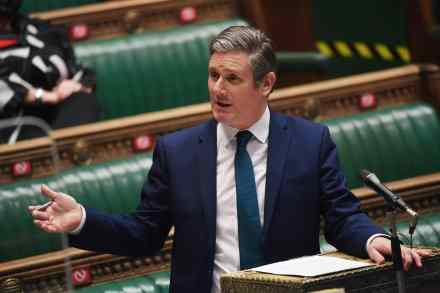
Starmer’s essay is gold dust for Boris

Keir Starmer’s incredible shrinking pamphlet was initially said to run to 14,000 words, then 13,000, then 12,500 and now 11,000 is even being mentioned. As someone who has read it from start to finish, let me assure you that whichever of those word counts is accurate, it’s still much too long. But those who are disparaging the document as useless are nevertheless barking up the wrong tree. In fact, it is a tremendously useful document – but useful to the Conservatives rather than Labour. Because while earnest Sir Keir has failed to come up with anything that will produce the kind of visceral connection with the electorate that could presage political momentum, he has nonetheless telegraphed to the Tories his basic plan of attack.

Starmer is playing a risky game with the Labour left

Keir Starmer is a keen amateur footballer. It’s one of the few facts anyone knows about the Labour leader. He enjoys a game on his spare time, and on the campaign trail too. One person who played with him recently told me: ‘You can tell he plays a lot and takes it very seriously.’ What they couldn’t say was that he was very good at it. Starmer is currently trying to play a political game by changing the rules for Labour’s leadership elections. It’s a big and serious move as it would make it harder for the party to go left when it picks his successor. It is therefore a confrontation with the left that some in his camp see as Starmer’s Kinnock moment (more on this from Katy in this week’s magazine).

Fresh criticism for Rusbridger over Greenslade IRA article

Few journalists have been more celebrated by the liberal elite than Alan Rusbridger. The longtime editor of the Guardian for twenty years, a winner of the Marie Colvin prize for improving British journalism and a former head of an Oxford college: there are few baubles which have eluded his grasp. But now the Roy Greenslade scandal has cast a belated shadow over his former editor’s career. Back in 2014, Greenslade wrote an article in his capacity as the Guardian’s media commentator about Mairia Cahill in which he questioned her motives in going public about her sexual abuse at the hands of an IRA man.

Is Joe Biden OK?

10 min listen

President Biden has spent the week meeting with foreign leaders including Prime Minister Boris Johnson. Now, the number of people starting to speculate about the state Joe Biden’s health is growing. Freddy Gray sits down with Amber Athey, the Washington Editor for The Spectator to discuss where the cracks are beginning to show and what this could mean for Kamala Harris.

Will the energy crisis leave Britons cold?

17 min listen

For this week's Saturday Coffee House Shots, Katy Balls, Fraser Nelson and James Forsyth sit down with John Kemp, senior energy analyst at Reuters to discuss the energy crisis. How long will this continue? How high will prices go? What will the government do in response? And is there a possibility of blackouts during the winter months?

Katy Balls, Nicola Christie, Hannah Tomes

-1 min listen

On this week's episode, Katy Balls gives us her thoughts on the importance of Keir Starmer’s performance this weekend at the Labour Party Conference. (00:54) Then Nicola Christie raises the curtain on the exciting new wave of British musical theatre. (06:53)And finally, Hannah Tomes talks about why Facebook won’t let her post about the English waterway Cockshoot Dyke.

The gas crisis shows how important net zero is

This gas crisis has hit Britain because we rely too much on gas. That’s not a reason to abandon net zero. It’s a reason to do it. Gas prices are soaring, energy companies are failing. A few people are blaming government environmental policies for that. Their apparent hope is that Boris Johnson proves wobbly on green causes and backs away from net zero. I think they’re wrong, both about the policy and about the politics. Start with the policy. The net zero decarbonisation of the UK economy isn’t the cause of the gas price crisis. It’s the solution.

Is Brexit really to blame for fuel-rationing?

All current ills in the world, of course, can be blamed on two things: climate change and Brexit. So far, there are few people blaming the rationing of petrol and diesel on extreme weather-related to climate change (although give it time), but the usual suspects have certainly been quick out of the blocks to blame it all on Brexit. Lord Adonis, for example, has claimed:  'Brexit is now leading to fuel-rationing' BP has blamed its inability to keep petrol stations stocked on a shortage of lorry-drivers, but can that really be blamed on Brexit?  In July, the Road Haulage Association (RHA) published a survey of 615 haulage firms as to what they thought was the cause of the then already-developing driver shortage.

What’s causing the petrol shortage?

11 min listen

First gas, now petrol. The strange thing is there is no actual lack of petrol just a dearth of drivers to bring it to the stations. There are differing thoughts as to the reason for this, some say Brexit, others that this is a wider issue. Katy Balls, Isabel Hardman and James Forsyth discuss this as well as what we can expect from this weekend's Labour conference.

The Bataclan trial is forcing France to confront some difficult questions

It's a stroke of good fortune for France that Salah Abdeslam is a coward. Had he not been he would have died with the other nine members of the Islamist terror cell (one of whom was his brother) when they attacked Paris on the evening of 13 November 2015. Instead of detonating his suicide vest, Abdeslam dumped it in a dustbin and then called a friend in Belgium and asked to be collected. He spent the next four months hiding in a suburb of Brussels before police tracked him down. It's rare for a potential suicide bomber to be taken alive. In most cases all we have to judge them by is a theatrical video message filmed shortly before their death. The capture of Abdeslam therefore has been a boon. The trial is now in its third week and is expected to last until May.

Keir Starmer loses his fizz

Well, the reviews from the critics are in. Keir Starmer's 11,500 word essay dropped late on Wednesday night and two days on it's clear the treatise has not had quite the impact Labour HQ will have wanted. The manifesto – described by The Spectator's own Sam Leith as a 'cliché-ridden disaster' – has caused little excitement among hacks and politicos in SW1, aside from the usual synthetic frothing from the National and Morning Star about Scotland and socialism apparently being excluded. And now the most damning verdict has been delivered by the most discerning critics of all: the readers of The Spectator. At 10 a.m. yesterday we published Keir Starmer's essay in full online.

The Sarah Rainsford Edition

35 min listen

Sarah Rainsford was a BBC foreign correspondent stationed in Moscow for 20 years until August when the Russian Federal Security Service (FSB) declared Rainsford a national security threat. They expelled her from Russia and gave her only three weeks to pack up her things, bring home her husband and their dog. On the podcast, Sarah goes back to her youth to share how she fell into learning Russian and the adventures she got up to as a Cambridge student during her year abroad in St Petersburg during the fall of the Soviet Union.

AOC’s Iron Dome defeat is a win for the United States

Moshe Feiglin is the figurehead of far-right, free-the-weed libertarianism in Israel, a country where this barely makes the top ten weirdest ideological mash-ups. Back in 2013, when he was still a powerful player on the right-wing of the right-wing of the Likud, Feiglin gave an interview to the New American, the magazine of the John Birch Society. He used the opportunity to do something most ambitious Israeli politicians would never dream of doing: he called for an end to US military aid to Israel. Noting America’s unemployment troubles at the time, Feiglin said he was ‘totally against this aid’ because it ‘doesn’t look moral to me’.