How should Biden respond to Putin’s invasion of Ukraine?
24 min listen
Freddy Gray talks to Jacob Heilbrunn, the editor of The National Interest, about Vladimir Putin's military action.
Read about the latest political news, views and analysis
24 min listen
Freddy Gray talks to Jacob Heilbrunn, the editor of The National Interest, about Vladimir Putin's military action.
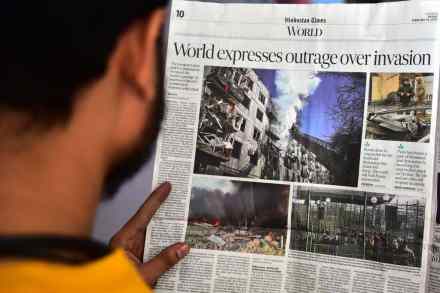
What do Russians make of Putin's invasion of Ukraine? The violence has been condemned around the world, and it seems that thousands of Russians who have taken to the streets on anti-war protests agree that Putin has gone too far. But some Russians continue to support their president, in spite of suggestions from abroad that he has 'lost the plot'. The coverage in the Russian press of the first day of the invasion of Ukraine reflects the mixed feelings about the conflict. Here's how Russian newspapers reacted to war in Ukraine: Izvestiya Izvestiya is one of Russia’s most widely-circulated broadsheet newspapers, with a focus on bringing business news to its readership.
44 min listen
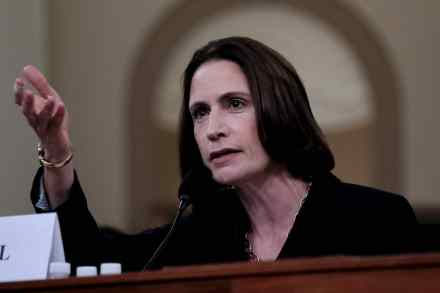
Fiona Hill is the former director for European and Russian Affairs on the United States National Security Council. She has advised presidents Donald Trump, Barack Obama and George Bush. In November 2019, she testified at Trump's first impeachment hearing. On the podcast, she tells Katy about growing up in the North East and moving the America, meeting Vladimir Putin, working in Trump's White House, and why getting a perm was such a bad idea.
Boris Johnson has just outlined a series of further sanctions on Russia. They are considerably more substantial than the ones he announced earlier this week. They exclude Russian banks from the UK financial system, bar Russian firms from raising capital in London and will see the UK join the US’s technology sanctions on Russia. However, Russia will not be cut off from the Swift payments system — it is clear that the UK has, sadly, lost the argument on that for now. This does raise the question of what, if not the unprovoked invasion of a sovereign country, would be enough to lead to Russia being cut off from Swift.
15 min listen
Vladimir Putin's invasion of Ukraine is fundamentally inspired by his determination to preserve the Orthodox identity of Holy Mother Russia, according to the Rev Giles Fraser, writing for UnHerd today. That's not as preposterous a suggestion as you might think, given that the first mass baptisms in the ancient homeland of 'Rus' took place in Kiev – and that the Ukrainian Orthodox Church recently repudiated the authority of the Patriarch of Moscow. But does that mean that Putin's murderous behaviour should be seen in the context of a war of religion? Does the former KGB agent have a religious bone in his body? Is he secretly laughing at those Christian right-wingers who have cast him in the role of defender of Christendom?
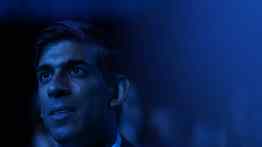
How at home Rishi Sunak looks in the company of academics. The chancellor delivered the 34th Mais Lecture this afternoon at the Bayes Business School in east London. Standing at the lectern in his dapper blue suit, he had the air of a cerebral super-monk bred on figs and yogurt. He’s the first British chancellor to hold an MBA from Stanford and he seemed perfectly at ease in this warm, well-lit room full of brain-boxes with double-firsts in economics. He speaks their jargon fluently. Instead of a ‘job’ he talks about ‘an employment outcome ’. His term for a ‘career’ is ‘a fulfilling professional experience.’ And when he refers to education he says, ‘upskilling’ or ‘support for learning.
35 min listen
In this week’s episode: What does Putin really want for Russia?For this week’s cover story, Niall Ferguson writes about how Putin seems to be trying to recreate the Russia of the Past, while this week's diary by Timothy Garton Ash says the West has misunderstood his intentions, Niall and Timothy join the podcast along with Mary Dejevsky a columnist for the Independent. (00:48)Also this week: Should there be women-only spaces on trains? Jeremy Corbyn suggested it when he was Labour party leader and now Scotland seems to be flirting with the idea. Mary Wakefield says in this week’s Spectator that although she enjoys the idea of lady carriage, it doesn’t make much sense.
15 min listen
Vladimir Putin has launched an attack on multiple fronts across Ukraine. In a televised speech, the Russian leader announced a 'military operation' in Ukraine's Donbas region.Today, Boris Johnson has vowed to hit Russia with a 'massive' package of sanctions. But who will really suffer from these sanctions? And will it be enough to deter stop Putin in his tracks?All to be discussed as Katy Balls speaks to James Forsyth and Owen Matthews, The Spectator's Russia correspondent.
He's probably the most powerful man in journalism you've never heard of, but last night Martin Clarke – the head honcho of Mail Online – handed over the reins at Northcliffe House. The chain-smoking journalist spent 13 years turning the online version of the Daily Mail into a journalistic powerhouse, ruling with an iron fist over a sprawling global tabloid with millions of daily viewers attracted by tales of gossip, celebrity and scandal. Truly, an inspiration to Mr S. Unfortunately Clarke lost out in the recent power-struggle over on High Street Kensington. Geordie Greig, the editor of the Daily Mail, was axed and replaced by Ted Verity, his rival over at the Mail on Sunday.
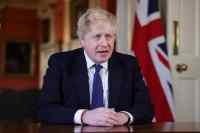
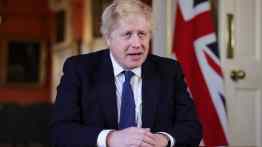
Shortly after 4 o’clock this morning I spoke to President Zelensky of Ukraine to offer the continued support of the UK, because our worst fears have now come true and all our warnings have proved tragically accurate President Putin of Russia has unleashed war in our European continent. He has attacked a friendly country without any provocation and without any credible excuse. Innumerable missiles and bombs have been raining down on an entirely innocent population. A vast invasion is underway — by land, by sea, and by air. And this is not, in the infamous phrase, some faraway country of which we know little. We have Ukrainian friends in this country; neighbours, co-workers.
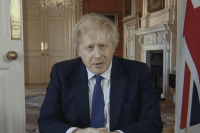
Following Vladimir Putin's decision to launch a full-scale invasion of Ukraine, Boris Johnson has addressed the nation. Speaking from 10 Downing Street, the Prime Minister spoke of his regret that 'our worst fears have now come true' and Russia had 'unleashed war in our European continent'. Johnson said he had spoken with the Ukrainian president to reiterate the UK's ongoing support. A vast invasion is underway — by land, by sea, and by air. And this is not, in the infamous phrase, some faraway country of which we know little. We have Ukrainian friends in this country; neighbours, co-workers: Ukraine is a country that for decades has enjoyed freedom and democracy and the right to choose its own destiny.
The New York Times has it in for Britain. And the latest beneficiaries are the Islamists condemned by a UK government inquiry into the activist takeover of schools. I am the most senior serving Muslim parliamentarian, and have been an MP in Birmingham for over twenty years. The NYT's ‘Trojan Horse Affair’ podcast portrays a city that is unrecognisable to me. It is an act of utter irresponsibility. Hamza Syed and Brian Reed present eight programmes seeking to make the case that a 2014 letter ‘Operation Trojan Horse’ detailing an activist plan to influence local schools, was a hoax. Without proof the letter is genuine, it follows there was no plot, and indeed little or no problem.
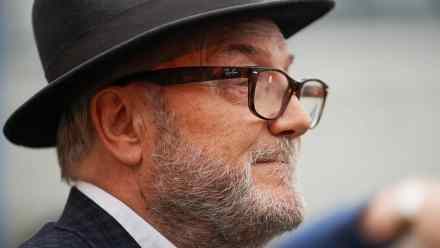
Ah, gorgeous George, the man so often on the right side of history. The rabble-rousing politician, who has had more parties than Boris Johnson, has been at it again in recent weeks, insisting that 'the West provoked this crisis' in Ukraine. Coincidentally, the former Labour MP also hosts a show on Moscow-backed network RT UK – previously better known as Russia Today. Galloway struck a bet earlier this month with a pro-Unionist Twitter account. Under the suggested terms of the deal, if Europe reached July without an invasion, Ukrainian soldiers killed in action or without any Ukrainian territory gained by Russia, the user in question would have to change their profile picture to one of George Galloway and post a public apology.
The nature of the Russian attack on Ukraine, striking across the country and not just concentrating on the territory claimed by the so-called breakaway republics, shows Vladimir Putin’s confidence that he can weather whatever sanctions the West imposes. This is not an assault designed to sit in any kind of grey area, but an unambiguous invasion — which the West has always made clear would bring forth the maximum set of sanctions. This is not an assault designed to sit in any kind of grey area Putin’s confidence is driven by two things. First, as I say in the magazine this week, Russia has been preparing to face expanded sanctions since the annexation of Crimea in 2014.
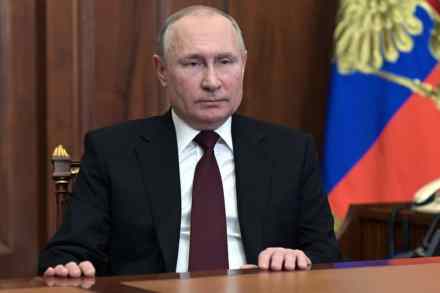
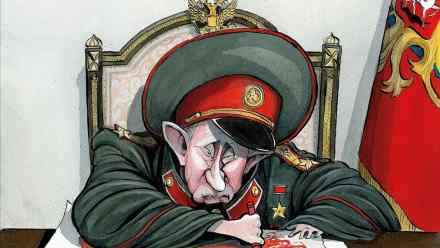
Sitting alone at the end of an absurdly long table or marooned behind a vast desk in a palatial hall, Vladimir Putin’s idea of social distancing has gone beyond the paranoid and into the realm of the deranged. His distance from reason and reality seems to have gone the same way. In little more than 48 hours, Putin’s sensible, peace-talking statesman act flipped into something dark and irrational that has worried even his supporters. As Putin’s hour-long address announcing official recognition of the breakaway republics of Donbas went out on Monday, a producer on Kremlin-controlled TV texted me: ‘Boss okhuyel [the boss has wigged out].’ Indeed.
No British soldiers will go to fight in Ukraine. The UK’s military involvement will be limited to weapons shipments and more forces to Nato’s eastern flank to try to deter further Russian revanchism. Despite this, domestic opinion in Britain — and other western countries — will be hugely significant in this conflict. The West is trying to use sanctions to influence Vladimir Putin’s behaviour. However, there are clear limits to deterrence through economic measures, as Niall Ferguson writes in his article. The threat of sanctions was not enough to stop Putin unilaterally recognising the two breakaway republics in the Donbas, Donetsk and Luhansk, and agreeing to send troops there.
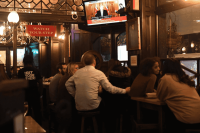
As the current crisis unfolded in Ukraine, some of Westminster’s finest sought sanctuary in its watering holes. Among those enjoying libations on Tuesday night was Tory MP Stuart Andrew, recently reshuffled out of the much-maligned Whips’ Office to become the eleventh housing minister in ten years. Andrew popped into the popular Red Lion establishment next to parliament after work for a quick one. Unfortunately, in the excitement the minister put his briefcase down, only to discover moments later the bag had been stolen. Cue pandemonium among the bar staff as a squadron of the Met’s finest was dispatched to try and find it, arriving on the scene within ten minutes of the reported theft. Not exactly David Cameron leaving his daughter in a pub but hardly ideal.
Did Boris Johnson fail to put his money where his mouth is when it came to hitting Russia with sanctions? The Prime Minister's critics think so: they argue that the targeting of five Russian banks and three oligarchs as a response to Putin's invasion of Ukraine was too little, too late. These cries came not only from Labour, and from the Green party's Caroline Lucas (who scandalously accused the PM, without a shred of evidence, of wanting to appease would-be Tory donors), but from his own side. Tory backbencher Iain Duncan-Smith demanded a more general blacklisting of Russian banks and plutocrats, while his party colleague Nickie Aiken went so far as to suggest forcibly expelling oligarchs’ children from English fee-paying schools.
Remember Alex Salmond? The former SNP leader is back. Since 2017 his little-known programme, The Alex Salmond Show, has aired weekly on RT which receives its funding from the Kremlin. Today at PMQs the party leaders combined to plug Salmond’s programme and to boost his ratings. It wasn’t a debate. It was a 30-minute Salmond advert. Sir Keir Starmer began by suggesting that RT’s licence should be revoked. ‘I see no reason why it should continue to broadcast.’ Boris replied that Ofcom and not politicians should make that decision. But he added that he believes in ‘free speech’. In other words, he opposes a ban on RT. A political choice, obviously. And Ofcom will have heard the PM loud and clear.
Boris Johnson and Keir Starmer had one thing in common at PMQs: they were both keen to talk about the escalating situation in Ukraine. While the Prime Minister wants to use the crisis to show there are more important issues than parties, the Labour leader views it as an opportunity to put some clear blue water between himself and his predecessor, Jeremy Corbyn. Starmer is using the Ukraine situation this week to emphasise Labour’s return to the centre His call at Prime Minister’s Questions to ban Russia Today has already received some criticism from figures on the left and right of the party who believe it would be self-defeating.