Russia

Keir Starmer's Russia problem is here to stay

Keir Starmer will travel to Berlin this afternoon to join European leaders for a ‘mini-summit’ in support of Ukraine following two days of talks between president Volodymyr Zelensky and American officials. Zelensky has been in the German capital since yesterday, locked in talks with US special envoy Steve Witkoff and Donald Trump’s son-in-law Jared Kushner to hammer out the terms of a peace deal on the war in Ukraine that can then be presented to Russia. US representatives have also been invited to this afternoon’s mini-summit – due to kick off shortly after 5.30 p.m. UK time. Overnight, Witkoff declared that ‘significant progress’ had been made with Zelensky. There has

How Russia’s National Guard may stymie the latest Ukraine plan

One of the crucial obstacles to a Ukraine peace deal appears to be Vladimir Putin’s demand for the remaining fifth of Donetsk region not in Russian hands. Kyiv not only resents the idea of surrendering hard-defended land, it also fears this could be use it as a springboard for future attacks deeper into Ukraine. One potential workaround under debate is apparently allowing Moscow to claim it, but also making it a demilitarised zone (DMZ) to ensure Russian troops stay out. But it’s not so cut and dried. The notion of a DMZ may seem like an elegant way to square the circle of Putin’s demands and Ukraine’s concerns, but it’s

When will Europe's leaders wake up to the Russian threat?

Europe’s leaders flocked to London this week, determined to show the world a united front. Like school boys at a bus stop, Ukraine’s president Zelensky stood beside Keir Starmer, German chancellor Friedrich Merz and French leader Emmanuel Macron in a carefully staged tableau of Western resolve. It was designed to send a message to Moscow: Europe is ready. Yet the spectacle only highlighted the uncomfortable truth: Europe talks like a military power, but behaves like a political debating society. The continent insists it has woken up to the new reality, yet it still refuses to build the armies required to confront it. Europe talks like a military power, but behaves

How Europe can turn the tide on Russia's underwater warfare

Europe is right now fighting an enemy it cannot see and protecting a vulnerability it has not mapped. Undersea drones are taking the conflict between Russia and the West below water. But these sea drones are not looking for soldiers or civilian targets: they are patrolling infrastructure thousands of metres below sea level, aiming to prevent vital communications cables from being severed. In a silent, deep-sea war, Europe and its allies are already counting the cost of Russian damage to its vital undersea cables In a silent, deep-sea war, Europe and its allies are already counting the cost of Russian damage to its vital undersea cables – the spinal cords that

There’s nothing equal about Russia’s relationship with India

Vladimir Putin lands in Delhi, steps off the plane and instantly gets what he came for: the pictures. The handshake with Narendra Modi, the red carpet, the talk of a ‘special and privileged strategic partnership’. For the Kremlin, this week’s summit in India is mainly a PR exercise: proof to Russians that their country is still received as a great power, while the West tries isolation. But don’t be deceived if it appears that two equal giants are meeting. They are not. India, the land of the future, has surged to become the world’s fifth-largest economy and is on course to overtake Germany and Japan. Russia, the land of the

Putin is warning Britain – but we're not listening

When Vladimir Putin declared this week that Russia was ‘ready’ to fight a war in Europe, the remark barely seems to have rippled the surface of Britain’s political consciousness. It should have sent a shockwave. The US delegation that had flown to Moscow in the hope of reviving a peace plan left empty-handed. Putin’s message was not bluster but a statement of intent: Russia is preparing for possible escalation now. Yet Britain continues to behave as though danger is tidily scheduled for years in the future, safely beyond the horizon of any present responsibility. It is a comforting delusion, but a very dangerous one. Britain cannot lead Europe if it

Why Putin thinks destiny is on his side

The Kremlin pulled out all the stops for the visit of Donald Trump’s son-in-law Jared Kushner and special envoy Steve Witkoff to Moscow today. Accompanied by Putin’s envoy Kirill Dmitriev, Witkoff and Kushner strolled through crowds on Red Square with minimal security after lunching at a fancy restaurant on Petrovka street. Not coincidentally, Chinese foreign minister Wang Yi was also in town for a meeting with Russian Security Council head Sergei Shoigu, where Russia affirmed its support for Beijing’s One China policy.  It was a sophisticated piece of great power signalling intended to send a multi-part message to Donald Trump. First and foremost, the Kremlin was showing off its new

Inside the mind of Putin's real hatchet man

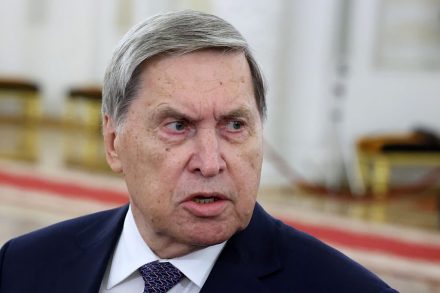
As Moscow and Washington prepare for talks on the latest version of Donald Trump’s peace plan next week, leaked recordings of a conversation with US envoy Steve Witkoff have thrown a spotlight on to senior diplomat Yuri Ushakov. It seems he, not Foreign Minister Sergei Lavrov, is the prime mover behind Russia’s negotiating position. The stature of Lavrov, once a legend in the diplomatic community, has steadily diminished since 2014, when he wasn’t even consulted before Vladimir Putin decided to annex Crimea. Every year since then, the now-75-year-old minister has petitioned Putin to be allowed to retire; every year this is denied. Instead, Lavrov remains confined to a role of

Russia is willing to keep on fighting in Ukraine

At a time when Western commentators are tying themselves in knots trying to parse the ongoing Ukraine peace discussions, the Russian media is suddenly strikingly united in its coverage. There is a common misperception that, like their Soviet forebears, the Russian press simply reproduces some standard party line, day in, day out. In fact, there is often surprising pluralism, with different newspapers having their own interests and angles. However, the Kremlin does impose its will when it comes to especially important or sensitive matters, with editors receiving tyomniki, informal but authoritative guidance from the presidential administration on lines to take and topics to avoid. When the press is speaking in

Is Trump trying to strike a fresh deal on Ukraine?

With fresh wind in his sails after his success brokering a somewhat fragile peace in Gaza, Donald Trump has once again turned his attention back to Ukraine. According to reports, the US President’s team has secretly been working on drafting a new plan to end the war. Concerningly, though, once again that confidential plan is being hashed out with Russia – without any input from Ukraine or its European allies. Details of the plan are, as yet, scant – although a report by Axios suggests that it will be made up of 28 points falling under four rough headings: peace in Ukraine, security guarantees for the country, security in Europe

Why is Putin obsessed with nuclear 'wonder weapons'?

I don’t think it’s accurate or helpful to think of Vladimir Putin as some Bond villain figure – but he certainly does make it harder to hold this line sometimes. In particular, his enthusiasm for ‘wonder weapons’ – often of questionable strategic value – does suggest a certain grandiose vanity. Some have genuine military utility, but others seem more useful in psychological than actual warfare. Last week, the Russians announced a successful test of the 9M730 Burevestnik (‘Storm Petrel’), a nuclear-armed and -powered cruise missile. Its reactor allows it to travel further than any regular cruise missile, manoeuvring at altitudes as low as 50 metres. This would mean that it

Zelensky’s attack on Odesa is a step too far

In a single week, Kyiv has launched a triple attack on Odesa: on its language, history, and elected government. The city, which for almost four years has endured relentless bombardment and held Ukraine’s maritime front, now finds itself besieged by its own capital. With growing calls for an election, Zelensky appears to be clearing the field of rivals The most startling of these moves against Odesa is president Volodymyr Zelensky’s decision to strip Gennady Trukhanov – the city’s three-times-elected mayor – of his Ukrainian citizenship and office. The charge is that Trukhanov holds a Russian passport, which the mayor flatly denies. Yet without a court hearing or any due process,

How Germany is preparing for war

Hamburg What would happen if Russia was planning an attack on Estonia, Lithuania or Latvia – and the threat was sufficiently great that Nato felt the need to send troops east across Europe to face off against Moscow? This was the scenario the German Bundeswehr spent several days rehearsing last month, working out how the army would transport its soldiers towards Nato’s eastern flank in the event of conflict in the Baltics. For three days, the port city of Hamburg played host to the exercise Red Storm Bravo: 500 soldiers, along with roughly 300 members of the emergency services and other civilian organisations, took part – the largest military exercise

Putin is mortgaging Russia's future to pay for Ukraine

We will wage the war in Ukraine for longer and make you pay more for it. That was the message the Kremlin sent its subjects following the Russian government’s presentation of next year’s budget and the accompanying economic outlook. The budget, which reached parliament for rubber-stamping on Monday, outlines the Kremlin’s vision ahead of the war enterring its fifth year next February: the war will continue at the expense of the economy and people’s incomes. Higher taxes are expected to keep the budget deficit at 1.6 per cent of GDP next year. For three years, rising fiscal spending stimulated both economic growth and climbing incomes. The downside of this amphetamine-fuelled

Moldova has been saved from Russian influence, but at what cost?

The European Union, guardian and champion of democracy, rightly takes a dim view when ruling parties ban their opponents, refuse to open polling stations in areas likely to vote against them, censor opposition news channels and allow a large staff of foreign election monitors to police social media in the run-up. If Serbia, say, or Georgia tried systematic election rigging of this kind, Brussels would be the first to call foul and disregard the result as illegitimate. But when it’s the EU that’s running the interference, as in Moldova this week, the rules are apparently quite different. This week the pro-EU party of Maia Sandu, Moldova’s President and a former

Putin's dads' and lags' army is struggling

The news that Vladimir Putin is pushing for 135,000 new young recruits in ‘the biggest autumn conscription’ for nearly ten years comes as no surprise. Recently, the Russian leader’s war-machine has been scraping the bottom of the barrel: convicts freed from prison, men in their sixties, debt-ridden farmers, factory workers pulled straight off the line…and foreigners who don’t even speak Russian. The Russian leader’s war-machine has been scraping the bottom of the barrel When Putin began his ‘special military operation’ in February 2022, he expected the entire nation to rally in support of his war. But reality hit hard: plunging approval ratings, economic collapse, and a mass exodus. When partial

Believe it or not, Russia is great

I have been invited to Moscow by the Russian Orthodox patriarchate because the organiser is a fan of my podcast. Everyone at home thinks I am either dangerous or mad. My mother is convinced I’m going to be bumped off by the FSB or killed by a drone. Others claim I have become a useful idiot of the evil dictator Putler because the patriarchate are merely his stooges. ‘Is that true?’ I ask the patriarchate’s media affairs guy. ‘Well, under Peter the Great we were run by the government. And under communism we weren’t allowed to exist. So you could argue that, historically, we’re about as independent as we’ve ever

Trump has called Europe and Ukraine’s bluff

Has Donald Trump just announced the most consequential foreign policy reversal of his presidency? If so, Ukrainian President Volodymyr Zelensky and France’s Emmanuel Macron – the last leaders to speak to Trump just before his epochal announcement – should be careful what they wish for. Despite a reputation in some quarters for being a master manipulator, Putin utterly failed to correctly read Donald Trump In the mother of all flip-flops, Trump on Wednesday posted on Truth Social that ‘Ukraine, with the support of the European Union, is in a position to fight and WIN all of Ukraine back in its original form.’ That’s a position that even Joe Biden, in

Why Putin's military drills are good news for the West

Another Russian military exercise is over, and some Western commentators would have us believe that we ought to be heaving a collective sigh of relief that Putin’s legions didn’t use this as an excuse for another invasion. Of course, that was very overblown hype. Instead, what we saw was a Russian military still clinging to outmoded ways of war, as if its armoured columns had not been blocked and burnt when they rolled into Ukraine in 2022. The Zapad-2025 (West-2025) exercises, which concluded on Tuesday, involved perhaps 30,000 Russian and Belarusian soldiers in a wargame stretching from the Arctic Circle to Belarus. This was the latest iteration of a biennial

Trump is living in Putin's world

It all began with such promise. Donald Trump would sweep away all the failures of past administrations, sit astride the globe like a Nobel Prize winner in the making and solve the world’s seemingly unresolvable security challenges. To be fair, it has only been eight months since he began his second term in the White House. But it is a fact that Trump has struggled to bring the force of his personality and chutzpah to bear in trying to end the wars in Ukraine and Gaza, as he pledged he would in short shrift during his presidential campaign. His return to the White House was supposed to be the start

Putin doesn't want to live forever

‘Rejuvenation is unstoppable, we will prevail,’ blared the editorial in the Chinese newspaper Global Times. The subject was China’s resurgence, but it looked oddly apposite in light of an inadvertently overheard conversation between Vladimir Putin and Xi Jinping. Some Western journalists have mistaken this as evidence of Putin’s hubris and his personality cult ‘Biotechnology is continuously developing,’ commented Putin as the two men walked towards the podium in Beijing’s Tiananmen Square during the military parade to mark 80 years since Japan’s surrender in World War Two. ‘In the past, it used to be rare for someone to be older than 70 and these days they say that at 70 one’s still a

The vampiric desires of Putin and Xi

‘They’re vampires’ was my first thought. I had just heard the news that Putin and Xi were discussing how to prolong their lives, as they walked toward their places at the Tiananmen Square military parade. On the official news footage, Putin’s translator could be heard saying in Chinese: ‘Biotechnology is continuously developing.’ And then: ‘Human organs can be continuously transplanted. The longer you live, the younger you become, and [you can] even achieve immortality.’ Xi responded: ‘Some predict that in this century humans may live to 150 years old.’ Kim Jong-un was there too, but is not known to have contributed to the conversation. Maybe the blood-sucking image came to

Kim Jong-un’s alliance with Xi and Putin is growing stronger

When analysing authoritarian states, not least North Korea, most of the time we have to read between the lines. But on other occasions, things are more obvious. Today, China celebrates eighty years since its victory over Japan in the second world war. Xi Jinping has invited Western and non-Western leaders past and present, but all eyes will be on the guest list’s top two invitees: Vladimir Putin and Kim Jong-un. Marking the first multilateral gathering of all three leaders since the Cold War, today’s spectacle aims to send a clear signal to the West. Xi, Putin, and Kim might have their differences in foreign policy priorities, their relations may fluctuate,