
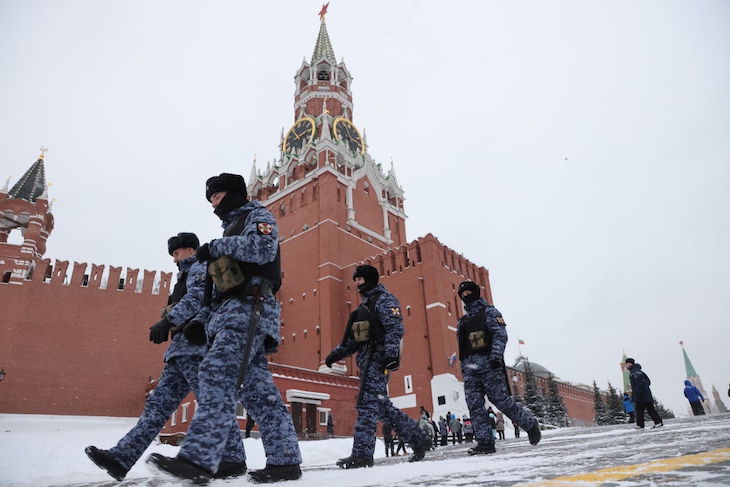
It may sound like a rather arcane development, but a change in the command structure of the Rosgvardiya, Russia’s National Guard, offers some clues about both the state of the country and the Ukraine war – and the Kremlin’s fears for the future.
Zolotov has been lobbying for some time for the Rosgvardiya to have its own General Staff. This week, he got it
The Rosgvardiya is an internal security force of some 180,000 personnel, ranging from the blue-camouflaged OMON riot police who patrol the streets alongside the regular police, through to the Interior Troops, a virtual parallel army with its own tanks and artillery. (There are also at least as many in FGUP Okhrana, its private security firm.) It was established in 2016 to a large extent because the Ministry of Internal Affairs (MVD) was increasingly unhappy at being called on to suppress public protests. When Interior Minister Vladimir Kolokoltsev – a career cop, not a KGB veteran like his predecessor – communicated the mildest of dissent to Vladimir Putin, the Kremlin responded by stripping the MVD of its security forces and transferring them to a new agency. Ex-presidential bodyguard, Viktor Zolotov – a man who has acquired the nickname “Putin’s Doberman” – was put in charge. The Kremlin was confident that he would have no qualms ruthlessly suppressing any and all protest.
Zolotov has been lobbying for some time for the Rosgvardiya to have its own General Staff. This week, he got it. The Rosgvardiya has long had a Main Staff, and its elevation to a General Staff may sound like a trivial name change. However, in the highly stratified Russian security bureaucracy, this means an expansion in the Rosgvardiya’s command and planning staff and its scope to work with the regular military on a more equal basis and essentially boss the police around. According to Moscow insiders, this reflects Rosgvardiya’s current responsibilities and also a sense in the Kremlin that it may have to lean on the service all the more heavily in the years to come.

In Ukraine, the Rosgvardiya largely handle rear-area security, which can mean anything from guarding prisoners to engaging in often vicious counterinsurgency operations against Ukrainian infiltrators and pro-Kyiv partisans. To an extent, though, the slow movement of the front line has meant that Ukrainians hostile to the idea of finding themselves under Russian rule have the time to flee, joining the up to 3.8 million other internally-displaced people. Now that there is at least a possibility that Kyiv will be forced to relinquish the remaining portion of Donetsk Region as part of a peace deal, Moscow is having to contemplate how to control and pacify an area still containing around a quarter-of-a-million people. Many of them may not practically or psychologically be in a position to flee, yet they have no desire to become Putin’s subjects. According to one Russian journalist who works on the security forces, the current plan is that three full brigades, more than 15,000 officers and men, might need to be deployed, in its largest operation for years.
At the same time, the prospect of a power struggle in Chechnya as a result of the declining health of ailing strongman Ramzan Kadyrov, is raising the specter of a new rebellion, or at the very least an upsurge in nationalist and jihadist violence. With the army occupied in Ukraine, this would be a massive practical and planning challenge for the Rosgvardiya.
Arguably the greatest concern, though, is that the coming years will see more and more protests across the country. Increasing economic hardship, decaying public services, resentment at resurgent corruption, and the return of hundreds of thousands of psychologically scarred and brutalized veterans, who are likely to feel the promises made to them were broken, have all been identified as potential sources of trouble.
The Rosgvardiya is large, but Russia is larger. In the past, it has relied on only having to deal with one or two serious crises at any one time, so it could concentrate to deal with each in turn. As one retired Rosgvardiya veteran observed, its nightmare scenario is “a veterans’ protest here, a demonstration by unpaid workers there, a major prison in a distant camp, and a wave of terrorism in the North Caucasus, while Moscow demands you settle each one of them, right now.”
Giving the Rosgvardiya its own General Staff is thus the next step in a process which has been gathering momentum for years, of giving it the power and capacity to, in a crisis, co-opt local army garrisons, police commands, municipal workers, volunteers and even transport services, in the name of dealing with mass unrest. Rosgvardiya commanders could even be empowered as virtual local warlords.
All that said, let’s be clear: it is not that the Kremlin is planning to impose martial law and paramilitarize its whole administration. Yet it is hard not to conclude that, over the passive resistance of both the army and police, it is considering that it may have to in the future, and is establishing the structures that it may need. That Rosgvardiya veteran, who retired last year, sent me a text this morning: “I’m beginning to think I got out just in time.”





Comments