Economy

  • AAPL

    213.43 (+0.29%)

  • BARC-LN

    1205.7 (-1.46%)

  • NKE

    94.05 (+0.39%)

  • CVX

    152.67 (-1.00%)

  • CRM

    230.27 (-2.34%)

  • INTC

    30.5 (-0.87%)

  • DIS

    100.16 (-0.67%)

  • DOW

    55.79 (-0.82%)

Why Xi thinks he has the upper hand

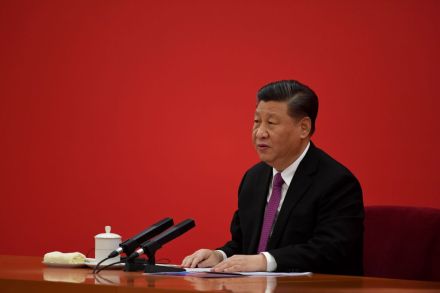
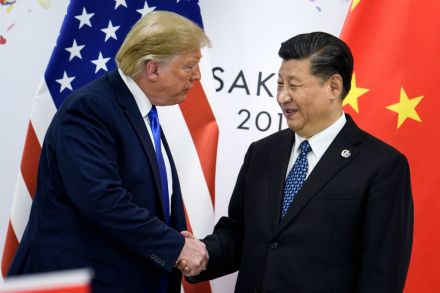
Taiwan is “the most important issue,” Xi Jinping warned Donald Trump. “If mishandled, the two nations could collide or even come into conflict, pushing the entire China-US relationship into a highly perilous situation,” according to Chinese state media. The contrast with Trump’s comments was striking. Trump had earlier named trade as the most important issue. In opening remarks, the American President stuck to bland flattery, saying he and Xi had a “fantastic relationship,” that Xi was a “great leader” and that “it is an honor to be your friend.” “The relationship between China and the USA is going to be better than ever before,” he insisted.

Spotlight

Featured economics news and data.

Cutting Britain’s giant welfare bill would be an act of kindness

Does having money really matter that much? There are those, usually with quite a bit of it, who want us to care less about materialism. But, unequivocally, money really does matter – not because of any status it supposedly brings, but for the freedom it buys: freedom to choose how we live and how we look after others. Considering this, it seems that the deep disillusionment with mainstream politicians in recent years stems from a protracted and ongoing period of stagnant living standards over which they have presided. But the truth is that the average person has not got poorer since the global financial crisis. They have got a little bit richer. Employment levels are still exceptionally high. And, both historically and internationally, we are a very rich country.

Powell orders media blackout for Fed staff

Jay Powell, the Federal Reserve Chairman, has banned any public appearances by any member of the Fed, Cockburn hears. Appearances at conferences have been canceled, all scheduled interviews have been abandoned and any comments on or off the record are outlawed. This unprecedented action is a reflection of two pressures. First, there are growing economic indicators that suggest the US is heading into a recession with the Dow plunging 800 points on Wednesday. Second, relations with the White House have reached a new low. President Trump has pinned the success of his presidency upon a strong economy and his qualifications as a businessman who understands the economy. If a recession takes hold, Trump believes his reputation will be destroyed and his chances of reelection dimmed.

jay powell fed

America should view China as a hostile, revolutionary power

Much has been made of the return of great power competition. In truth, it never went away, although the great game was so one-sided for a time that almost everyone in the West tuned out, assuming the match was over in perpetuity. It was too boring to contemplate and so attention drifted to other concerns and second- and third-order problems. China’s attention did not deviate, and once again it is a great power. Like cholesterol, great powers can be good, in that they accept the present international order, or bad, in that they do not. China does not, and seeks to overturn the contemporary order the West created.  This is the source of what is already the great conflict of 21st century. China is not a status quo great power.

xi jinping power

Silicon Valley is your government now

The Federal Trade Commission’s decision to fine Facebook $5 billion for privacy violations is an expensive slap on the wrist that will do little to change anything in what is developing as a titanic struggle between the nation states (governments) and the new market states (technology companies). Across the world, the nation states are struggling to keep pace with technology developments and largely failing. Meanwhile, the nation states are proceeding at breakneck speed to develop a world of their choosing where countries become less and less relevant to the course of our future history. The FTC fined Facebook for a series of ethics and privacy violations and imposed the largest fine in the FTC’s history.

silicon valley

When Mexico enforces its own laws, immigration drops

‘We’re holding a gun to our own heads,’ said Sen. John Cornyn in June. He was talking about President Trump’s threat to impose tariffs in order to force Mexico to crack down on illegal immigration into the Unites States. Many congressmen agreed, fearing, as establishment figures are prone to do, that Trump was risking the whole economy for some nebulous border demand. A month later, it seems Trump’s tariff gambit has worked. After Mexican officials agreed to crack down on illegal immigration to avoid US-imposed tariffs, the Department of Homeland Security reports that border apprehensions dropped from 144,278 in May to 104,344 in June — a 28 percent decrease.

mexico

Trump’s bad Huawei deal with Xi

Trump’s decision to lift the ban on US companies doing business with Huawei, the Chinese telecommunications company, is a stunning defeat for him. It’s also a major reversal for the US intelligence community, which has been concerned for years about what it considers to be Huawei’s wholesale theft of American technology.Lifting of the ban reinstates Huawei at the leading edge of China’s global spying. It undercuts months of private attempts to encourage America's allies to join in what the US hoped would be something close to a worldwide ban. And, over the long term, it also threatens America’s strategic advantage as a leader in new technologies.

huawei

China’s Belt and Road Initiative is neo-Imperialism

China’s Belt and Road Initiative (BRI) is touted by Beijing as an attempt at multinational economic cooperation and development, comprising everything from foreign direct investment to the development of infrastructure. However, the purpose of the BRI is not economic or cultural but strategic, and is an effort to mask the expansion of Chinese power. In its strategic intent, the BRI should be considered an imperial project alongside the likes of the British East India Company (EIC) or the Dutch East Indian Company, Vereenigde Oostindische Compagnie (VOC).  With the BRI, China is exercising the 'imperial excuse', just as the EIC and VOC did centuries ago.

belt and road initiative

Bastard capitalism

‘If we will not endure a king as a political power,’ Sen. John Sherman of Ohio said in 1890, ‘we should not endure a king over the production, transportation, and sale of any of the necessities of life.’ These words helped drive through the Sherman Anti-Trust Act that saved early American capitalism by breaking up Standard Oil and the robber barons’ fiefdoms.A long line of Anglo-Saxon dragon slayers straggles behind the senator, all the way back to King John at Runnymede. Over-mighty kings and industrial barons get short shrift in Britain and America. This isn’t mere resentment. It is a philosophy of power and knowledge, and the principle behind democracy and free markets.

capitalism

Pompeo summons up fresh Iran sanctions from the Gulf

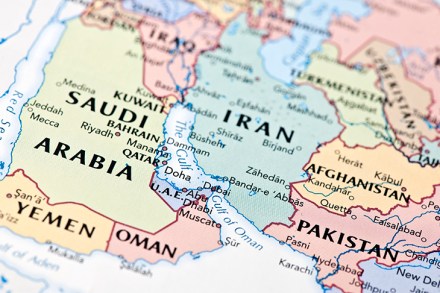
'First, I think it’s really important to understand that the Iranians are sowing disinformation,' Mike Pompeo told reporters Sunday en route to the Kingdom of Saudi Arabia and the United Arab Emirates  ('two great allies in the challenge that Iran presents.')'You’ll see too,' the secretary of state continued, 'that our campaign that began when President Trump took office will continue. On Monday, there’ll be a significant set of new sanctions.' Sure enough, this afternoon Trump announced intensified sanctions on Iran’s Supreme Leader.With that, the secretary was off, jetting from Joint Base Andrews to Riyadh and Abu Dhabi.

iran sanctions

Trump was right to threaten Mexico with tariffs

Let's not mince words. President Trump and his loyalists were dead right. His threat of tariffs pushed Mexico to work harder to stop the Central American caravans, and the migrants who hope to exploit immigration law loopholes in order to receive asylum in the United States. And the bipartisan, Trump-loathing political, business and media establishments were all dead wrong. They warned that his strong-arming would ignite a trade war, disrupt the thick web of supply chains linking the American and Mexican economies, and risk a recession. Equally off-base was the establishmentarians' angst that Trump's gambit would endanger the revamp of the North American Free Trade Agreement (Nafta) that he has sought and which Mexico and Canada recently signed.

donald trump mexico trade deal

Trump’s Mexican tariffs could wipe out his 2017 tax cut

Donald Trump likes to brag about his deal-making prowess. During his visit to the United Kingdom, he’s touting the prospects for a ‘very, very substantial trade deal.’ But even as he dangles sugarplums before the British, he’s blowing up another agreement that he wanted to complete before the 2020 election — the United-States-Mexico-Canada Agreement, which is supposed to supplant NAFTA.His attempt to fuse national security and nationalism in the form of a tariff on Mexico could end up torching his own presidency. Trump’s big idea — concocted by his aide Stephen Miller — is that he can pressure Mexico to crack down on immigration by pressuring it with tariffs.

mexican tariffs

Should we fear Facebook’s cryptocurrency?

The cryptocurrency winter has turned to spring: having slumped from $20,000 in late 2017 to $3,200 a year later, bitcoin has lately risen like a rocket to $8,800. Though it doesn’t change my negative opinion, I admit that if I had bought a fistful of these wacky gaming chips last October when I gave the crypto concept a kicking at our Spectator conference on the subject, I’d be up almost 40 percent. Evidently, hints from the US Federal Reserve and the European Central Bank that further bouts of ultra-low interest rates and quantitative easing may be in the offing have spurred what the FT calls ‘a rally in riskier assets’. Crypto is the new gold for those who distrust central banks and seek stores of wealth that governments can’t reach.

cryptocurrency

Donald Trump’s one-front trade war

At 12:01 a.m. on Monday, President Donald Trump went a long way toward defusing a potential war – not with Iran, but Canada and Mexico, where Trump revoked tariffs he had imposed in the name of national security. Why the sudden bout of tariff reduction? The president is focusing on a one-front trade war with China. The restrictions began as two fronts of the same war. Trump imposed 25 percent tariffs on steel and 10 percent tariffs on aluminum imported from China last March. Then he extended those tariffs to the EU, Canada, and Mexico on June 1. But the president seems to have concluded that the US can no more fight a two-front war in trade than on the battlefield.

Donald Trump one-front trade war

How I learned to stop worrying and love Trump’s trade war

Alarmist news reports and panicky stock sell-offs. A threat to impose tariffs on US goods in retaliation for President Trump’s threatened levies. You’d think that Beijing had just ruthlessly shut down a major engine of American growth. But the truth is that tariff fear-mongering reveals the gulf between America’s financial markets and its real economy that provides everyday goods and services. The Chinese economy has grown spectacularly since Beijing turned away from Maoism in the 1980s. It’s true that major American industries from aircraft to agriculture have profited handsomely from supplying Chinese demand. The offshoring model supercharged by China’s admission to the World Trade Organization (WTO) in 2002 has been especially lucrative.

donald trump trade war

Our real problem with China: Xi Jinping

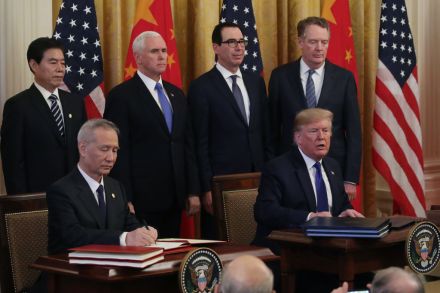
At the last minute the Chinese Communist Party chief Xi Jinping vetoed the trade deal with the United States, after his representatives had negotiated and agreed to it. Xi claimed that he will take the responsibility for ‘all possible consequences.’ This left President Trump no choice but to impose higher tariffs on some Chinese imports. This battle over trade marks only the early rounds of the US struggle with China. China’s economic success was achieved in large measure by taking advantage of the working people of both China and the US. It was made possible because the US allowed it to enter the world’s free trade system. Because China entered the West’s economic ecosystem a generation ago, it has flourished.

xi jinping

The future of world trade is in the balance

Ongoing trade talks between American and Chinese officials took an unexpected turn on Sunday: President Trump took to Twitter and announced a plan to impose tariffs on all Chinese imports by Friday. The tariff threat adds urgency to negotiations that will continue on Wednesday, when a Chinese delegation is due to arrive in Washington, DC. The move is a departure from last week when US Treasury Secretary Steven Mnuchin and Trade Representative Robert Lighthizer arrived in Beijing to initiate a fresh round of trade talks with China. Despite chronic trade tensions, both sides had sounded optimistic ahead of the meeting. State Councilor Wang Yi, China’s top diplomat, expressed hopes the two sides could ‘reach a mutually beneficial, win-win agreement’.

world trade

A booming economy makes Trump look wiser than his detractors

What delicious reading it makes going back over Paul Krugman’s missive in the New York Times on the morning after Donald Trump was elected in 2016. ‘Global recession with no end in sight...when are markets going to recover? A first pass answer is never...’ Those words should be carved into a façade somewhere in Wall Street and held up for ever after as an example of hubris of economic forecasters. In liberal circles nowadays there is always misery. The end of the world is always around the corner, where from economic calamity in the global capitalist system, climate change, rise of fascism, AI taking our jobs and creating mass unemployment, or whatever. But let’s get back to the real world for a moment.

donald trump booming economy

Will Donald Trump tackle the vampire squid?

Goldman Sachs isn’t just unpopular in the United States: their reputation black hole is expanding worldwide. In December 2018, Malaysia filed criminal charges against the investment giant over the 1MDB scandal, referred to as ‘the biggest financial scam in history’ — though Kuala Lumpur has indicated that it might be willing to drop the charges if Goldman pays $7.5 billion in reparations. After years of turning a blind eye to Goldman’s predatory behavior, hopefully 1MDB will push governments to take action against the firm memorably described as ‘a vampire squid’.

goldman sachs vampire squid

Is the Fed caving to the demands of the market?

Has ‘Jay’ Powell gone wobbly, or does he know something we don’t? That was the question being asked after the US Federal Reserve, of which Powell is chairman, kept dollar interest rates on hold last week — rather than continuing to notch them upwards as it has been doing for two years — and hinted that the next move might actually be downwards. Trade tension with China, the impact of Donald Trump’s government shutdown and the risk of a no-deal Brexit were all cited as ‘cross-currents’ affecting the decision, but pundits led by Wall Street ‘bond king’ Jeffrey Gundlach declared the Fed to be ‘caving in’ to the demands of the stock market and the President.

fed jerome powell

The rise and rise of the daddy big bucks candidate

We live in a time of hatred of elites, yet all these billionaires keep running for president. Howard Schultz, the ex-Starbucks CEO, has declared he is considering a run as an independent because he, like many others, is fed up with the current president and politics in general. Funnily enough, that is why the current billionaire president ran three years. That, plus ego. ‘This president is not qualified to be the president,’ says Schultz. That’s also what Michael Bloomberg (net worth: $44 billion) says, and the whispers that he is about to announce his candidacy are stronger than usual in this pre-election cycle. Bloomberg calls Trump a ‘pretend CEO’, and his would-be voters thrill at the thought that he is considerably richer than the Donald.

howard schultz billionaire

Leading Brexiteers in DC to talk US-UK free trade agreement

David Davis, the former Brexit minister, and Owen Paterson, another pro-Brexit ex-minister, confirmed Friday morning that they’re meeting with Trump administration officials to discuss a US-UK free trade agreement. Theresa May, the stricken British prime minister, refuses to discuss a US-UK FTA until after Britain has withdrawn from the EU in March 2019, and after Britain and the EU have made a new trade deal. This week, May forced a draft of her withdrawal bill through her cabinet, but sparked resignations from her cabinet and open revolt from pro-Brexit Conservatives. ‘We’re clearly here to advocate for a US-UK free trade agreement,’ said Shanker Singham of the Institute for Economic Affairs, who serves as an outside adviser to Boris Johnson.

david davis owen paterson washington