Arts Reviews

The good, bad and ugly in arts and exhbitions

The invisible man | 12 November 2011

Besides being one of the most exquisitely melodious, sensitive singer-songwriters you’re ever likely to hear, John Grant is also one of the most beautiful men you could ever hope to meet. I’m not the only married man to feel this way about the tortured gay pop star. As he tells me over lunch on London’s South Bank, male fans are constantly gushing after his shows about how utterly they worship and adore him. ‘Then they’ll go and ruin it by saying, “Oh, and by the way, may I introduce my wife?”’ And it’s not that the Michigan-born 42-year-old is excessively handsome or exquisitely ephebic or anything like that. In fact,

Intelligent design | 12 November 2011

In 1935, Paul Nash observed that Edward McKnight Kauffer (1890–1954) was responsible for the change in attitude towards commercial art in this country. An American, Kauffer arrived in England in 1914 during a period of European study. He liked it and decided to stay, enabled to do so by his remarkable ability to design posters. In 1915 Frank Pick commissioned him to produce the first of what became a remarkable stream of some 140 posters for London Transport. Hugely impressed by Vorticism, Kauffer became a friend and ally of Wyndham Lewis and introduced the Modernist sensibility into commercial art. Paul Nash commented, ‘It was the courage and aesthetic integrity shown

Bird watching | 12 November 2011

The setting is appropriate: Rochelle School is on Arnold Circus in Shoreditch, at the end of Club Row, once famous for its pet market, where, until it was closed down in 1983, you could buy caged birds from around the world. Now the school is hosting an exhibition entitled Ghosts of Gone Birds (till 23 November), a wide-ranging and stylistically eclectic show with a single emotive theme: extinct birds. More than 100 artists, musicians and writers, including Peter Blake, Margaret Atwood and Ralph Steadman, have made work in aid of BirdLife International’s Preventing Extinction scheme. Steadman did one picture and then found himself gripped by the theme, and went on

Ritual humiliation

Ricky Gervais’s latest sitcom, Life’s Too Short (BBC2, Thursday), is really a series of sketches on his favourite themes — failure, rejection, self-delusion and humiliation. I gather from friends of friends that at UCL he was often teased, not always pleasantly, for not fitting in with the right gang. Exclusion of one kind or another and the desperate need to fit in is another constant topic. You may remember the scene in Extras in which he and his friends are turfed out of the VIP area in a club to make way for David Bowie, who then makes things more horrible by improvising a song about what a pathetic and

High hopes

For more than 40 years, Scottish Ballet has been one of the most vibrant and interesting companies on the UK dance scene. It is a ballet company born of a well considered vision and the desire to prove that there can be good ballet without grandiose spectacle. Indeed, for many years it has been notable for its almost ‘chamber’-like choreographic repertoire, which has included intelligent adaptations of the great classics. Now a new chapter is about to start, as Christopher Hampson takes over the company’s artistic directorship, succeeding Ashley Page and an impressively illustrious roster of equally enlightened directors. Like many in the dance business, I have long admired the

Blood-stained humour

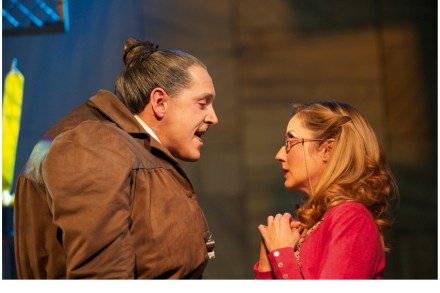
I take no pleasure in saying this but the director of the National Theatre, Nicholas Hytner, appears to have lost his sense of propriety. Or possibly the balance of his mind. He’s asked John Hodge (author of the Trainspotting screenplay) to write a sitcom about the Great Terror. And, rather than bunging it in the nearest skip, Mr Hytner has decided to direct it at the Cottesloe. The blood-stained gag-fest begins in 1938 when a secret policeman orders Russia’s leading satirist, Mikhail Bulgakov, to write a play about Stalin’s early life. Bulgakov meets the Great Leader and Teacher and finds him keen to assume personal control of the scriptwriting. So

Bleak and bold

As a major admirer of all writer/director Andrea Arnold’s previous work — Wasp, Red Road, Fish Tank — I was looking forward to her version of Wuthering Heights more than I can say, and? Wow! Or, at least, mostly ‘wow!’ It is a ‘wow’ with a few reservations. It is two thirds of a ‘wow’, so perhaps a ‘wo!’? Wo! It is impressively bold. And brave. And brutish. It will rile the purists, which is always good, as riling purists is a particular hobby of mine, and I like to set aside at least half a day a week to do just that. (I favour putting them in a cage,

Skirting the sensational

I only very recently began going to live Met relays in the cinema, but if you can get in it’s very well worthwhile. In Cambridge, where the sound is so-so, as I discovered going to Siegfried, there is no hope of getting in except on the day booking starts. In Huntingdon, where the sound is fantastic, there was just a handful of oldsters for Die Walküre in May, who were rewarded with the best Act I that I have ever seen, thanks to the electrifying conducting of James Levine and the amazing Siegmund of Jonas Kaufmann; and the rest of the performance was of a high standard. Siegfried skirted the

Back to the Mainland

Back on the mainland after a magical week on Jura* and, frankly, reacquainting oneself with whatever’s been happening in the rest of the world is a pretty grim business. Must be done however, so expect a measure of catch-up blogging here soon. What happened last week that mattered? *Should you be tempted to visit the island I can’t recommend the Ardlussa estate too highly. A special place.

24-Hour Play People

This month, Mike Bartlett’s new play, 13, opens at the National. It follows the success of his play Earthquakes in London. At Paines Plough, George Perrin and James Grieve unveil the prototype for a revolutionary new theatre space, a portable in-the-round auditorium. And, at the Arcola, Tom Atkins brings us How The World Began, which comes to London after a hit run in California. The link between these may not be obvious, but it’s crucial. Like many of theatre’s fastest rising stars, each these gained vital career traction at the Old Vic’s now-legendary 24 Hour Plays, the boot camp that launches newcomers into the industry by giving them experience, contacts

Stealing beauty

I’m standing alongside Angela Rosengart, in a room full of portraits Picasso drew of her, when something spooky happens. Out of the corner of my eye, the old woman beside me becomes the young woman on the wall. It’s over in an instant, but it’s still strange and rather wonderful. For a moment, Frau Rosengart is young again, just as Picasso saw her. We’re in the Rosengart Museum in Lucerne, a grand neoclassical building (formerly a branch of the Swiss National Bank) that houses Rosengart’s extraordinary art collection — more than 100 works by Klee, plus dozens of other modern masters: Léger, Kandinsky, Modigliani…Yet it’s her Picassos (32 paintings, plus

Sensation seeker

For far too long, John Martin (1789–1854) has been dismissed as ‘Mad’ Martin, the prophet of doom. In the eyes of many, this unacademic painter was a grotesque curiosity, producing colossal pictures of apocalyptic destruction, crude dramas of catastrophe and tumult, much to the delight of the populace. The mere fact that he was so popular an image-maker made him irredeemably vulgar (rather like Lowry today), and the cognoscenti looked for faults rather than appreciating his strengths. In fact, Martin was a reforming inventor as well as a painter, much concerned with draining the marshes around London and ensuring a pure water supply for the capital, simply because he wanted,

Fantasy auction

Have you ever felt the urge to rush backstage, brushing aside the objections of minders, and introduce yourself to a favourite actor? Or perhaps you’ve fantasised about dressing up in the old clothes of a Hollywood star? Don’t blush and walk away! We can reveal exclusively that you have nothing to be ashamed of. On the contrary, the future of British theatre could well be in your hands… Starting out as a producer of big commercial shows like Yes, Prime Minister or South Pacific is a hazardous business. It takes not just an eye for a good idea, and a firm managerial hand, but a hefty capital investment to boot.

Padding out

One of the useful things about having teen and near-teenage kids is discovering what the vulgar masses watch. Last week, for example, during half-term, I got to see two hugely popular programmes which I would probably never have bothered watching on my own: Undercover Boss USA (Channel 4, Wednesday) and The X Factor (ITV, Saturday, Sunday). Yes, I suppose it is a terrible indictment of my lackadaisical attitude that it has taken me till now to watch a full episode of the most talked about programme on TV. Thing is, though, I’ve been right all along. The X Factor just isn’t as good as University Challenge. Or The Simpsons. Or

Mixing it

The term ‘fusion’ is a trendy one, which hints at the interaction of ingredients from different backgrounds in many areas of today’s culture. In dance, it often refers to the pairing of different genres, such as modern dance or hip-hop and ballet, or to the coupling of a distinctively western choreographic idiom with an equally distinctive non-western one. In Rian, the award-winning choreographer and performance-maker Michael Keegan-Dolan has opted for a more intricate game of combinations by weaving together Liam Ó Maonlaí’s splendid music — itself a powerful mix of influences and quotations — with dancing that draws upon a diversity of backgrounds and styles. The result is an almost

Triple bill

Three films for you this week, amazingly, and they are all at the smaller, independent end of the spectrum because I’ve had my fill of mainstream blockbusters, at least for the minute, and probably know all I will ever need to know about evil villains who wish to take over the world. (Just take it and go, why don’t you? Here, borrow my Oyster card.) I’ll start with Sound It Out, which happens to be my favourite, and is at the very, very opposite end of the spectrum, having been made by a crew of one with a budget of around $0 million and, I suspect, no catering beyond the

Heaven and hell | 5 November 2011

Rameau is the great baroque master who has yet to be properly rediscovered, at any rate in the UK. It isn’t easy to see why, when one contemplates the Handel-mania that has been sweeping the land for the past quarter-century. Rameau is at least as melodically fertile, his scoring is extraordinary and often extraordinarily lovely, and his plots are far easier to grasp. And while Handel’s operas grind to a dramatic halt every few minutes for an extended expression of feeling, and there is only rarely the sense of interaction between characters, with Rameau we have that sense constantly. The main trouble, I think, certainly the main trouble for me,

Splendid dereliction

Long may it lie in ruins. Wilton’s Music Hall, in the East End of London, is a wondrous slice of Victoriana which exploits its failing grandeur to the max. All visitors are implored to find a couple of quid for the restoration effort. But decay and dilapidation are the best things about it. Every wrinkled façade, every petal of tarnished gilding, is like a tear shed for an age that will never return. It’s wonderful. The administrators have realised this, too. Ruination is their main selling point. The cover of the brochure shows a heart-rending image of the terracotta entrance flaking and declining beautifully. If the renovation campaign were to