Arts Reviews

The good, bad and ugly in arts and exhbitions

Heaven knows they’re miserable now | 1 June 2017

On the face of it, the two new big drama series of the week don’t have a great deal in common, with one set in a determinedly present-day Britain, the other in a dystopian American future. What they do share, though, is a general air of classiness, some impressively understated central performances and, above all, an almost heroic commitment to unrelenting misery. In the first episode of Broken (BBC1, Tuesday), a typical scene consisted of single mother Christina — who’d just been sacked from her badly paid job and told she was ineligible for benefits — reluctantly selling off her wedding and engagement rings, before returning home to find her

Army surplus

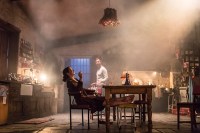
Georg Büchner, a justly neglected German playwright, died at the age of 23 leaving a half-finished script about a mad soldier and his cheating girlfriend. This relic has fascinated dramatists ever since because Büchner is regarded as a visionary left-wing artist cruelly stolen before his time. (Not a moment too soon, if you ask me.) Jack Thorne is the latest to rehash the leftovers. It’s 1981 and we’re in a divided Berlin. We meet a mopey British squaddie, Woyzeck, who shares a flat with his girlfriend from Derry who has the voice of a seagull and the personality of a dishcloth. The flat pongs because it’s located over a slaughterhouse.

Music matters | 1 June 2017

The ancient Greeks had a word for it —katabasis, descending into the depths, to the underworld itself, in search of answers. To cross the threshold between life and death, innocence and knowledge, the everyday and what lies beyond, is an act woven through art, resurfacing in each generation. For Orpheus, and for Monteverdi, the journey may be a literal one, but for Bartok’s Bluebeard, imagined in the age of Freud and Jung, hell is not found outside, or even in other people, but within the darkest recesses of our own selves. When we speak of Orpheus it is of music, of birds and beasts beguiled, and men and women drawn

Making waves | 25 May 2017

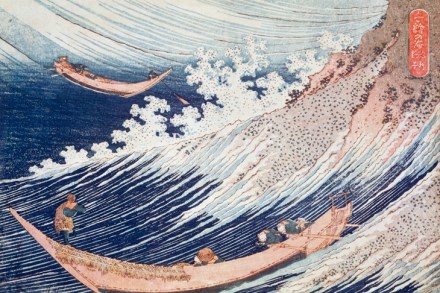
The end, whenever it came, was always going to be too soon for Katsushika Hokusai. There was still so much to see. So much he had not painted. On his deathbed, Hokusai, attended by his doctor, said a prayer. ‘If heaven will extend my life by ten more years…’. He paused and made a private calculation. ‘If heaven will afford me five more years of life, then I’ll manage to become a true artist.’ He may have been 90, but he wasn’t done yet. In life, Hokusai (1760–1849) painted dragons, creatures of long life, by the dozen. He has them disappear in puffs of inky smoke, then reappear across the

Being and nothingness | 25 May 2017

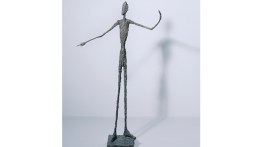
Size, of course, matters a great deal in art; so does scale — which is a different matter. The art of Alberto Giacometti (1901–66) illustrates the distinction. There are very few major artists who have produced objects so physically minuscule. But the smaller and thinner his people are, the vaster the space they seem to inhabit. That’s where scale comes in. There was a period of about five years, wrote his friend the critic David Sylvester, ‘when every figure Giacometti made (with one exception) ended up an inch high more or less.’ You encounter just such a work about halfway around Tate Modern’s big new Giacometti exhibition. Aptly entitled ‘Very

Death wish

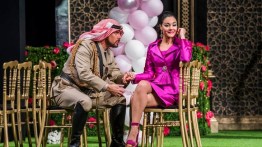
Anyone who thinks they have experienced absolute boredom, or even doubts that such a state can exist, should go to Glyndebourne’s first offering of the season, Cavalli’s Hipermestra. The first two acts, played without any break, last for 130 minutes, the third for a mere hour. The audience broke into its normal rapturous applause at the end, no doubt to reassure itself that it still existed. This opera of the inordinately productive Cavalli has been revived only once since its first outing in 1658, and I can only hope that its present resurrection is temporary and its second death final. Arriving at Glyndebourne, we saw a couple of Arabian newlyweds

When will I ever learn?

Oh, Pirates of the Caribbean, I have given you every chance down the years. Every chance. I am always hopeful. This may be the one that has a proper story I can follow, I have told myself. This may be the one in which Johnny Depp even bothers to act, I have told myself. This may be the one that doesn’t make me wish I’d stayed home where I could be doing something more interesting and fulfilling, like sorting laundry or cleaning out the fridge. When will I ever learn? When? Pirates, you’re on film five now, and I don’t understand. Well, I do and I don’t. You’re one of

Crime and punishment | 25 May 2017

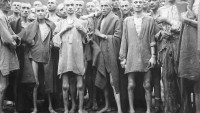
‘Hell is better than what I personally witnessed,’ says Ben Ferencz, who was one of the American troops sent in to the Nazi death camps to collect vital evidence. ‘Dead bodies mingled with those alive. Piles of bones waiting to be buried. The smell of burning flesh. Those who were still alive pleading with their eyes.’ All of which we have heard many times before, perhaps too many times. But then Ferencz added, ‘SS men trying to flee, running away, and the inmates, those who could still walk, trying to chase them, grabbing at them.’ It was an unusual, vivid detail that captured the attention. Ferencz was talking to Emma

The great rock’n’roll swindles

Birds have been giving me a lot of grief of late. There’s Tappy — the blue tit who has built his nest just underneath my bedroom window and makes rat-like scuffling noises that bother me at night and wake me early in the morning. And Hoppy, a mistle thrush fledgling who can’t quite fly yet, which means we have to keep the cat indoors, which means I have to deal with its horrible shit in the litter tray every day before breakfast. And the rookery in the big ash, whose inhabitants are very vocal, especially when one of their babies falls out of the nest and gets devoured by the

Impeccable filmmaking from Michael Haneke: Happy End reviewed

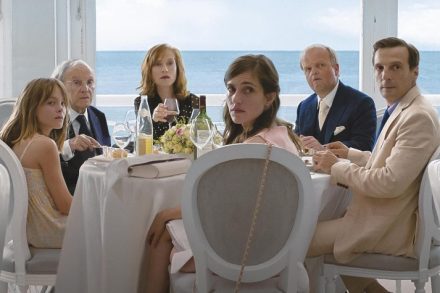
The title is ironic. The end is not happy for Michael Haneke’s bourgeois French family, whose hamper of festering secrets the Austrian director unpacks with glee. His twelfth feature, which is vying for an unprecedented third Palme d’Or at this year’s Cannes Film Festival, features an acting masterclass from French veteran Jean-Louis Trintignant as Georges Laurent, a dotty patriarch who has lost the will to live. For added piquancy Haneke has set his latest tale in the northern French city of Calais where po-faced immigrants stroll silently about the streets – their lack of menace no doubt intended as a counterpoint to the dastardly doings of the Laurent family. The significant youngest member

Amusing, waspish take-down of Jean-Luc Godard: Redoubtable reviewed

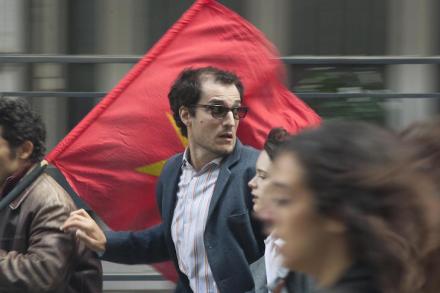
Jean-Luc Godard’s famous dictum was: ‘all you need for a movie is a girl and a gun’. In Redoubtable, French director Michel Hazanavicius’s jaunty biopic of Godard, set during the student insurrection of 1968, which premièred yesterday at Cannes Film Festival, there is plenty of the first and none of the latter. The girl is Anne Wiazemsky, Godard’s teenage bride and one-time muse, who wrote an elegant memoir of their time together, Un an après, which is the basis for Hazanavicius’s film. Wiazemsky’s role is taken by French-English actress Stacy Martin who reveals almost as much flesh here as she did in Lars von Trier’s Nymphomaniac. Though, it must be said,

Coffee, mist and brilliance: Sky Atlantic’s new series of Twin Peaks reviewed

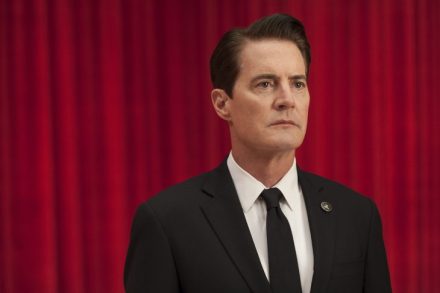
So much coffee. Just like in the original, the characters in the new series of Twin Peaks get through so much coffee. Major characters huddle around it in diners. Background characters raise mugs to their lips. Entire scenes revolve around the stuff. There’s just so much coffee. And, I’m proud to say, I played my part too. I knocked off an entire cafetière so that I’d be awake for the two-part opening to the series, which aired at 2am this morning on Sky Atlantic. And I finished another cafetière to write this post. This is not an occasion I was going to miss. Not only is the return of Twin

League of nations

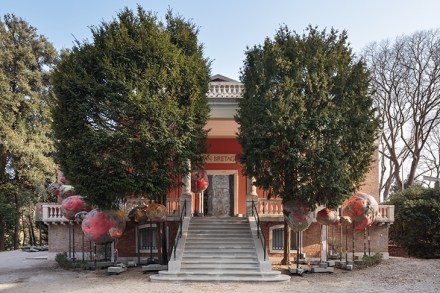
‘Are you enjoying the Biennale?’ is a question one is often asked while patrolling the winding paths of the Giardini and the endless rooms of the Arsenale. It is not easy to answer. The whole affair is so huge, so diverse and yet — in many ways — so monotonous. Like the EU, an organisation with which it has something in common, La Biennale di Venezia believes in the principle of subsidiarity. Therefore individual nations are allowed to do what they like within their own pavilions. However, there are also strong homogenising forces at work — so much of what is on view in the national pavilions and elsewhere tends

The play’s the thing | 18 May 2017

Donald Winnicott once told a colleague that Tolstoy had been perversely wrong to write that happy families were all alike while every unhappy family was unhappy in its own way. It is illness, Winnicott said, that could be dull and repetitive, while in health there is infinite variety. Winnicott was reared in an environment of plain-speaking west-country Methodism. He was a people’s doctor who earned his spurs in the crowded children’s wards of east London’s wartime hospitals, allergic to dogma and fearless of being labelled a heretic. He believed that mothers did not need experts to tell them how to care for their own babies and, equally, that artists didn’t

No laughing matter | 18 May 2017

We love Amy Schumer. Fact. And we love Goldie Hawn. Fact. But can we love Snatched? Not so much, if at all. Perhaps the addition of ‘if at all’ is unnecessary, and rather mean. But it’s done now. There are a couple of decent jokes, it’s true, but they are 1) all in the trailer and 2) happen within the first ten minutes, after which there is every chance you will 1) lose the will to live and 2) wish you’d opted for Guy Ritchie’s King Arthur. But, as we are so often warned, do be careful what you wish for. From what I’ve heard, King Arthur may not only

Killing time | 18 May 2017

Jez Butterworth’s new play The Ferryman is set in Armagh in 1981. Quinn, a former terrorist, has swapped the armed struggle for a farming career and now lives with his sick wife, their countless kids, his sister-in-law and her only son. But the IRA, who murdered his brother as punishment for his disloyalty, are due to pay a visit with unknown intentions. More violence, perhaps? Protection money? Or both. Well, neither, it turns out. They merely want Quinn to refrain from blaming his brother’s death on them. Rather a low price to ask. And yet Quinn is willing to defy them even though he knows they repay disobedience with murder,