Annilese Miskimmon, the artistic director of English National Opera, has asked critics not to reveal the ending of her new production of Tosca. Happy to oblige, though by the time Tosca makes her final exit, it’s been flagged so heavily that you’re not so much surprised as impatient to get it over with. Still, a spoiler’s a spoiler and opera, after all, is showbiz. The late Graham Vick, a genius at building new audiences, didn’t even provide a synopsis at his groundbreaking Birmingham Opera productions. Having read (and written) my share of opera synopses, there’s something to be said for that.
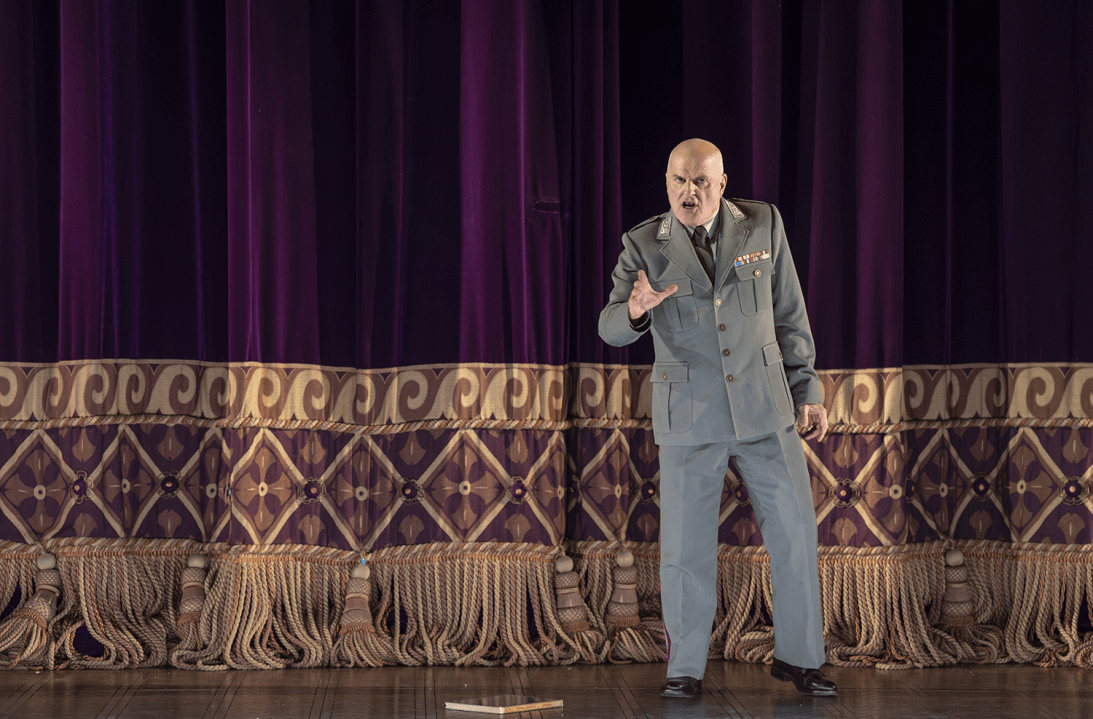
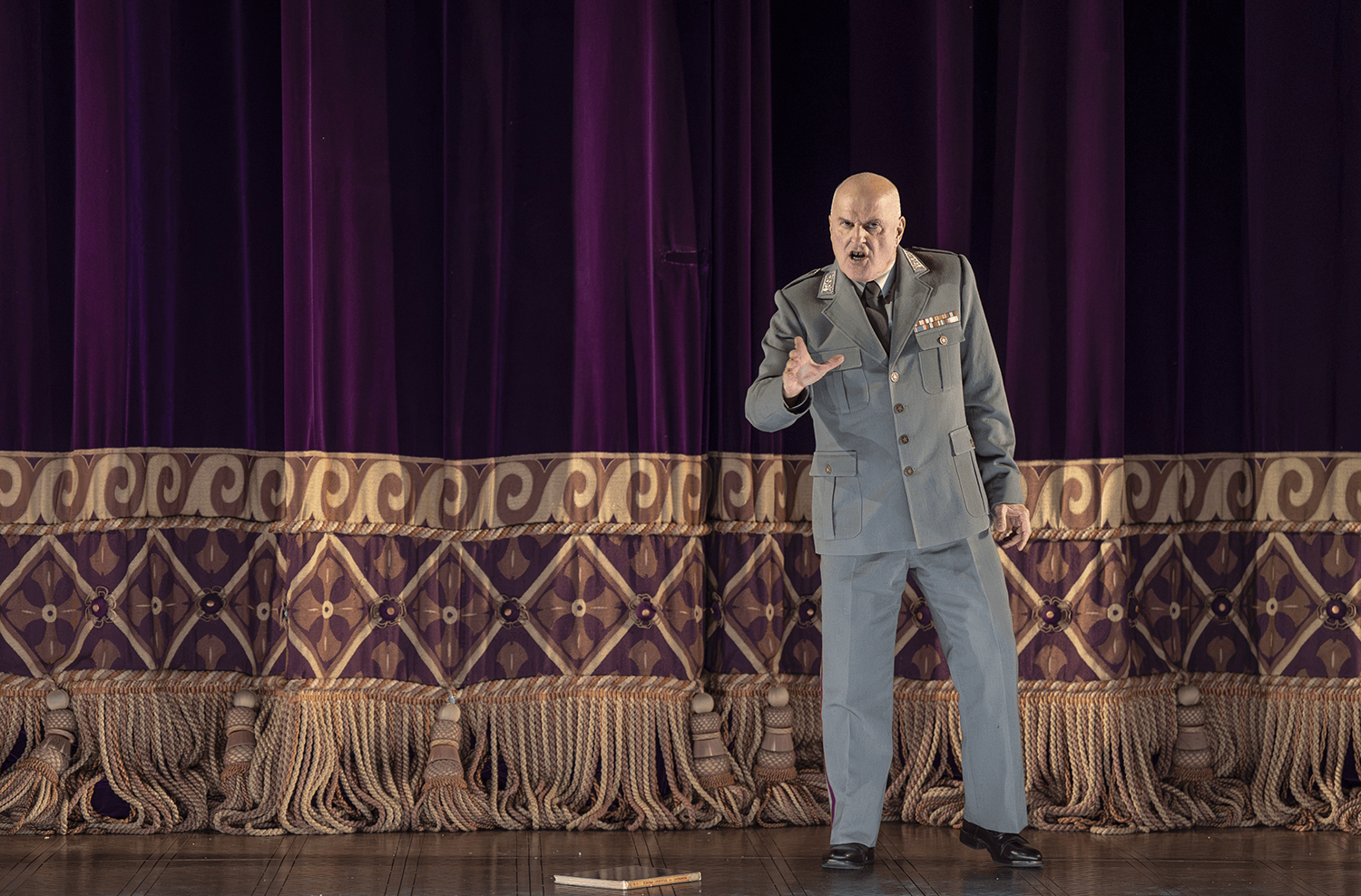
But very few opera directors are as radical as Vick. By and large, most ‘reinvented’ productions follow fashion, and Miskimmon has set the action in a contemporary militaristic dystopia – meaning that of the UK’s six publicly funded national opera companies, five currently have a Tosca set in a contemporary militaristic etc., etc. It works about as well as all the others, and this being ENO the English translation (by Amanda Holden) smooths over the worst anachronisms, though it doesn’t put anything particularly flavoursome in their place.
Instead, we get lots and lots of juicy modish brutality. There are paramilitary thugs, an implied sexual assault and – an original touch – the suggestion that Spoletta (Osian Wyn Bowen) is a predatory paedophile. The setting is a drab community hall, and the children’s choir (Marlborough Primary School, sounding exuberant) doubles as a school orchestra whose instruments are confiscated and finally heaped on a bonfire. A piano is smashed, and Cavaradossi’s fresco is whitewashed.
So it’s art good; violence bad – a simplification of Puccini’s more troubling (and more realistic) moral scheme, in which reactionary Church and repressive state are enthusiastic patrons (connoisseurs, in fact) of Cavaradossi’s and Tosca’s work. Miskimmon’s angle flatters artistic sensibilities, for sure, but it’s not very consistent. Why are Scarpia’s heavies disrupting a concert that glorifies their own regime, and murdering priests (the poor old Sacristan, wittily played and sonorously sung by Robert Hayward) who support them?
Miskimmon is a seasoned director, and she has an eye for detail. We see the flash of the prison’s warning gun, and watch the sheltering civilians recoil in fear. But there are a lot of people on stage a lot of the time, and this Scarpia (Christopher Purves) runs a remarkably slapdash apparatus of repression. For much of his time under arrest Cavaradossi (Chaz’men Williams-Ali) is free to shamble about as he pleases, occasionally sparking up a cigarette. That nightmarish sense of being isolated beyond help – of a trap closing – is wholly absent.
Performance-wise, this was one of those Toscas that has you rooting for Scarpia. Purves delivers pale, clenched menace – a Iago in military uniform, who provides a parting masterclass in the banality of evil by expiring in his Y-fronts. Cavaradossi as stoner, meanwhile, is certainly a new take on the role. For an artist, lover and revolutionary he seems unengaged, though Williams-Ali’s narrow-bore tenor, with its buzzing vibrato, did open out excitingly in the second and third acts (Miskimmon runs the first two acts together, by the way, so it’s at least 90 minutes before you can get to the loo or the bar).
Of the UK’s six publicly funded opera companies, five have a Tosca set in a militaristic dystopia
And as Floria Tosca, Axelle Fanyo is squally and bright; stronger on ferocity than tenderness and dressed, latterly, in an awful folk costume. Other audience members sounded more bothered than I was by her strong American accent; in any case, the first-night Coliseum crowd, with its claque of West End influencers, was enthusiastic. In the case of Ben Glassberg, who conducted the ENO orchestra with masterful breadth and alertness to texture, the whoops and yells were entirely merited. As for the ending, let’s just say that it involves an effect which (when the composer actually demanded it, at the end of ENO’s 2021 Valkyrie) we were told was not possible at the Coliseum. Glad to see they’ve sorted that out.
A quick word about Gothic Opera, a terrific fringe company who stage one opera a year at Battersea Arts Centre – always a forgotten 19th-century work, and always around Halloween. This year they’d chosen La Dame de Pique by the excellently named Fromental Halévy, and it’s my regrettable duty to report that the opera itself (a pre-Tchaikovsky adaptation of Pushkin’s The Queen of Spades, composed in 1850 and set in pre-revolutionary France) is a dud. It’s boilerplate French romanticism; well crafted and formulaic.
No matter: with skilful lighting and judicious use of mist, the minimal sets created a marvellously sinister atmosphere. The seven-piece orchestra was brilliant, if a little glockenspiel-heavy, and James Hutchings (as Constantin) is a lead tenor to watch. Hannah von Wiehler conducted, Johnny Danciger was the imaginative and resourceful director and the whole (largely youthful) company went at it with such panache that it was very hard to resist.






Comments