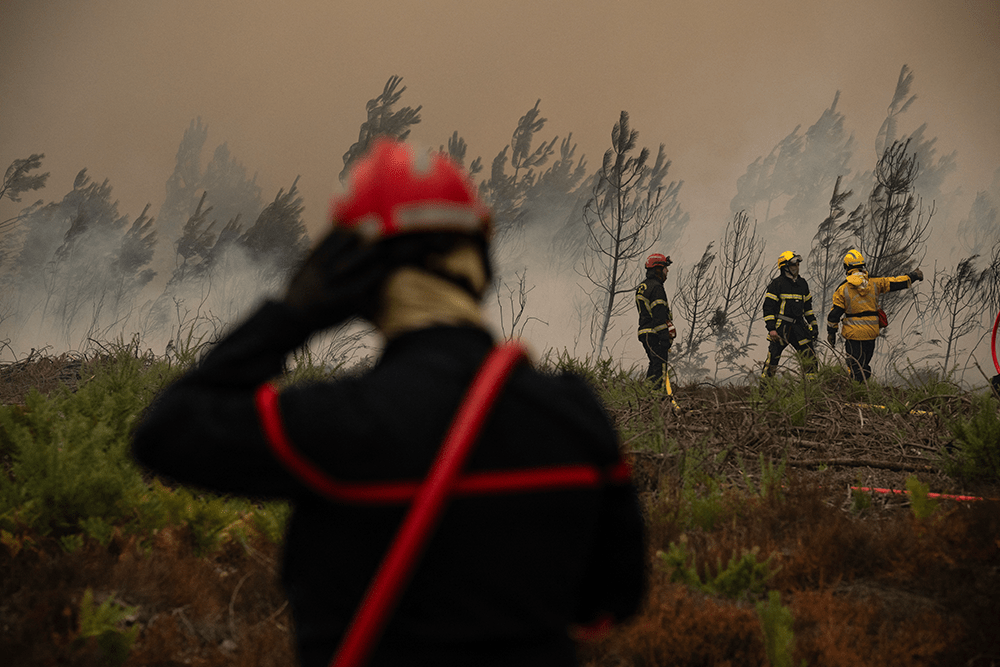


There was something surreal about my visit to La Cité du Vin, Bordeaux’s wine museum, last Saturday. From the top floor, with its panoramic view of the city, you could see the smoke from the Gironde wildfire turning the sky yellow, yet none of the staff seemed remotely concerned. This was in spite of the fact that the conflagration had already triggered France’s largest evacuation since the second world war and was getting closer to Bordeaux every hour. OK, maybe they thought it unlikely they’d be asked to leave their homes, but weren’t they worried about the region’s vineyards? These people worked at a museum dedicated to celebrating wine, for Christ’s sake.
Some of the finest reds in the world are located on the Gironde’s left bank, the same side as the fire
The day before, I’d made a pilgrimage to Château Rauzan-Ségla as part of a trip to Bordeaux which Caroline had organised to celebrate our 25th wedding anniversary. It was 35°C when we were taken into the vineyard – the first stop on the tour – and at that point our guide seemed more concerned about the ongoing drought than the nearby fire. The lack of rainfall means the berries are still quite immature, but that could turn out to be a blessing as unripened grapes are less likely to suffer from ‘smoke taint’, whereby an entire vintage can be contaminated. Even if the fires don’t reach the vineyards, the smoke probably will. By the time I left Bordeaux on Saturday afternoon, the entire city smelt like a bonfire.
I know I risk sounding like an unfeeling plutocrat, given that several firefighters have already lost their lives, but I cannot help thinking about the 61 crus classés of 1855. These are among the finest reds in the world and all are located on the Gironde’s left bank, the same side as the fire. If they go up in smoke, it would be a civilisational blow equivalent to the Louvre burning down. I’m amazed there’s been so little attention devoted to this in the coverage the fire’s received. Yes, the threat to the local wildlife probably makes for a better story, but even so. We’re talking about Lafite Rothschild, Latour and Margaux.
I was keen to go to Rauzan-Séglabecause its second wine is one of my favourites, particularly the 2015. The winemaker did better than many of its competitors that year because the recently appointed director, Nicolas Audebert, took the bold decision to bring the harvest forward by three weeks. I fantasised about meeting Audebert in the underground vault where the magic happens and comparing tasting notes.

Getting in wasn’t easy. Rauzan-Ségla is owned by the same family who own Chanel, and when Caroline called the château to book a tour she was quizzed about my taste in wine. She had to send photos from my collection, but because the whole trip was supposed to be a surprise she couldn’t ask my advice about which bottles to photograph and chose some pretty ropey ones. ‘C’est pas possible,’ came the haughty reply. She ended up having to book the trip through a tour operator called Smooth Red, which was better at sweet-talking the gatekeepers than her.
Naturally, the difficulty of getting past the velvet rope made the experience that bit more special, although seeing up close how a famous wine is produced was always going to be fascinating. Some of it I knew, but much of it I didn’t, such as the fact that the juice is initially left to mature in wooden barrels produced by master craftsmen, with each cooper’s brand introducing different notes. I had naively thought that the different elements that need to be combined to create a great vintage were just varieties of grapes, with the wines of the left bank dominated by Cabernet Sauvignon. But in fact there are dozens of different variables, including the barrels, and there’s no formula to fall back on, because of how the ingredients taste changes from year to year. It’s an art that owes as much to the institutional memory of a great château as it does to chemical analysis.
The climax of the tour was a trip to the tasting room, from which you could see the vines that had produced the wine in your glass. We sampled the 2019, 2017 and 2015 – all good vintages, although the first two are a little young. The 2015, by contrast, was exquisite, and our guide kindly gave us the bottle to take home. As we sat in our hotel later, drinking the wine, ashes began to appear outside the window and a smell of burning trees filled the room. Caroline found an Instagram video of horses galloping down a main road in Cap Ferret to escape the fire, and started worrying about them and all the pets people have been forced to leave behind. But my mind was still fixed on the 61 crus classés. Please God, let them be spared.






Comments