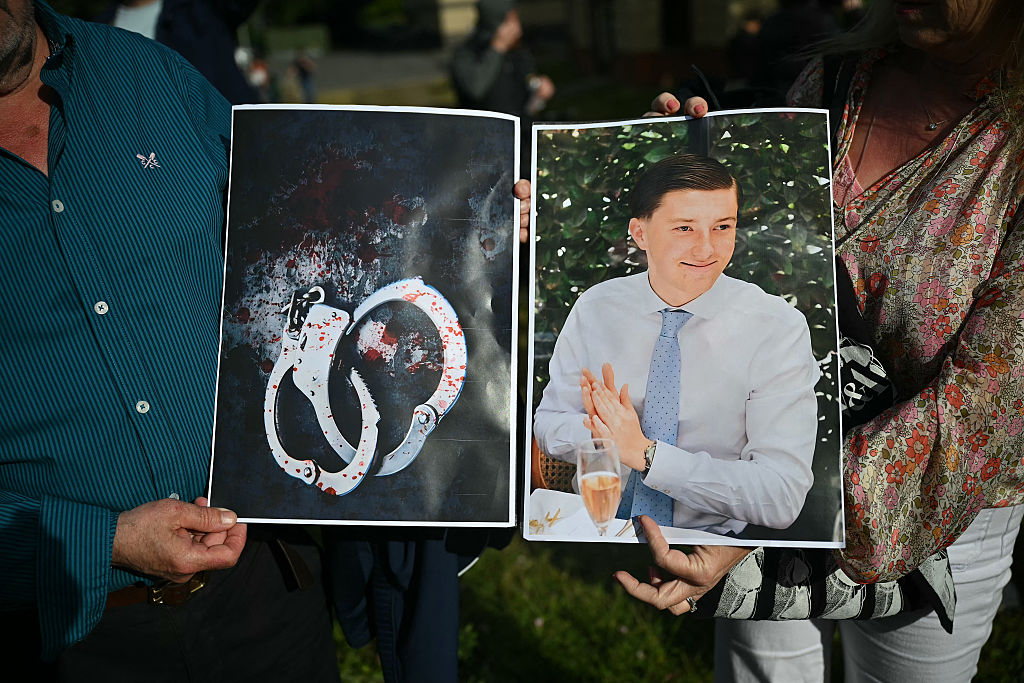
Britain’s Independent Office for Police Conduct (IOPC) have announced they are investigating two officers who attended the scene of Henry Nowak’s death. This does not necessarily mean they will face disciplinary proceedings, merely that such proceedings are now possible. This was probably the only course of action open to the IOPC, particularly after last week’s release of a transcript and more video footage of the incident, seemingly with the consent of the Nowak family. They paint both the police and the Digwas in an even more damning light.
The video shows Vickrum Digwa being questioned by police while Henry lay dying on the ground nearby. Henry was manhandled by police and cuffed behind his back. When he said he’d been stabbed, the officer replied, “I don’t think you have mate.” By contrast, Vickrum Digwa was politely questioned by an officer. During that questioning Digwa lied that he had been the victim of a racist attack by Henry, and claimed that his brother was a witness to the assault. Even when being arrested on suspicion of attempted murder, Digwa was not handcuffed by police. The difference in their treatment, the two-tier policing driven by anti-racist doctrine, could not be clearer.
The transcript may be even more damning. From it we now know that it took the police officers who arrested Henry eight minutes from arriving on the scene to search for and discover his stab wound. This is despite Henry telling them he’d been stabbed when they arrived, being deathly pale and losing consciousness shortly after being arrested. Again, their assumptions about guilt and innocence were very clearly at play.

No doubt as a result of these videos and transcripts being published and contact from Henry’s family, the IOPC are also investigating whether the “race or religion of either Henry or the Digwa family impacted on the actions and decision-making of the officers.” But can they be trusted to investigate properly and fairly? There are reasons to be skeptical.
The IOPC’s “director of investigations,” Nicola Marfleet, took up her role in May 2025. Prior to that she was governor of HMP Woodhill, a high-security jail which was given an “Urgent Notification” – put into special measures – by HM Inspector of Prisons who found “a worrying decline in outcomes across all four” of their “healthy prison tests.” Inspectors reported that “leaders had yet to take effective action to make the prison safer,” “were not tackling the…lack of access to basic amenities.”
Earlier in her career, as deputy governor of Woodhill, she was heavily criticized in a 2018 employment tribunal, in which the judge said she “painted a picture… both wrong and prejudicial,” and that she claimed to have read a report “very carefully,” but did not note the obvious errors and omissions in the reports, nor did she question the absence of documents.
None of this stopped the British state rewarding Marfleet with an OBE in December 2025, and a very senior role overseeing investigations into police misconduct.
When I asked the IOPC to comment they said the following. “Nicola Marfleet was appointed our Director of Investigations in 2025 after she was the successful candidate in a highly competitive four stage recruitment process. Like all senior IOPC employees, Ms. Marfleet was subject to rigorous pre-employment checks.”
I also spoke to Nick Timothy, the shadow justice secretary, who told me, “this appalling story says a great deal about what is wrong with the civil service, prisons and criminal justice system. We need everything to change, so we can find, promote and reward the best leaders and ensure accountability throughout the whole structure. There is nothing more important than law and order and public safety. Rewarding failure is simply unacceptable.”
I would go further than Timothy. While I understand that individual decisions on IOPC investigations are made by investigations managers, someone like Marfleet simply cannot be trusted to do this job properly. None of us, and most of all Henry Nowak’s family, can have trust in an organization which appoints failures to senior positions.
In the end we may have to rely on the full inquest, which plans to probe the role of the police in Henry’s death. Coroner Jason Pegg has said “the issue in this case is likely to be whether any act or omission by a police officer or any delay in the treatment Henry Nowak received caused or contributed to death.”
So in the end we will learn whether police officers’ anti-racist handling of Henry accelerated his death, and whether a different approach might have saved his life. Ultimately, those officers may well face prosecution. This is right and proper. No justice system, and no country, can excuse, or reward the failure of its public servants.





Comments