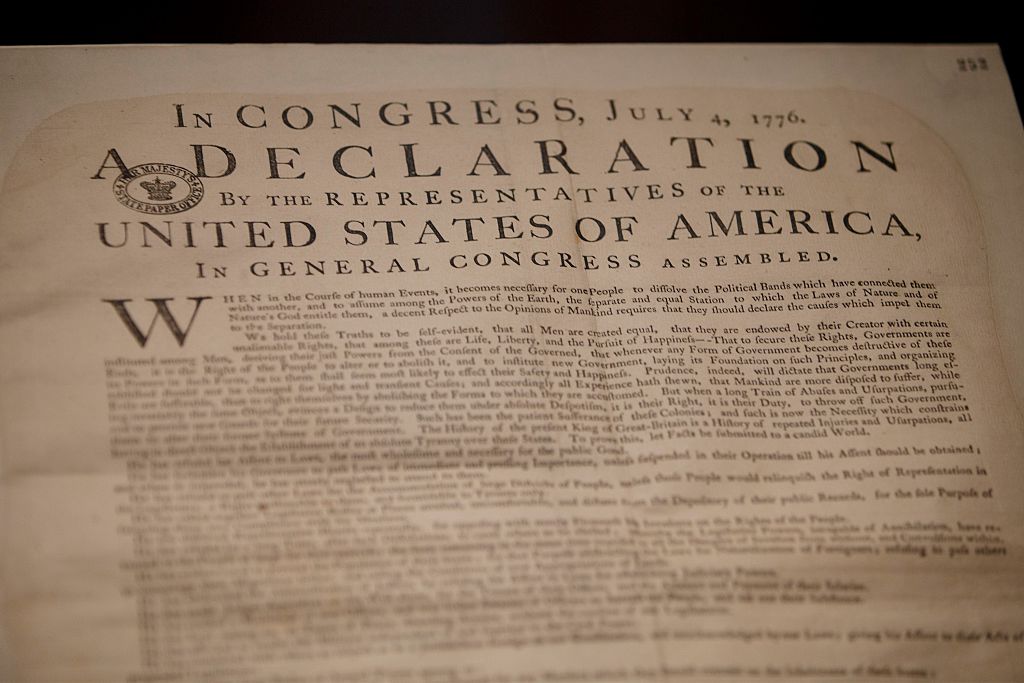
Supreme Court Justice Neil Gorsuch’s tour to tout his new children’s book about the Declaration of Independence should have been uneventful. But then Gorsuch decided to talk about what America is.
On Fox News, with the New York Times and in the pages of the Wall Street Journal, Gorsuch kept staking out his view on what makes America special: America has no religion, no race, no people at all really, but instead a singular majestic idea.
“We’re a creedal nation, right,” Gorsuch told the Times. “I mean, we don’t share a religion, we don’t share a race, we share an idea, OK? And that idea has to be passed down generation to generation through history, as we discussed.”
That idea, Gorsuch says, is the words of the Declaration of Independence: that all men are equal, that they possess God-given rights and they have a right to self-government. These concepts alone, he says, define the American nation.
There may soon be enough American citizens raised in China to swing a US election
There’s nothing novel about Gorsuch’s statement. It is classic conservative pablum, syrupy boilerplate of the highest (or lowest) order. Calling America a “creed,” a “proposition” or an “idea” has been a lazy go-to for American conservatives afraid to give their country any further cultural identity.
In 2016, Paul Ryan called America “the only nation founded on an idea, not an identity.” At the 2012 RNC, Marco Rubio called America a nation “united not by a common race or ethnicity, [but] bound together by common values.” Irving Kristol boasted that “being American has nothing to do with ethnicity, or blood-ties of any kind, or lineage, or length of residence even.”
At almost any other time since World War Two, Gorsuch’s remarks would be unremarkable. It’s an appealing take if one doesn’t think much about it: generous, optimistic, morally flattering. It carries no vague whiff of racism (which Gorsuch’s generation has learned to fear more than anything, including death) and it means nobody has to fear feeling left out in America.
For a long time, whether it was true or not, it at least felt harmless. But at this very moment, America is facing a reckoning with Gorsuch’s saccharine attitude. We are about to find out whether mindless rhetoric and a naive self-conception can kill a country. Because, of course, in a matter of weeks, Gorsuch and his eight fellow justices will rule on the question of birthright citizenship. Fed up with anchor babies and birth tourists, the Trump administration hopes to clarify that US citizenship is, in fact, only passed on to the children of those who actually owe America allegiance, rather than every traveler peregrinating through its borders.
We don’t know how Gorsuch will vote, yet reducing America to a mere “creed” anyone can sign on to has long been the first step for American conservatives to justify mass immigration, amnesty and more. Since only the American “idea” matters, there is little moral ground for leaving anyone out, and in any case, since the people themselves are irrelevant, nothing is ever changed or lost by bringing them in.
Yet no matter how often repeated, the idea that America is a “creedal” nation detached from physical reality is so flimsy it can be collapsed with little more than a series of rhetorical questions. Has America ever gone out of its way to recruit immigrants who adhered to its supposed shared creed? Has America ever taken steps to expel residents who reject it? If blood is irrelevant to American nationhood, why does US citizenship still pass automatically from parents to their children? If the Founders meant for America to be defined by ideas alone, why did America’s first Supreme Court Justice, John Jay, write in “Federalist No. 2” that America was blessed to have “one united people… descended from the same ancestors, speaking the same language, professing the same religion, attached to the same principles of government, very similar in their manners and customs?” Why did Thomas Jefferson himself warn America against excess immigration, precisely because emigrants from monarchies could not be counted to preserve “temperate liberty?”
At best, when people reduce America to a mere idea, they are just lazily saying something pleasant (fine for dinner party chat, but unfortunate from a Supreme Court Justice). More often, the idea of a “creedal” America is simply a façade – it is actually a way of saying it has no identity at all, or one so vague that America can import any number of new arrivals, from anywhere on the planet, without destroying or even endangering its fundamental character.
So, which is it for Justice Gorsuch? His vote on birthright citizenship will give us the answer. If Gorsuch does, in fact, rule that US citizenship is the right of anybody born on US soil, regardless of circumstance, then he will also be voting to abolish one of the very concepts he just extolled as a core American “idea” – the right of Americans to govern themselves.
Because, in the present age of jet travel, tourist visas, IVF and surrogacy, birthright citizenship is a policy of handing a nation’s existence over to the rest of the planet, to preserve or destroy it at will.
An estimated 26,000 children are born in the US via birth tourism every year – higher than the annual number of births in 15 US states. About a third of all surrogate births in America are for foreign parents, whose children, raised abroad, will still possess lifelong US citizenship. In California alone, there are hundreds of companies dedicated to helping Chinese citizens find a surrogate who will give birth in America. There may soon be enough American citizens raised in China to swing a US election – and all of this is dwarfed by the reproductive efforts of illegal immigrants, whose children make up a tenth of all births in the US.
Neither these new citizens nor their parents will be expected to buy into some quintessential American idea – but they will have the right to abolish that idea. And if that idea is gone, what identity will America have at all, according to Gorsuch?

Comments