
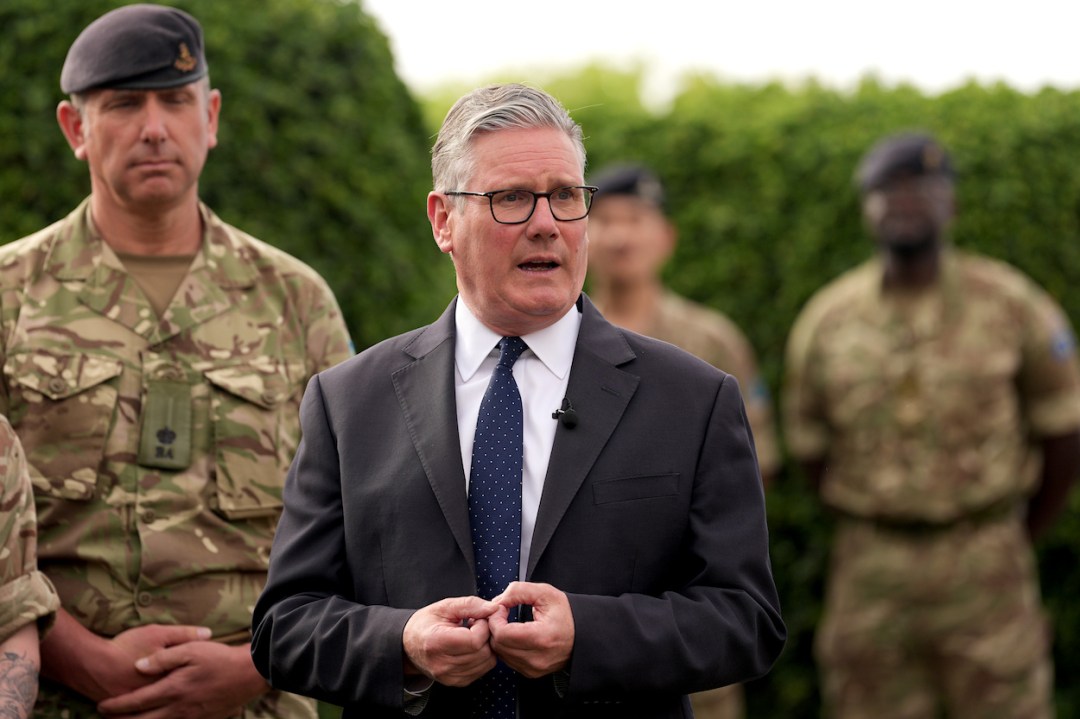
George Robertson’s critique of the government’s reluctance to commit to proper defence spending is deeply politically inconvenient for Keir Starmer. This is not just because the Prime Minister has tried repeatedly to claim that Labour is the party that is protecting the armed forces – while holding onto Ben Wallace’s ‘hollowed out’ line about the Tories as a comfort blanket. But the speech that the co-author of the strategic defence review will give tonight also highlights the government’s failure to reform welfare, with one of the pre-trailed lines being ‘we cannot defend Britain with an ever-expanding welfare budget’.
This morning, a government spokesperson insisted that ‘we are finalising our defence investment plan that will publish as soon as possible, putting the best kit and technology into the hands of our forces, rebuilding British industry to make defence an engine for growth and doubling down on our own commitment to Nato.’
Starmer has so far failed to resolve the tension in his own government over defence spending which is holding up the very, very delayed defence investment plan, and over welfare cuts and reform. The latter is something this prime minister is now incapable of getting to grips with, having messed up the opportunity he had to reform benefits by allowing the Treasury to propose crude cuts and dress them up as ‘reform’. He is now pursuing the most modest of changes that he knows will get past his agitated MPs, rather than the sort of radical and thoughtful overhaul that the system needs – and which he could, had he managed his large majority properly from the outset, have designed and implemented. Instead, on welfare and on defence we are left in the political equivalent of a phone queue where the government acknowledges that something is important, but does little about it.
Labour has ended up being the ‘your call is important to us’ government, subjecting the public to a much more painful version of holding music in the form of Starmer talking at length about the problems the Conservatives left the country with. It’s not just on welfare or defence: it’s social care, immigration, healthcare, really any of the big intractable problems that the Prime Minister knows he must address but which he doesn’t have a great deal of will to deal with beyond insisting that he takes them more seriously than the last lot. At least most of the real telephone queues eventually reach a conclusion, whereas the reality for Starmer is that he has already lost the political capital he needed to address the big policy questions, meaning the British public has a lot longer to wait for someone who really will answer the call.




Comments