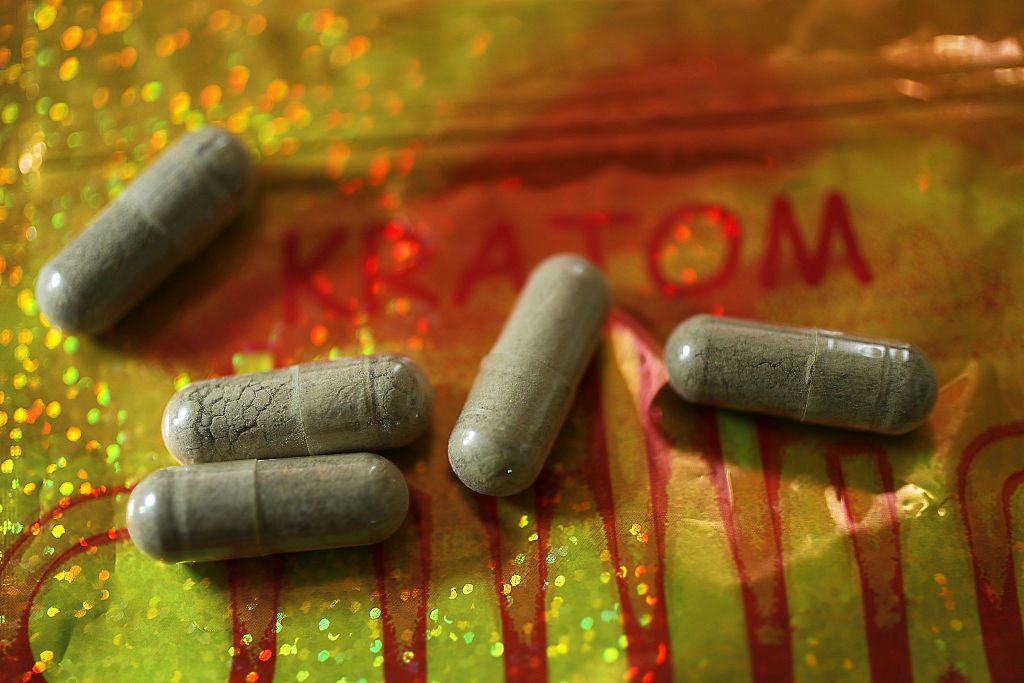
You could visit a gas station every day and never realize that, alongside the candy and the disposable vapes, it was selling kratom, a potentially lethal drug.
Kratom looks normal – just another herbal pick-me-up. It is sold as tablets, gummies and in little bottles of “tonic,” with names such as “Kraken” and “Happy Hippo.” But I’m a police officer in Charleston, South Carolina. And in my line of work, we call it “gas station heroin.”
I tend to finish a 12-hour shift, in the early morning, on the side of a highway in a gas station among the longleaf pines and chirping crickets. And I see a lot of kratom. It comes from the leaves of a Southeast Asian tree, and its active chemicals act on the brain’s opioid receptors. As a pure product, it has long been popular among wellness advocates and hippies. But what’s sold over the counter tends to be concentrated extracts or even more powerful synthetic derivatives. In small doses, it’s a stimulant but when taken in larger doses it works as pain relief and makes you drowsy. And just like a real opioid, you can overdose and die. As many as two million Americans use it regularly and a recent study by the University of Michigan and Texas State found that the majority meet the criteria for substance use disorder. Kratom is incredibly addictive.
In September, in Oxford, Mississippi, two college students at separate addresses were killed by kratom capsules. Aidan Hamilton was 18 and a freshman at Ole Miss. He was found dead in his dormitory room. About an hour later, police were called to an off-campus address, where 20-year-old junior Robert Strang was also found dead. Near both bodies were the open packets of “Smax.” Each packet had $39.99 price stickers and each had a black smudge over the first nine. The flavor was “Mango Breeze.”

Strang’s roommates pointed detectives toward a gas station in a nearby town. Bank records showed Strang made two purchases there. The day after his death, an undercover narcotics officer went in and successfully bought Smax. Hamilton’s bank records led the police to a different vape shop near the university. Three days after the deaths, they sent in a secret informant to pretend to be a customer that wanted to buy some kratom.
According to the arrest affidavit, the shop’s clerk, Yahya Mohamed Mosleh, took a key, unlocked a drawer beneath the till and brought out a packet of Smax. The customer indicated that this was what he wanted and Mosleh laid out several more. Mosleh told him to be careful with these pills. People were dying from them.
At this point, other customers entered the shop. Mosleh quickly pushed the packets out of sight and told the man to keep quiet . The man moved away from the counter and waited. When the shop was clear, he returned and handed over $100. Mosleh put the pills into a black plastic bag and tied it closed. Then he again told him to be careful. Police subsequently searched the shop. There were the same Smax packets, the same $39.99 price and the same black smudge over the nine.
According to a postmortem, both students’ blood contained mitragynine, kratom’s main active chemical, along with MGM-15 and MGPI, two potent opioids chemically related to it. Mississippi has no statewide ban on kratom. In fact, it is only illegal in 14 states.
For federal prosecutors, however, there was another route. On August 26, less than a month before the students died, the DEA had placed MGM-15 and MGPI in Schedule I, its most restrictive category of controlled drugs. The contents of the packets were now a federal matter and Mosleh and his 18-year-old son, Islam, were charged in federal court with possession with intent to distribute controlled substances.
For Americans without health insurance, the attraction of kratom is easy to understand. Prescription painkillers can be expensive and hard to get. Kratom doesn’t require a prescription and you don’t need to meet a drug dealer late at night. But just like heroin, going without means aching muscles, cold sweats, diarrhea and lying awake until morning. You need another packet just to keep this at bay.
Between 2020 and 2024, the Centers for Disease Control linked kratom to more than 5,000 overdose deaths. In early October, Utah announced that four deaths were directly caused by gas station kratom. In each of those Utah deaths, the products had labels promising customers that what they were taking was perfectly legal.
Last summer, I stopped a man who had managed to give up fentanyl, a drug that is extremely addictive and 100 times more potent than heroin. Kratom was proving more difficult. When I asked where he bought it, he named a gas station I knew well. Most of us went there for coffee each morning.
I had stopped him because he was driving as though he were drunk. At his window, there was no smell of liquor on his breath, no half-drunk cans in the cupholder. He was steady on his feet, too. But when I searched the car, I found empty kratom packaging in almost every crevice: bottles, pill strips and wrappers from edibles, all sorts of different brands.
He said it had started with a back injury at work and a prescription for painkillers. When the doctors wouldn’t renew it, he began buying fentanyl. By then, he realized he had gone much further than he had ever intended. He managed to get off it. But it was kratom, he said, that had ruined his marriage and driven him into petty crime. He was living in the car. Whatever he earned delivering food and groceries went straight back to kratom. He couldn’t stop buying it. Had I found fentanyl, he would have spent the night in jail. But there was nothing in the car I could arrest him for. I had to let him go.





Comments