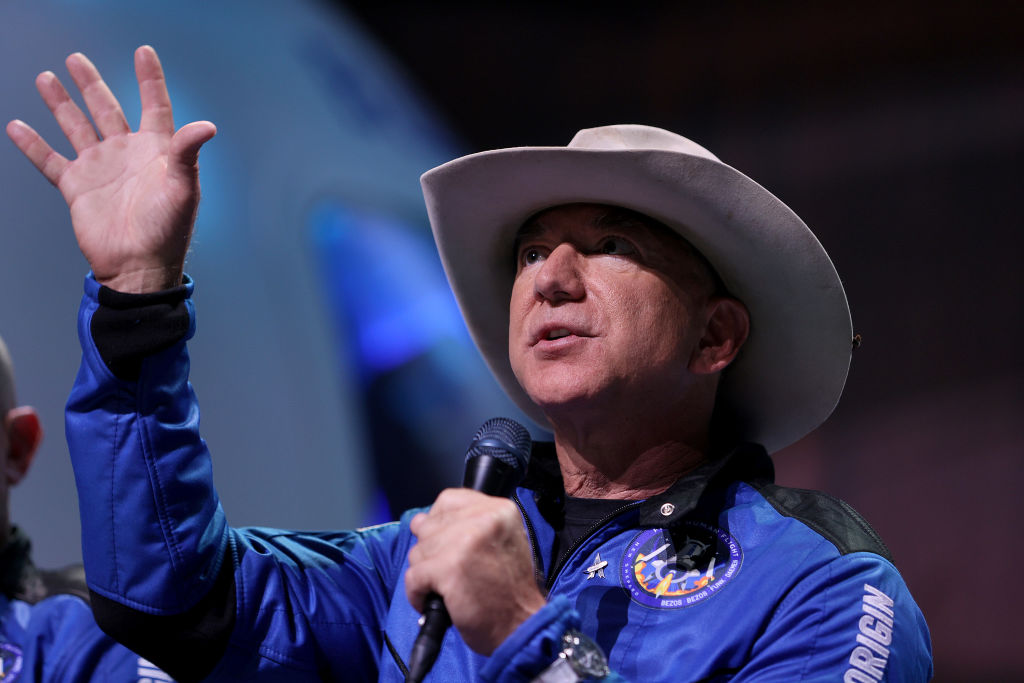
Even Elon Musk has to face a dose of reality every once in a while. Technology and politics have forced him to turn his gaze away from Mars, for the moment at least, to put Americans back on the surface of the Moon before China gets there. But it might already be too late. If America has any chance of beating China, it now seems inevitable that the next American human landing on the Moon will not be by Musk’s Starship but using a craft being developed by his rival Jeff Bezos.
Announcing the pivot, Musk wrote on X: “For those unaware, SpaceX has already shifted focus to building a self-growing city on the Moon, as we can potentially achieve that in less than 10 years, whereas Mars would take 20+ years. The overriding priority is securing the future of civilization and the Moon is faster.”
Since its inception in 2002 Mars has been the focus for SpaceX. The company faced a series of setbacks on the road to becoming the world’s most prolific satellite launcher – at its nadir it was one failure away from collapse had its Falcon 1 rocket failed for the fourth time in 2008. It didn’t, though satellite makers remained wary and the craft’s projected launch rate was insufficient to be profitable. What followed was a stroke of genius. Falcon would launch SpaceX’s own satellite constellation – Starlink – whilst growing its reputation, flight rate and reducing costs. The result was space dominance and the cash to think big.
The big thinking was the Starship and the superheavy booster, which is the most powerful rocket ever built with twice the power of the Saturn V that sent the Apollo astronauts to the Moon so many decades ago. Just over a year ago Musk said that SpaceX and Starship will go “straight to Mars,” and that the Moon was a distraction.

But there was a problem with the Mars priority. In April 2021 NASA selected Starship to take astronauts to the lunar surface. The award was controversial. NASA countered by saying it had given SpaceX the contract because Elon Musk had a history of delivering. Five years later Starship is nowhere near ready.
Since 2023 Starship has launched 11 times on development missions. Six of these flights have been successful or partially successful, five have been failures. Yet this is the vehicle that NASA wants in just a few years to dock with the Orion capsule in lunar orbit and ferry the crew to the surface and back again. To get to the Moon Starship needs refueling in Earth-orbit (no Starship has yet orbited the Earth) which will take 10-12 refueling flights. In-orbit refueling is untested on this scale.
Meanwhile Artemis 2 with the Orion crew capsule is still on the pad at Cape Canaveral, delayed until March because of a fueling problem. Artemis 2 is intended to be the first crewed mission around the Moon since Apollo 17 in 1972. It is to be carried into space by the Space Launch System, which uses former Space Shuttle components, and has launched just once in the past 15 years.
Yet given all these problems Elon Musk has said the Starship will make a test landing on the Moon next year, and will then put astronauts on the Moon a year later with Artemis 3.
This is where reality bites. With China advancing its space ambitions it is time to stop pretending. The stars are not necessarily aligning for SpaceX.
Last fall the then-Acting NASA Administrator Sean Duffy became concerned with the pace of Starship’s progress, and announced that he was going to reopen SpaceX’s Moon landing contract to competition from other companies.
Later in the year in a Congressional testimony former NASA administrator Michael Griffin was harsh in his criticism. He advocated cancelling Artemis 3. “China is sticking to a plan that makes sense. It looks a lot, in fact, like what the United States did for Apollo. We have stuck to a plan that does not make sense.”
Jeff Bezos’ far more traditional Blue Moon lander lost out to Starship in 2021 for the contract for the next lunar mission and subsequent touchdown, but was awarded the one after that – Artemis V. Bezos’ company is now designing Blue Moon Lander 1.5 and insiders expect it to be given the first landing.
But the Blue Moon lander also has its problems. It uses a space tug to transport it to the Moon which will also require up to six Earth orbit refueling missions by Bezos’ New Glenn rocket, which has so far only flown twice. A test variant is expected to be sent to the Moon later this year. It’s smaller and more compact than Starship and it also carries a crew of 4.
Yet Musk is adamant that success is in sight, claiming that “Thanks to advancements like in-space propellant transfer, Starship will be capable of landing massive amounts of cargo on the Moon… Once there, it will be possible to establish a permanent presence for scientific and manufacturing pursuits… Factories on the Moon can take advantage of lunar resources to manufacture satellites and deploy them further into space.”
Therein lies the problem. Long-term vs short-term. The irony is that SpaceX once made other aerospace companies and NASA look slow. But faced with the real and immediate prospect of China putting people on the Moon before them, many are now regretting focusing on the long road to cities on Mars.



Comments