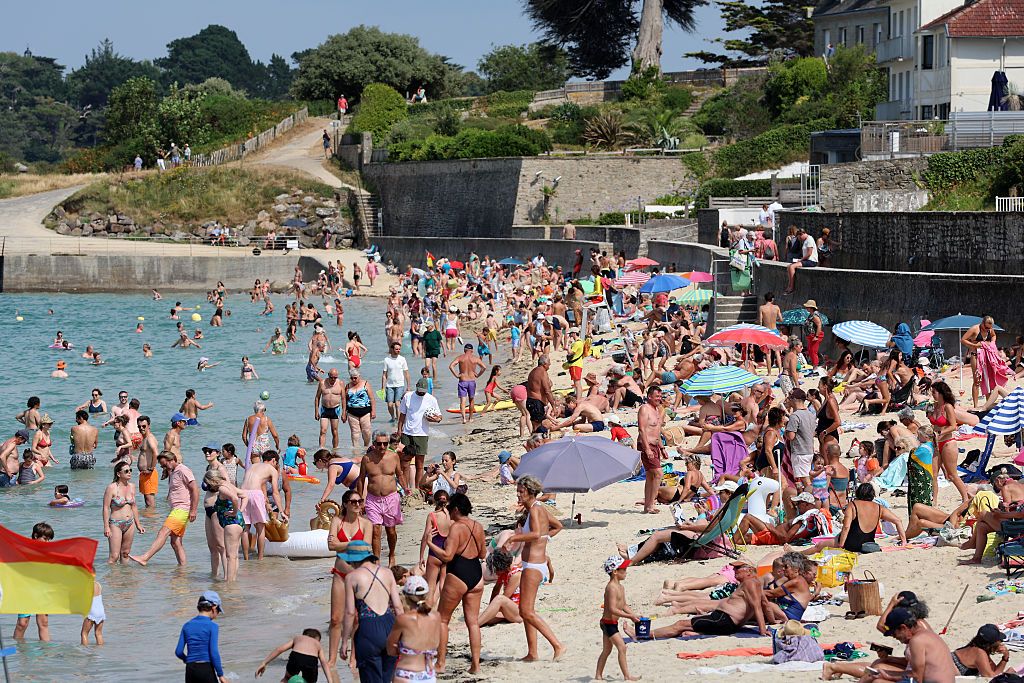
Five million people live in Brittany but each summer the population swells to three times that figure. It seems that some locals have had enough. It’s not overtourism per se that is the problem but it’s the presence of Parisians that particularly grates.
In recent days cars with Parisian number plates (ending in its departmental number of 75) have been vandalized in some towns and graffiti has been daubed on walls telling Parisians “to get out.”
Frankly, Paris is another country to the rest of France
This resentment has been simmering for a number of years. There were protest marches in 2022 about the difficulty for Bretons to get their feet on the property ladder. The Covid lockdowns of 2020 led to a huge surge in demand for holiday homes in Brittany, especially from Parisians in search of a seaside bolthole. In some towns 80 percent of houses are holiday homes.
The mayor of Plobannalec-Lesconil has reacted with dismay to the hostility expressed by some of his residents in recent days. “I wish to express my deep indignation and revulsion at the acts of vandalism committed against vehicles registered in the Paris region,” he declared.
Parisians are the main target of the malcontents but there has also been a message for tourists in general. On the wall of a building in Douarnenez was daubed in English the declaration: “Refugees welcome, tourists go home!”
What shocking xenophobia from a region that prides itself on its openness. Bretons like to boast that theirs is the only region in mainland France that has neither a mayor nor an MP from Marine Le Pen’s National Rally. In the 2017 presidential election, few regions were as supportive of Emmanuel Macron as Brittany but in recent years there has been a drift towards Jean-Luc Melenchon’s far-left La France insoumise (LFI).

Plobannalec-Lesconil and Douarnenez are in the constituency of Finisterre, the scene of a fierce contest in the 2024 parliamentary election. The candidate from Macron’s party edged out her LFI rival by just 3 percent. It was a similar scenario in Paris in the 2024 elections. Macron’s party won the seats in the center and west of the capital while LFI were successful in the north and east. The National Rally have no representation in the capital.
For many on the far-left there is no difference between Macron and Marine Le Pen; one is despised for being a “fascist” and the other for being the “president of the rich”. It is, however, harder to single out Le Pen voters. There are millions more of them for a start, and they are scattered across France – everywhere except Paris. Many of them are working-class men and women who have defected from the Socialist and Communist parties.
Macron voters are much easier to identity by their dress, their behavior and their expenditure. There are also so few of them nowadays, and most live in wealthy enclaves in Paris, Bordeaux and other major cities.
The irony is that these Macron-supporting Parisians are loathed by Le Pen voters as much as they are by LFI supporters.
I live in rural Burgundy, Le Pen land, where the National Rally won a landslide in the 2024 parliamentary elections. I’ve never been told to “go home” by the locals and have been warmly welcomed. On other hand they’re less friendly towards affluent Parisians. They tolerate them – and as in Brittany they have no problem taking their tourist money – but they have little in common with most Parisians.
Frankly, Paris is another country to the rest of France. In 2010 the sociologist Christophe Guilluy wrote a book entitled Les fractures françaises in which he warned of a country losing its social and cultural cohesion. The British answer to Guilluy is David Goodhart, who coined the phrase “Somewheres” and “Anywheres” in his 2017 book The Road to Somewhere.
In Britain and France there is a now a distinct disconnect between the cities and the “sticks”. In some cases, as in Brittany, it can be an economic disparity but elsewhere, like Burgundy, the gulf is ideological.
In 2017, Macron declared that there is “no such thing as French culture”. Maybe not to a progressive (adopted) Parisian like him but French culture is alive and well in the provinces. And they don’t want it contaminated by Parisians.




Comments