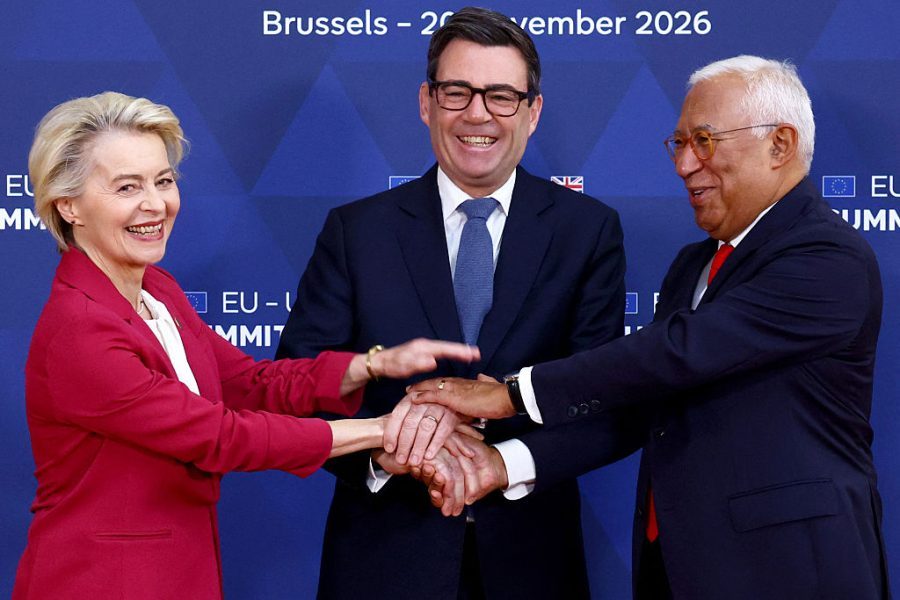
The weekend’s press and social media were full of takes on last week’s Brussels summit. Different as they all were, there was one thing they all had in common: every one of them was irrelevant. As has been almost every word written or spoken about the would-be deals since last week.
It’s not going to be up to Andy Burnham, Ed Miliband or Hamish Falconer – the motley crew now in charge of our EU relations – as to what happens next. It’s not even going to be up to Ursula von der Leyen and her fellow EU commissioners. It’s up, rather, to the 50 million French voters who will choose a president next April.
Should either win, the main player in Burnham’s beloved EU will be a French neo-fascist
Back in the day, British EU fanatics used to use a (surely apocryphal) newspaper headline, ‘Fog in Channel, Continent Cut Off’, to caricature Brits who had doubts about the European project. How parochial their fellow Brits are, they sneered, as they then did throughout the Brexit referendum and as they have done ever since we left. But there is a delicious irony in how the government thinks it is now paving the way for deeper ties with the EU – and possibly rejoining – by offering up on a platter a willingness to allow Brussels and the European Court of Justice to once again determine British law, by conceding rule-taking in return for supposedly smoothing the path of British exports to the EU.
Burnham, Miliband and Falconer appear to think they are engaged in a piece of brilliant political strategy, forcing the debate over EU membership back to the forefront of politics by agreeing a series of reset deals and thus opening up that wider debate about membership. But far from having developed a successful four-dimensional chess strategy for EU relations, all they have done is demonstrate how clueless they are.

The next stage of these reset negotiations is slated to take six months. That takes us to April. Something else is happening that month that will have a far more profound impact on the EU than whether British apples need a different type of certificate to be exported to the single market: the French presidential election. The first round will take place on 18 April. According to the current polls – admittedly things can change dramatically as candidates emerge or depart – Marine Le Pen leads on 36 per cent, followed by Jean-Luc Mélenchon on 19 per cent.
Le Pen is proposing to reduce France’s EU contribution by 60 per cent, as well as removing von der Leyen and a fundamental remaking of the EU’s powers and institutions. As one ally has put it: ‘Europe will be right-wing or it will be nothing.’ From the other end of the horseshoe, Mélenchon proposes unravelling ‘destructive’ trade agreements.
Should either win – and at the moment, Le Pen seems by far the most likely next president – then the main player in Burnham’s beloved EU will be a French neo-fascist. Add the rise of the AfD in Germany and it is possible that, before long, the Franco-German axis in the EU will have a very different complexion.
But that is in the medium term. More immediately, it is far more likely than not that at the very time when Burnham concludes his six-month reset negotiations, France will have a president who is almost certain to respond to the proposed new agreements with the same word that De Gaulle famously used to veto British membership of the then Common Market: ‘Non.’ All of which means that we are now set to spend months yet again debating our relations with the EU, even though every word of that debate will almost certainly be entirely pointless.






Comments