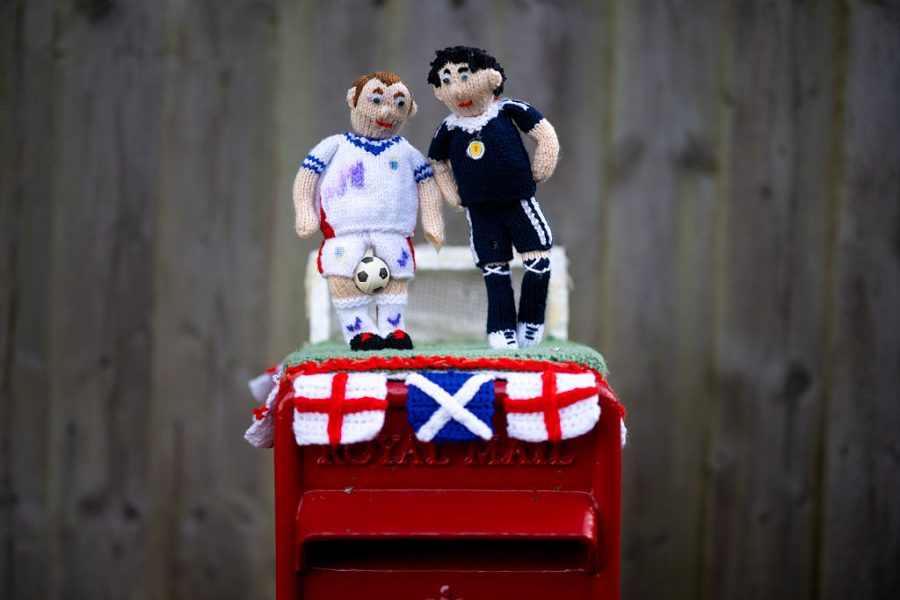
As this year’s World Cup got under way, a pub called MacGregors on Shore Street in the Scottish town of Gourock installed two Saltires and two Lion Rampant flags on poles above its front door. The Scottish national side has not advanced past the first round in any of the nine World Cups in which it has appeared, but every time it heads off to compete against the best teams on the planet, the country enters a sort of fever dream of expectation.
Sadly, 2026 was not to be Scotland’s year either. And so, even before crashing out in the tournament’s group stage at the weekend, the nation had switched to its default setting during the second phase of a World Cup summer: England-baiting.
At MacGregors, this is taking the form of supporting the Auld Enemy’s opponents, whoever they may be. In the run-up to England’s game against Ghana in the group stage last week, it added the red, yellow and green flag, complete with a black star, of the west African nation. This was joined by the Panamanian colours before Saturday’s game and yesterday it flew the red diagonal slash on a blue background with yellow star that is the national flag of the Democratic Republic of the Congo – the side England faces this evening.
My Scottish friends explain that it’s England’s condescension that gets their goat
To an Englishman who spent his school-age years in Scotland, such obsessive anti-Sassenach fervour is nothing new. It’s also why, when King Charles expressed his hope at the weekend that the Tartan Army might ‘cheer with full voice’ for England now their own team had been knocked out, I knew his call was doomed to failure.
Take my experience in Inverness in 2002, the year the World Cup was hosted by Japan and South Korea. I had agreed to go sailing for a week in my brother’s boat on the strict condition that we moored up in advance of any England games, so that the football fans amongst us could watch the match at a local pub.
And so it was that, on the day of the Three Lions’ quarter final against Brazil, I found myself at one of the 25,000 pubs permitted to open early to show World Cup fixtures because of the punishing time difference, ordering a pint of Tennent’s at 7.15 a.m.
As kick-off time approached, I realised that I was the only England fan in the pub. But large numbers of Scots wearing Brazil shirts, often matched with a kilt, were getting ready to roar on the Samba Kings.
England went ahead after 23 minutes with a goal from Michael Owen, and you could have heard a sgian dubh drop to the carpet, the place was so quiet. But when Ronaldinho equalised early in the second half, the pub erupted. And when he went on to deliver the coup de grace seven minutes later, it was as if the Scottish midfielder Scott McTominay himself had done the business.
The cutest display of anti-Englishness came, however, when we headed for the local Asda to buy some provisions for the trip back to our home marina on the Firth of Forth. There we were greeted by a sandwich board which carried the words: ‘Show your Brazilian passport and get a free coffee and Danish.’
It was a similar story when England reached the final of the Euros in 2021. Scotland fans showed their support for Gareth Southgate’s opponents, Italy, by booking up Italian restaurants across the country. In Glasgow, one restaurant ensured a sell-out by advertising that it would be offering pasta in Italy’s colours.
You only have to examine the lyrics of Scotland’s unofficial national anthem, ‘Flower Of Scotland’, to trace the roots of this feud. Written by a member of a folk group called The Corries in the 1960s, it’s a stirring rallying cry that calls upon the Scots to rise again, inspired by Robert the Bruce’s victory at Bannockburn in 1314.
Yes, you read that correctly; the Scots are still wanging on about a 14th-century engagement in a centuries-long conflict. It’s a bit like the English harking back to the Battle of Pinkie Cleugh, a crushing victory that was part of Henry VIII’s so-called ‘Rough Wooing’ of Scotland in the mid-16th century.
My Scottish friends explain that it’s England’s presumption and condescension that gets their goat. While successful homegrown sportspeople south of the border are described as English, they say, the moment a Scottish athlete hits the world stage, they are appropriated for the nation as ‘British’. In the same way, they resent how the term ‘Scottish goalkeeper’ has become shorthand for someone completely useless between the sticks.
The irony is, of course, that it was a Scottish king who ultimately took over England in 1603 without a drop of blood being spilt, when King James VI of Scotland inherited the English throne following the death of his cousin, the childless Elizabeth I. Not that you’ll make many friends at MacGregors if you point this out.




Comments