
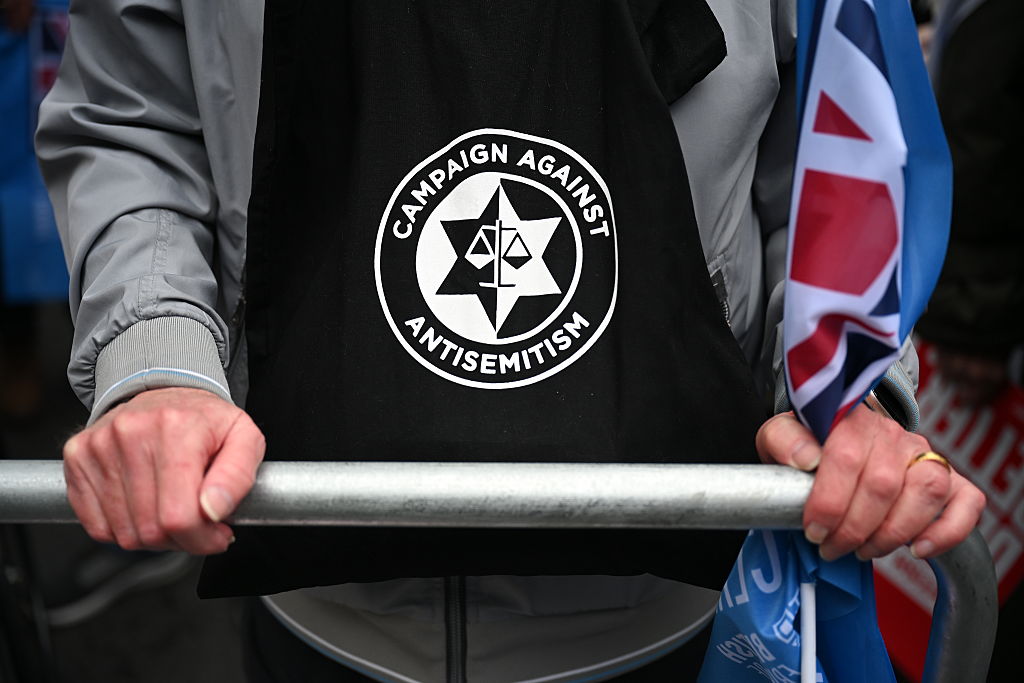
The internecine fights before the Extinguish Antisemitism rally in Whitehall are typical of British Jews, who tend to only speak with one voice when we think people are listening. The Campaign Against Antisemitism had originally planned to demonstrate separately from the Board of Deputies, the Jewish Leadership Council, Stop the Hate and the Office of the Chief Rabbi, so there would be two rallies in two days. That is a variant of a Jewish joke: a Jew on a desert island builds two synagogues, one to attend, and one to refuse to set foot it. It’s not funny anymore, and someone backed down. The rallies merged.
We are told that most of the country is with us. If this is true, they were not there
Bring a million menschen (good men), people said: let non-Jewish people stand in solidarity with us. I knew a million non-Jews wouldn’t come through the metal detectors (you are always searched when you enter Jewish spaces. You submit, Pavlov’s Jews). This is not because they hate Jews, or are indifferent to us, but because our rallies are not fun. There are no fireworks, calls to non-specific uprising, or potential for facile spiritual renewal through projection. They are not carnivals but wakes.
We are told that most of the country is with us. If this is true, they were not there. I doubt there were more than ten thousand people present, though others say different. The non-Zionists Jews, the Green Jews, and those who say Kaddish for Hamas and invite Jeremy Corbyn for Passover seders stayed away. A quarter of Jews aged 20 to 29 are anti-Zionist now; and a further 20 per cent are non-Zionist.
The non-Jewish ‘anti-racist’ movement did not come either, for they think we are the problem. Even the lone counter protestor was a Jew, which made me giggle: a man called Aaron held a sign that said, ‘The fact that people are conflating Jews and Zionists mean more people are being anti-semantic’. He waved a copy of Raphael Lemkin’s Axis Rule in Occupied Europe and told me Israel is a genocidal state, and the police refused to admit him. The Communist League were admitted, even if they were carrying signs saying, ‘US / UK military forced out of Middle East’. They look unthreatening, they carry books, and we know Communism has failed. It’s always heartening to see a Communist Jew anyway: a remnant of the continental European Jewish civilisation that has gone.
British people did not surround us, then. Counting non-Jews, I saw only a man in a flat-cap who looked dogged but embarrassed, someone with a large cross draped in Thatcher-blue fabric, and anti-regime Iranians holding their singular and faintly homoerotic kitsch: Israeli lions and Iranian lions embracing as if in love. Otherwise, it was Jewish London: family, enemies and friends. Two things are different for British Jews now. We are more afraid than we have been in modern times, and we are publicly divided for the first time I can remember.
When politicians spoke, it felt queasily like a beauty contest. Kemi Badenoch made the best speech because she is sincere. She was cheered by almost everyone. Richard Tice came from Reform: my guess is Nigel Farage did not dare after the testimony from his Jewish classmates at Dulwich College, who said he sang anti-Semitic songs as a schoolboy and said, ‘Hitler was right,’ to them. Jews have long memories. We’re famous for it. If we remember 1290, the year that Edward I expelled us – someone had a sign noting this – we can remember Farage’s childhood discourtesies.
Tice was less well received than Badenoch because many think that those who abhor one minority will soon abhor another, and that Reform is using us. Two thousand people signed a letter asking for Farage’s invitation to be revoked. According to the Institute of Jewish Policy Research, Jews are less likely to support Reform than the wider electorate but are more likely to support the Greens. After the rally Rachel Millward, the deputy leader of the Greens, accused mainstream Jewry of ‘ideological gatekeeping’ on X. Of the hard left, only the activist Peter Tatchell showed up. I admire Tatchell because he was arrested at a ‘pro’ Palestine march for speaking in support of Palestinian dissidents. Here, his Free Palestine badge was torn off, and he was removed.
Pat McFadden for the government had the worst time. I have never seen British Jews jeer anyone in public, but I have never seen them so defeated either. We are angry that our children are afraid to walk the streets as Jews: it isn’t said often enough that our children, and our university students, have the worst of it. People screamed at him: where is Starmer? ‘I hear your anger,’ he said, ‘I hear your pain’. I believed him, but it wasn’t enough.
Then came Ed Davey for the Liberal Democrats. I wondered where his waterslide, or novelty animal, was. The crowd was polite to Davey: either they ignored the paradox of a man calling Israel genocidal while claiming to mind anti-Semitism – I think that calling Israel genocidal is anti-Semitic, because what kind of genocide has more people at the end of it than the beginning? – or they didn’t care enough to heckle him because they think he has no power. My own view is we will survive in Britain as long as democracy does, and no longer. Among ourselves, we do not have a fixed plan on how to achieve this, and dread is our story now.





Comments