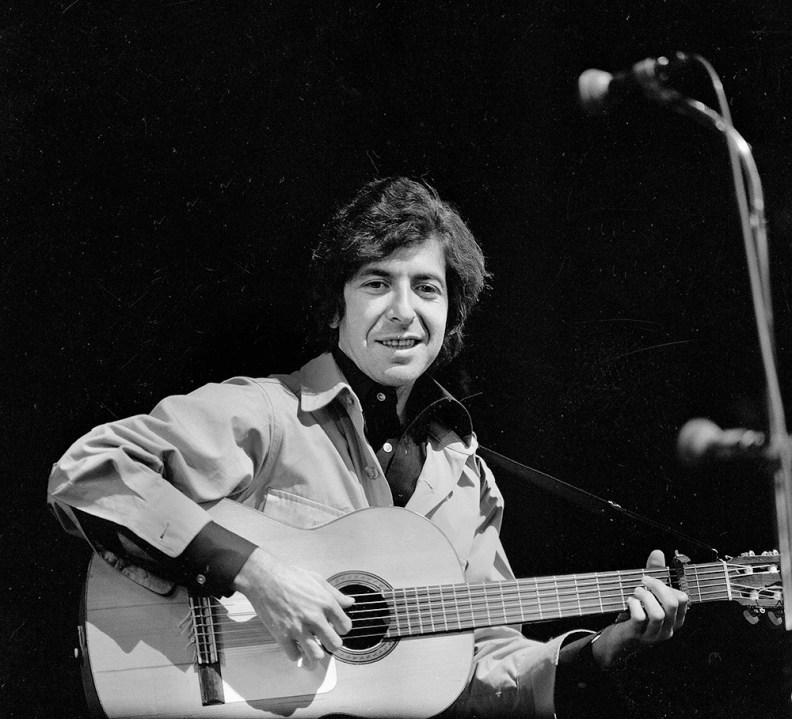
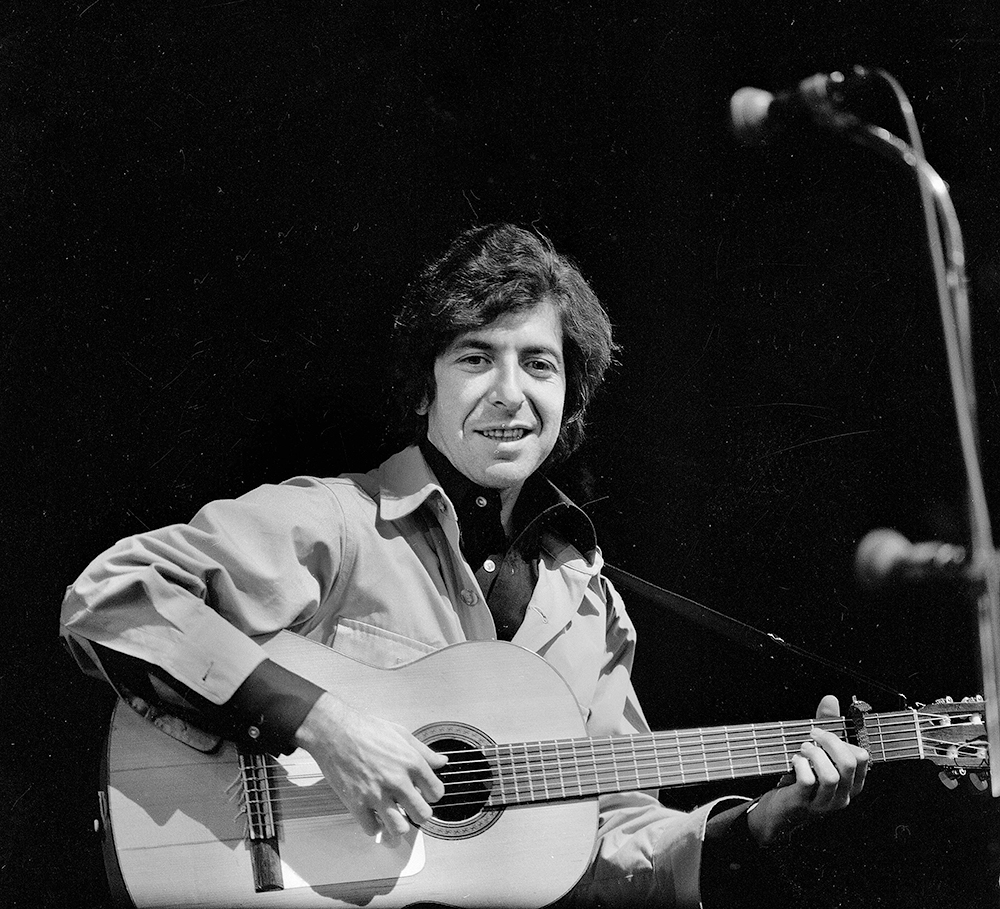
If it is true that a serious artist is one with the capacity to go on reinventing who they are in their work, Leonard Cohen unquestionably counts as serious. Not that anyone is likely to think of him as frivolous, exactly. While the famously acid description of his songs as ‘music to slit your wrists to’ is hardly fair, the whole persona, the register of his writing and performing, resists any mood of simple celebration. The ‘cold and… broken Hallelujah’ of his most celebrated and over-exposed song, the ‘broken hill’ from which praise is uttered (in ‘If It Be Your Will’), reminds us unsparingly of where he believed his music came from: a deep cellar in the spirit’s house, where sexual obsession and frustration, desperate isolation and feverish grasping at assurance, a vivid awareness both of God and of immeasurable human failure, are all interwoven. A cold and broken place; but, astonishingly, a place where something grows that is lyrical, magnetic, even consoling.
Cohen’s Orthodox Jewish family (it is not very surprising to learn that his forebears included rabbinical scholars) gave him a hinterland that he never really abandoned, and he took to heart the fact that he was literally a ‘priest’, a kohen, entitled as a son of Aaron to pronounce benedictions. His religious identity was, to say the least, fluid. Towards the end of his life, he could speak in an interview about the strong ‘tribal’ character of his Judaism (not just his ‘Jewishness’), but by that time he had spent years practising as a Buddhist (even taking vows as a Buddhist monk), in addition to having a longstanding fascination with the figure of Jesus.

These essays on Cohen’s ‘world’ include a set of intriguing pieces on this multiple religious identity. Elliot Wolfson writes about this Judaism as the ‘peripheral centre’ of Cohen’s imagination, and stresses the important role played in his work by the Kabbalistic myth of the ‘breaking of the vessels’, the primordial shattering of the heavenly containers of light, and the diffusion of hidden glory throughout the broken fragments of the universe, to be drawn back together by lives of holy attentiveness. Holy attentiveness is at the same time at the heart of Buddhist practice, displacing the agenda of an ambitious and hungry self. Cohen’s long apprenticeship in meditation – which seems decisively to have broken a cycle of depressive episodes – was fundamental in the shifting perspectives of his later work, with its wry and accepting brooding on mortality. Yet this later work also continues to draw on a whole repertoire of Christian images, with the focal figure of the rejected saviour somehow holding together a world which is never fully healed or integrated, but can be made habitable.
Marcia Pally details these allusions in a very thoughtful survey. Among other things, she picks out the strong biblical echoes (from Hebrew and Christian scripture alike) in some of the more overtly political songs, including ‘Amen’ and ‘Democracy’ (the latter ought to be engraved in granite for the USA just at the moment). Some vision of radical justice presses in on us – ‘real’ but not exactly ‘there’, in the powerful words of ‘Democracy’. But equally (in ‘Amen’) we can’t bring ourselves to see or name the atrocity of the present in full truthfulness; we prefer waiting to seeing and acting. If Cohen had a clear political vision, it was shot through with that sceptical knowledge of the human addiction to failure.
One of the most substantial essays here, David Boucher’s reflection on Cohen’s politics, is also one of the most critical. Without in the least questioning Cohen’s stature as an artist, Boucher probes whether he could reasonably be charged with a degree of deliberate evasiveness, even a lack of integrity, in his comments on and reactions to the big public issues of his long lifetime. Boucher is not saying that Cohen should have been spending his time on the barricades; but he does ask whether the later Cohen in particular was too much in love with a scepticism that drifted towards plain fatalism, and whether the Buddhist abjuring of selfhood worked here as an alibi for commitment. Instead we have what Boucher calls ‘passive-aggressive resistance’, a stubborn pessimism that always deflates in advance of any hopes of actual change.
Readers will disagree about the fairness of this, but it is a concern worth flagging. Is the mixture in the later songs of benevolent detachment and apocalyptic pessimism an honest place to be in a world like ours? As Boucher says, it is not a matter of left and right, but of how an artist properly owns their place in the world: did Cohen really have such a place?
He took to heart that he was literally a ‘priest’, a kohen, entitled as a son of Aaron to pronounce benedictions
Other essays answer this positively, discussing very acutely Cohen’s roots in Montreal – not only in the Jewish community of that city but in a variety of cultural and literary networks. Although his early career as a novelist proved abortive (mercifully, in the eyes of some), he had a substantial name as a poet before really embarking on his work as a songwriter; and to the end of his life, nomad as he often seemed to be, he would speak of his allegiance to Montreal and its history and culture.
But his artistic work was as eclectic as his religious identity. The chapters here on his musical influences trace the constant conversation with other singer/songwriters in his work, showing how both folk and cabaret-blues shaped his voice (that inimitable and much imitated whisky-and-smoke-over-gravel voice). It is telling that, as Gillian Mitchell notes, Cohen hoped that his songs would be ‘around long enough to become folk music’ – a hope that has certainly been fulfilled with at least a handful of them, from ‘Suzanne’ and ‘So Long, Marianne’ to ‘Hallelujah’ (whose extraordinary reception and deployment have a whole, well-merited chapter here).
At its most characteristic, the music is extremely simple. Sometimes, as in ‘Suzanne’, barely a melody at all, something more like a psalm chant; sometimes – ‘Sisters of Mercy’ – a balladic elegance and economy. As in the familiar, ironic lines from ‘Hallelujah’, (‘the fourth, the fifth, the minor fall, the major lift’), very basic musical tools do a remarkable amount of work, baffling the composer/singer as much as the biblical King David as he sings to praise the Lord. Distant memories of student parties in the early 1970s suggest that the popularity of some of Cohen’s songs arose not only from the haunting lyrics but from the more prosaic consideration that both guitarists and vocalists of modest skills could produce a credible version.
This is on the whole a very readable collection. There are one or two contributions that are too allusive to be helpful to readers not already au fait with details of Cohen’s life and writing; but overall these are thoughtful and insightful approaches. There is a bit of throat-clearing about whether Cohen would have fallen foul of the # MeToo generation (his Buddhist teacher, Kyozan Joshu Sasaki, certainly would, and deservedly so); but it was and is hard to see Cohen as systematically abusive or controlling, for all the chequered and often unhappy history of his many relationships.
He remains enigmatic, perhaps exotic. For the 21st century, both his faith and his scepticism will feel strange. He is not a partisan spirit; too much of an ironist, too aware of his own absurdity as a human being and an artist. Death, eros, God, failure, acceptance – these are not easy areas for contemporaries to walk in. But the voice goes on, echoing from the cellar, luring us into seriousness – and a kind of open-eyed, unillusioned joy.






Comments