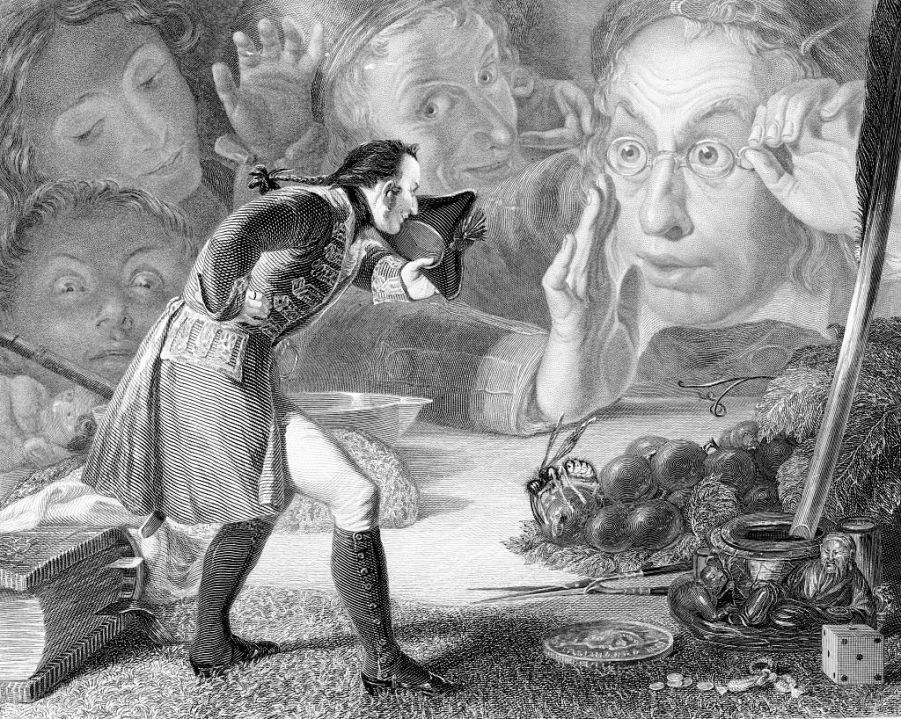
This October marks three hundred years since Jonathan Swift’s Gulliver’s Travels first exploded onto the world, in all its scabrous, coarse brilliance. It’s a strange book: a melange of journey narratives, utopias, satire, proto-science-fiction and fantasy, which renders its success all the more unusual.
Dean Swift (a notable man of letters and an anarchic Tory) was a playful chap. He arranged its publication pseudonymously, with the help of Alexander Pope. Yet it did not take long for Swift’s authorship to come out; even before then, the first edition sold hotter than hot cakes, reprinting within a week. Eventually, it became one of the most reprinted works in history. Travels into Several Remote Nations of the World, in Four Parts by Lemuel Gulliver (to give it its proper title) was, according to John Gay, ‘universally read, from the Cabinet-council to the Nursery’.
We petty, puling humans will always be part Yahoo, part Houyhnhnm
And therein lies its peculiar, rollicking appeal. Everyone can enjoy it. A reader’s relationship with Gulliver’s Travels moves from initial childlike wonder to a riper understanding of the book’s political and satirical intents. Where children marvel at the giant King of Brobdingnag, adults may recognise a portrait of Swift’s one-time patron, Sir William Temple.
Ostensibly a true account, Gulliver’s Travels employs just enough realism (whacking in references to Surinam and Japan) as anchors for Swift’s flights of imagination. Throughout, we encounter strange worlds, where we discover stranger inhabitants who, on closer inspection, turn out to be distorted versions of ourselves.
The hero, if he can be called such, is Lemuel Gulliver, a merchant ship’s surgeon. Gulliver is hurled into outrageous situations, which variously show him proud, gullible (the clue’s in his name), ridiculous and, towards the end, almost ascetic. Yet he’s no fool: he has an ear for languages (he learns Lilliputian from the Emperor) and is a keen observer of customs.

The first two parts of this four-part book are the best known, probably because they are the ones most often sanitised for children – usually with all the bodily fluids taken out. In the beginning, Gulliver is shipwrecked on the island of the Lilliputians. He is, to them, a ‘man-mountain’. The Lilliputians’ battles with their neighbours, their own civil strife, and the pompous nature of their emperor are rendered absurd. Gulliver puts out a fire in the palace by urinating on it; the Lilliputians do not appreciate this kind act. Their weeny size reflects their (and our) small-mindedness.
In Brobdingnag, the land of giants, the situation is reversed, and Gulliver finds himself in the position of a Lilliputian. Here, his own pretensions are scrutinised. When Gulliver boasts to the King about gunpowder, the monarch is horrified: ‘I cannot but conclude that the Bulk of your natives, to be the most pernicious Race of little odious Vermin that Nature ever suffered to crawl upon the surface of the Earth.’ The target here is us bluff old Englishmen.
The middle parts of the book, though generally less well known, contain wonders. The flying island of Laputa is inhabited by nobles so taken by their intellectual theories that they cannot properly govern their lands. In Lagado, ‘projectors’ work on experiments, such as breeding sheep with no wool or ‘entirely abolishing all words whatsoever’. On the island of Glubbdubdrib, sorcerers summon up the ghosts of Julius Caesar and Homer, amongst others. They are disappointing. Gulliver doesn’t understand Alexander’s Greek, and Hannibal tells him ‘he had not a drop of vinegar in his camp’. Scientists, historians, politicians: all come under unrelenting fire.
The final section, where Gulliver meets the Houyhnhnms, intelligent horse-like creatures, retains a hold on the popular imagination. These creatures rule rationally over a group of degraded, hairy, ape-like beings called Yahoos, whose extermination the Houyhnhnms often debate. Gulliver soon realises that he is more Yahoo than Houyhnhnm. He begins to hate mankind so much that, when he returns home, he lives in the stables. A bittersweet ending: he hasn’t learned his lesson.
The success of Gulliver’s Travels is manifold. Its influence on children’s literature has been immense. Lewis Carroll’s Alice in Wonderland could not have existed without it, using a similar double scheme: the Queen of Hearts is both a tyrant from nurseryland and a caricature of Queen Victoria. Mary Norton’s minuscule Borrowers and Philip Pullman’s doughty Gallivespians are direct descendants of Swift’s Lilliputians. The book’s argot has penetrated deeply into our language, particularly through insults. ‘Lilliputian’ is an excellent example, which we should use more often, particularly in Parliament. And if someone is a terrible brute, we call them a ‘yahoo’.
Yet all this has a barbed side. As much as we delight in the absurdities of Gulliver’s Travels, we are also slammed right up against all society’s worst ills. Modernity gallops ever onwards; society bends itself into ever stranger shapes; and the lack of a tongue as acerbic and acidic as Swift’s becomes increasingly evident. He towers over us, Brobdingnagian in scale. And that’s why he remains essential. We petty, puling humans will always be part Yahoo, part Houyhnhnm, and we will always need a Gulliver to remind us.





Comments