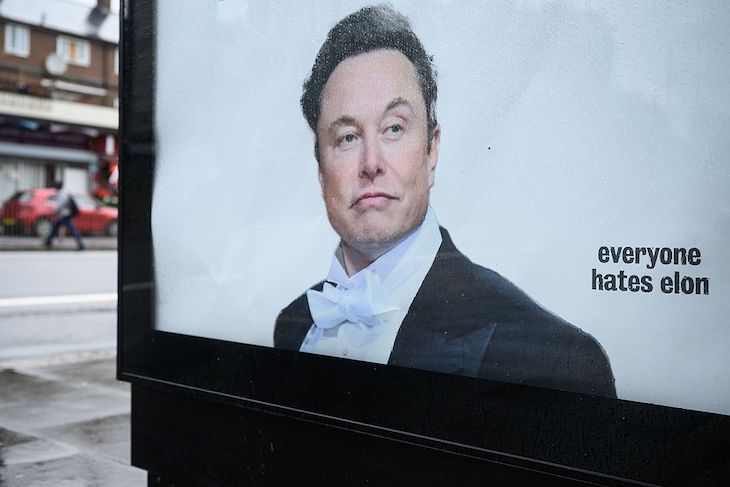
The quiet kid from my friend’s school has become a trillionaire, and many people are unhappy that this should be so.
Musk’s success narrows our lives only when we let it make us prisoners of our own resentment
Being a boy in a white South African classroom isn’t easy if you’re not outgoing and sporty. The culture that grew in the shadow of the Boers is not forgiving of eccentricity or admiring of unvarnished intellect. Elon Musk appears to have suffered childhood misery that a trillion-dollar fortune can’t buy back. What money buys, for him as for the rest of us, is freedom – and he has more of it than anyone alive.
“I call people rich,” Henry James had one of his characters say, “when they’re able to meet the requirements of their imagination.” My ageing Skoda meets mine when it comes to transport. Musk wants to die on Mars (“just not on impact”) which calls for more. Whether a trillion dollars will be enough is unclear, but it’s not a bad start.
Not that it was the start. The $22 million he took out of Zip2 in 1999 funded X.com, which merged into what became PayPal; eBay’s purchase three years later handed him some $180 million. He used that to take control of the fledgling Tesla and to found SpaceX, where he owns most of the voting shares, and some forty percent of the equity. “The delusion is thinking that SpaceX is going to lead the space frontier,” said Neil deGrasse Tyson, the American astrophysicist. He said there would be no financial return for getting there first. By the close of its first day trading on Friday, SpaceX’s market cap was $2.1 trillion.
‘Elon Musk is a real-life Bond villain’ ran the headline in the Financial Times, a paper which, faced with one of history’s greatest financial successes, thought mainly of Blofeld. Many others were more straightforwardly bitter. “The typical American household would have to work more than 11 MILLION years to make Elon Musk’s level of wealth,” Senator Elizabeth Warren pointed out on X. “We need a wealth tax.” X too is owned by Musk, and if he foregrounds his own voice, as most of us do, he also platforms his own critics. He bought Twitter arguing for a town square where voices were heard, and the audience could decide what was misinformation and hate speech. I think it reasonable that others are free to misuse X as they wish; it doesn’t stop me using it for its true purpose, anonymously posting pictures of my cats.
The idea that Musk’s financial wealth makes us poorer is a trivial error. Only our envy of his money makes the proposition true, and when it does it is our problem, not Musk’s and not the wider world’s. Wealth can most certainly be created rather than stolen. Reliable, reusable and cheap rocket ships weren’t spread evenly around the world before Musk monopolised them. Capitalism didn’t steal Starlink and electric cars from the public commonwealth. If he folded now he could give shares worth a hundred-odd pounds to everyone on earth but the moment he tried, they’d be worth less. Those buying SpaceX buy a company led by Musk.
The more interesting question is whether Musk’s freedom – bought by a trillion dollars and a track record of wild success – reduces our own. When one voice shouts loud, it shouts over others. His views get more attention than our own, and are more likely to be taken seriously as a result. Few are more frequently envied than those who have the power of forcing attention, wrote Dr Johnson. Elsewhere he remarked on a manifestation of envy: that riches do not so often produce crimes as incite accusers. Musk’s influence is also powerful enough to be worth taking seriously, but you don’t do that by comparing him to a Bond villain.
The remedy for a loud voice making a bad argument is not a regulatory gag but a better argument. Free speech comes at a price; its loss comes at a higher one. Those who believe Musk’s politics are mistaken have to put their own case, not try to silence his. His words are heard because he is rich, but repeated because they resonate.
Not all Musk’s money can buy him the chance to be a happy kid, but he gives the strong impression of a man who spends more time looking forward than back. My friend, a doctor colleague, is a kind man with the sporting accomplishments and easy friendliness that make life smooth in that society. He remembers Musk from school, and shows no rancour that Musk may not remember him.
As miseries go, an unhappy childhood is up there. There are sadnesses and tragedies in all our lives that we cannot set right, and happinesses and triumphs that will never be ours. But if we spend our time resenting others for having what we lack, we waste what we have. Musk’s success narrows our lives only when we let it make us prisoners of our own resentment. He hath a daily beauty that makes me ugly, said Iago. There is little so destructive to freedom as envy.




Comments