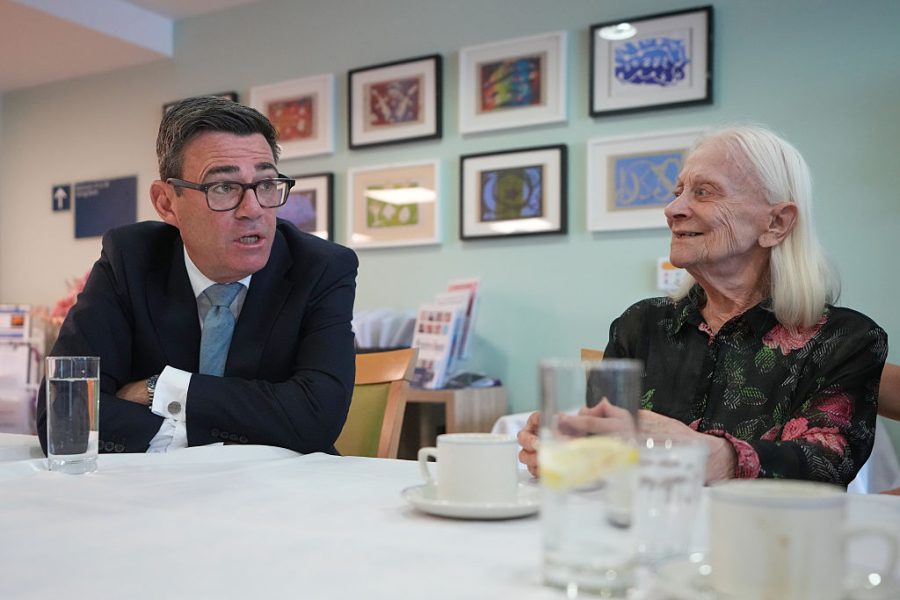
There have been trimmings and ornaments: the bus fare cap and the performative opening of a No. 10 North in an office block above a Manchester branch of the Slug and Lettuce. But Burnham’s first major act as Prime Minister is to walk back into the flames that consumed his last stint in high office. In 2010, his attempt at a legacy-defining Beveridge moment – creating a National Care Service – partially cost Labour power. Two failed leadership bids and exile to Manchester followed. Today, Burnham formally announced he’s having another go. ‘I’m making this choice and I’m prepared to put everything I’ve got behind it,’ he said.
For now the Prime Minister is benefitting from the honeymoon glow of a bounce in the polls. That may not be enough. Back in 2010, the British Social Attitudes survey showed public satisfaction with the NHS at an all-time high of 70 per cent. In 2024, it reached an all-time low of 21 per cent; the latest figure is 26 per cent.
No modern government would leave all social care to individuals; there has to be some kind of safety net. The danger of a National Care Service is not only the perverse incentives, the bureaucratic waste and the likely dependence on the immigration Burnham’s government has promised to cut. It is the risk that it transfers even more responsibility from individuals to the government.
Hospitals are the sump into which the failure of primary care now drains
Integration with healthcare is sensible; a massive expansion of the state, at a time when the state is becoming increasingly incompetent, is not. ‘We do have to be sure that there isn’t profiteering in the system,’ he said today. ‘What we cannot accept is money being taken out.’ If you refuse to allow profit, then you refuse to allow the free market. Societies that do that don’t fare well. Most residential and home care is delivered by private providers: Burnham is proposing nationalisation and calling it a safeguard.

Baroness Casey was alongside Burnham when he made his announcement today at a Jewish care home in north London. He has asked her to accelerate her review into adult social care, and publish her findings next year.
Already, Casey has called for an end to what she terms the ‘National Hospital Service’, and a move toward supplying care in the community. As an NHS hospital consultant caring for the frail elderly, I’d be delighted. On any day, more than half my patients are ‘medically fit’ – not in hospital because they need to be, but stuck waiting for somewhere more appropriate to go. But these calls have been made for decades, and we already have one of the lowest per capita hospital bed counts in the developed world – about half the OECD average.
Casey is right that we’ve created a National Hospital Service. But hospitals haven’t accumulated this work because they hunger for money and power. Instead, they are the sump into which the failure of primary care now drains. GPs and community teams don’t have spare capacity to lavish on those suffering decay and dementia. Hospitals deliver more and more of the care that GPs used to provide – not from empire-building, but because if we don’t, the patients come in as emergencies.
Burnham says he will wait for the accelerated Casey report before making any decisions on funding, but the direction of travel is clear. We are not moving toward a system built on personal responsibility and incentives to lean on the state less but toward tax rises. Whether it will be a new ‘death tax’, or the 1.8 per cent income tax levy already bruited by civil servants, remains to be seen. Alongside Baroness Casey’s plans to propose a National Care Service, she has said pay for carers must rise, and we need to spend more on the frail elderly.
Leaders need to make difficult decisions and they need to bring people with them, make them feel that challenges are unavoidable and difficulties worthwhile. Burnham’s push for cross-party consensus, supported by Casey’s independent report and wider public consultation, could be just that.
Alternatively, Casey’s independence may be just a means of outsourcing responsibility for the tax rises and immigration her recommendations are likely to require. And the invitation to other political parties to form a cross-party consensus could be hypocrisy given the conspicuous failure to invite Reform. Burnham appeals for everyone to be reasonable but behaves as though he’s after hostages, not partners.
Justice Oliver Wendell Holmes liked paying taxes: with them, he said, he bought civilisation. How much we pay, and in what form, is always up for negotiation, and social care is just as big a problem as Burnham says. His diagnosis is correct and he’s obviously sincere about wishing to help. The question is whether replicating anything about the NHS will do the opposite. Far from being the envy of the world, the NHS is an institution the great majority of Britons feel is failing. Having spent my life working for it, I think they’re right, and that without the incentives that come with competition, and the possibility of profit, it’s not only failing but fundamentally unfixable.
The Burnham bounce, built of short-term vibes rather than a persuasive electoral win, is unlikely to survive. If it lasts long enough to bequeath us a National Care Service, the state will have taken on even greater responsibility for our years of frailty and will intrude even more into our decades of health.





Comments