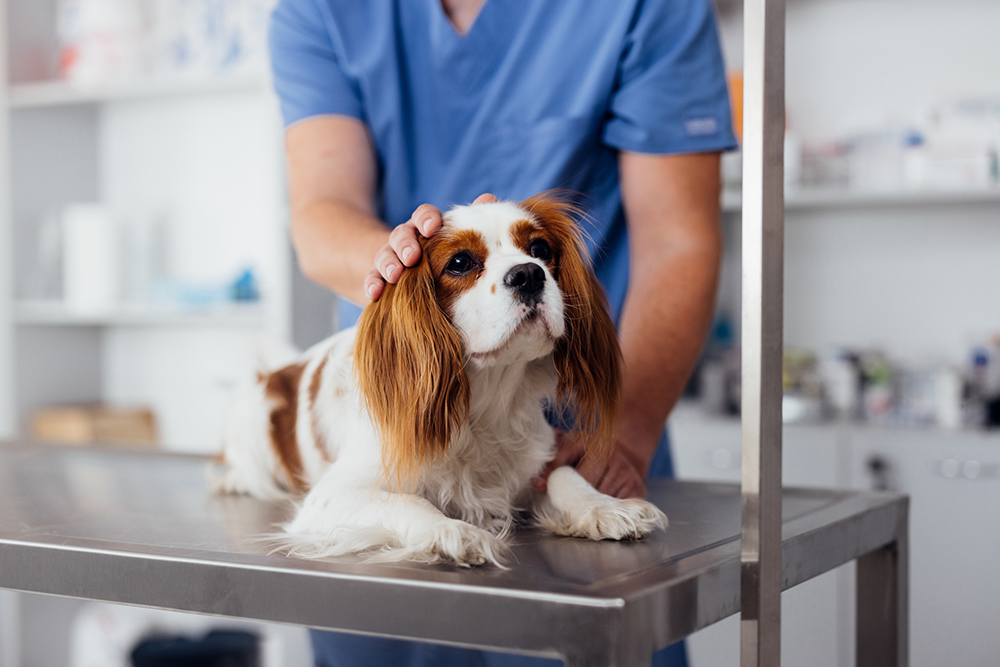
Dennis refuses to step on to the scales at the vet. Perhaps he’s nervous about his holiday weight. The upshot is that I have to climb on the scales holding him, and then again without him, so the receptionist can work out the difference. It makes for quite a humiliating morning, shouting my weight across a crowded veterinary waiting room. A woman clutching an elderly cat looks determinedly at the floor.
It’s our third trip to the vet in a week. Grass seed season is particularly bad this year, they say, on account of the heat, which has turned the seeds brittle and more likely to penetrate paws and ears. Local councils and their obsession with rewilding is also to blame, chunter some dog owners, since they’ve used this fashionable eco policy as an excuse not to mow. A few days earlier, Dennis had developed a swollen, weeping toe and a limp, and people tell you such horror stories about grass seeds worming their way from paws into internal organs and sprouting that I drove to the vet like Evel Knievel.

The first vet said it wasn’t a grass seed and advised salt baths. We returned after the weekend because the toe was still weeping, and the following day yet again so Dennis could be sedated and another vet could rootle around and fish the thing out.
No grass seed, it transpired, after this third trip. Perhaps a bite or a nail infection. We headed home with a strip of antibiotics, and I emailed Jilly Cooper’s literary agent, Felicity Blunt, to explain that I sadly couldn’t attend that evening’s Audible premiere of a short story by the late writer because my dog was too doped up. Jilly, I feel, would have understood.
Back we went a couple of days after that, visit number four, because I needed to pick up his tapeworm treatment. Dennis dug his toes into the pavement outside. Fair enough. Fortunately he’s insured (although the premium has just gone up again) because otherwise the whole ordeal would have cost £785.17.
‘Why are our vets so expensive?’ mused my friend Julia, on a dog walk in Dulwich woods later that week. Her mother lives in Spain, where she says an appointment and a jab or treatment of some sort may only set her back around €70-80, short of the hundreds that it may cost in the UK.
Good question. As it happens, our many recent expeditions to the vet coincided with the publishing of a government white paper on the industry, which is being heralded as the biggest shake-up of the veterinary sector in 60 years. Among various suggestions, it calls for vets to publish their price lists online, for caps to be imposed on prescription fees and for practices more clearly to disclose whether they’re kindly, independent, James Herriot-type places, or simply money-grubbing outlets that form part of a corporate chain.
Just over a decade ago, as the white paper points out, those sticky fingers in private equity started poking about in the veterinary industry. In 2013, around 90 per cent of British vet practices were independent. Now, the majority are owned by six corporate groups. Guess what? Prices have shot up, more than doubling since 2016.
I emailed to explain that I sadly couldn’t attend that evening’s premiere because my dog was too doped up
A host of other problems have conspired to worsen the situation, says Dr Caroline Allen, former chief vet for the RSPCA, who’s recently set up a consultancy, Pet Lighthouse, partly for those with elderly or sick animals who simply don’t know who to trust. Corporatisation hasn’t helped her profession, she tells me, but the pandemic puppy boom piled pressure on vets, and we Brits are much soppier than our European counterparts: ‘We’re just ahead with this whole, “dogs are a member of our family” thing.’ As a result, she says, we seek ever more sophisticated and expensive treatments for our pets and can’t bear to let them go when the time comes. The debate about assisted dying regarding humans may be one thing, but euthanasia regarding animals ‘is increasingly seen as a failure’.
Some years ago, a dog owner might have realised that a dog was coming to the end of its life, decided they’d had a good innings and it was time to put them to sleep. ‘Now, they may have a tumour, but they can be referred to an oncologist, they can do radiation, they can keep that dog going for another six months to a year. It may cost £10,000, but the attitude is it’s worth it.’ Don’t bash the vets, Allen adds, they’re doing the best they can in trying circumstances. Shockingly, the suicide rate among vets in the UK is four times the national average. Perhaps some of our sympathy for NHS staff could be shared.
Touch wood, the final decision is a few years off for Dennis (aged two). Although yesterday I discovered that he’d chewed the plastic eyes off a small toy sheep and swallowed them. ‘We’re sorry to hear that Dennis has been poorly,’ came a message from the insurers that afternoon, shortly before another confirming that they’d approved my claim. Hang on, I nearly wrote back, frowning at the poor, blind sheep, there may soon be another one.
In the meantime, mind how you go with that grass seed.




Comments