
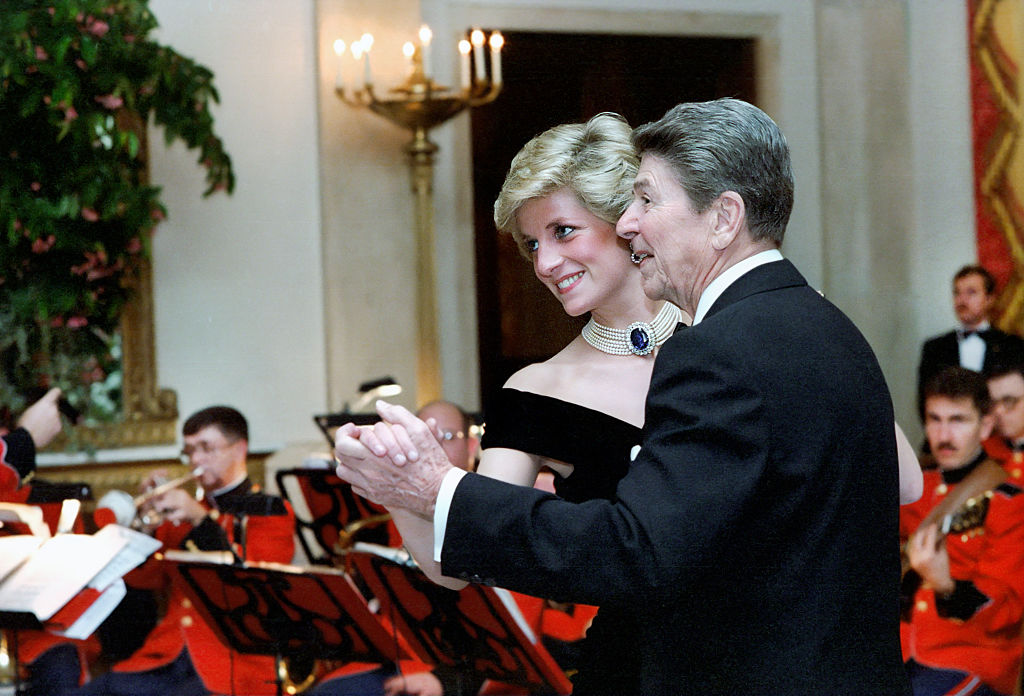
Even when he’s not visiting the United States, King Charles III might occasionally daydream about what his reign would be like today if things had worked out differently 250 years ago. The King is not, of course, the head of government anywhere nowadays, and were Charles the king of America, he wouldn’t necessarily wield any more power here than he does in modern Britain. Yet there’s reason to think he possibly could – for the truth is, Americans love monarchy at least as much as they fear it, and they love the royal family, too.
Ironically for the “No Kings” protesters who despise Donald Trump, the only reason we have Trump is because we don’t have a king: the office of president is what the Constitution’s framers came up with as a republican alternative to a hereditary monarchy. If the “No Kings” crowd had the slightest historical understanding, they’d be demanding the return of monarchs instead.
Americans in 1776 were not, in fact, fighting a revolution against monarchy. They’d spent years beseeching George III to protect them against what they saw as an alien legislature, a parliament in which they had no representation. The imperial constitution was supposed to be a mixed monarchy, where the king and legislature ruled in tandem, and if one acted contrary to the public good, the other could check the abuse. The king was not supposed to be aligned with any legislative faction or interest – he was above party, the sole, grand representative of the common good for all the peoples of his empire, including the Americans.
Bitterly anti-monarchical feelings were a product not of the American Revolution but the French
The Declaration of Independence was a long time coming, and many of America’s leading revolutionaries, including the man acknowledged as “the penman of the revolution,” John Dickinson, didn’t think the time had arrived to break with the king even in July 1776. But the demands of foreign policy urged the move: America needed aid from France, Spain and the Netherlands to carry on the war with Parliament, and those states were reluctant to intervene in a domestic disturbance. If America were a nation of its own, however – occupying, in the words of the Declaration, “the separate and equal station to which the Laws of Nature and of Nature’s God” entitle all states – then the precedent would not be so dangerous to the internal as well as external order of Europe’s powers.

The Declaration scrupulously avoids any language that would suggest the Americans are breaking away from their country. On the contrary, they’re presented as a distinct people who are not British but who share a monarch with the British, and now that this particular king has become an enemy to the American people, they are cutting their ties to him and assuming the full powers of government themselves, including the power to make treaties and foreign alliances (which even now are notionally among the king’s prerogatives in Britain).
Just how keen the Americans were on monarchy can be seen from the regular celebrations they held for the king’s birthday before they declared independence – and the celebrations they held for the birthday of their ally King Louis XVI of France after independence was won. When Benjamin Franklin was asked at the end of the 1787 Constitutional Convention what kind of government the delegates had devised, there was a possibility he might have said something other than “a republic, if you can keep it.” The Americans, now free, might have asked some other European of royal blood to become their king, as the English had brought in a Scottish king, James VI, in 1603; a Dutch prince, William of Orange, in 1688; and a German nobleman, George, the Elector of Hanover, in 1714.
The Americans could also have placed a crown upon the head of a man whose personal conduct showed him to be a model of a patriotic king, no matter how modest his background may have been. If General George Washington had wanted to be a monarch in name, and not in almost every respect but that, the people would have gladly given him the title. As it is, Washington’s presence at the Constitutional Convention and support for what it produced was indispensable to the creation of the new federal government: the uncrowned king’s popular authority was parent to the new government.
Bitterly anti-monarchical feelings were a product not of the American Revolution but the French. Thomas Jefferson ardently supported the revolutionaries, including when they murdered their king, his family and as much of the aristocracy as they could get their hands on. Seeing that others in the Washington administration did not share his zeal, Jefferson became convinced that the likes of Alexander Hamilton and John Adams not only favored Britain against France but wanted to undo the American Revolution itself, restoring the monarchy and ultimately reuniting America with Britain. Jefferson, like the French Revolutionaries, hated monarchy itself and hallucinated monarchist wreckers everywhere.
Yet his hatred never entirely caught on with the American people, despite Jefferson’s success at capturing the presidency in 1800 and establishing a political dynasty. Jefferson was dismayed at the end of his life to see Americans rallying to another kingly politician, General Andrew Jackson. Since then, the American president has often been more of a monarch in substance than many – and today, all – of Europe’s crowned heads. Presidents are certainly far more powerful.
The presidency is mostly power without grace
What presidents don’t enjoy, however, is the “unbought grace of life” to which Edmund Burke alluded during the French revolution: “All the pleasing illusions which made power gentle and obedience liberal.” American presidents, unlike British monarchs, have to make decisions about taxes and war and other dirty subjects that sully the illusion of power without pain. Yet Americans still cherish the dream of what they’re denied, which is why their grief at the death of Queen Elizabeth II was enough to make one think 1776 had never happened. It’s why they wept as inconsolably as the British – not to the credit of either country – at the death of Princess Diana, too. Burke understood that this side of royalty is best represented by women, from Marie Antoinette as Burke mythologized her to Queen Victoria in the days of Disraeli to Queen Elizabeth in the 20th century.
A king like Charles can’t occupy a similar place in Americans’ hearts, but monarchy in its own right still does. The presidency is mostly power without grace; monarchy, in its modern form, grace without power. Americans have understood the necessities of power better than any other people over the last 250 years, but they long for grace, too. And they still see something of that in royalty.



Comments