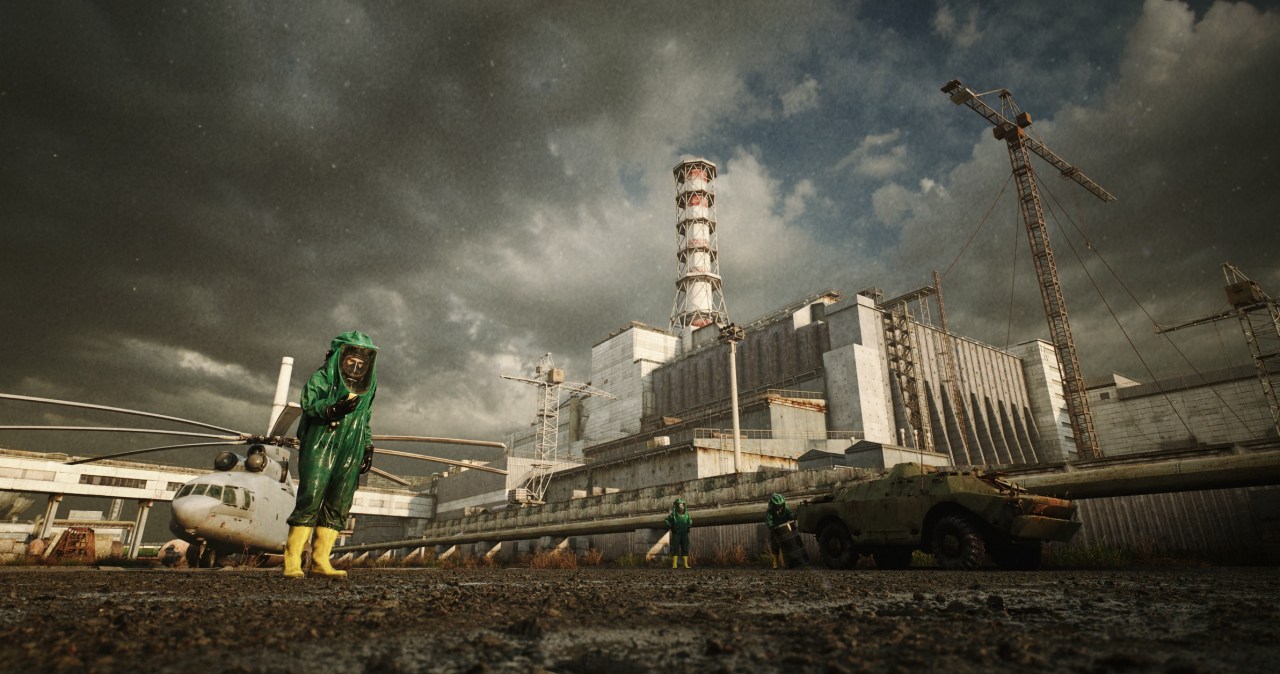
There are few things that look sadder than an abandoned sports field. I spent longer than I meant to sitting on a decaying bench looking out over the forest that was once the intended playing surface for the Stroitel Pripyat soccer club. The sky above was cerulean, cloudless and entirely still. The only life came from my hand-held Geiger counter which spluttered and crackled, telling me that I was in a territory that wasn’t fit for a stroll, let alone 90 minutes of lung-bursting athleticism.
This is the only place in Europe where we can, firsthand, witness what a post-nuclear conflict world would look like
Stroitel Pripyat ceased to be a club 30 years ago, just as they were about to move into the purpose-built Avanhard Stadium where I sat that afternoon. It was only after my visit that I discovered that the team never even kicked a ball in their new home – a small but poignant consequence of the events of April 26, 1986 when the reactor at the nearby Chernobyl nuclear plant exploded.
It was close to a decade ago that I spent a weekend in the exclusion zone around Chernobyl and the larger neighboring town of Pripyat – a trip I found myself reflecting on as the 40th anniversary came around. I had gone against my better judgment. Not because of any fears about radiation poisoning; the Geiger counter I had purchased displayed higher radiation levels back at my hotel in Kyiv than in most parts of what local refer to as simply “the zone.”
No, I had hesitated due to my deep doubts about “dark tourism.” This odd, and highly narcissistic, sub-strata of travel journalism has its origins in the late P.J. O’Rourke’s Holidays In Hell travelogue from the 1980s. Saturated in the essence of Tom Wolfe and Hunter S. Thompson, Rourke’s Reaganite update on New Journalism saw him travel to Belfast, Beirut, apartheid-era South Africa and El Salvador to contort his foreign correspondent dispatches into a holiday postcard.
Chernobyl and Pripyat, however, shouldn’t be tainted by this maxim. They were, until 2022, the one exception to a sensible life spent avoiding the embrace of “dark tourism.” Yet, four years into the war against Russia and 40 years since Reactor Number Four exploded, the chances of entering the exclusion zone to witness peacetime’s greatest manmade catastrophe are currently non-existent. My 48 hours in “the zone” continues to unsettle me to this day. Because this is the only place in Europe where we can, firsthand, witness what a post-nuclear conflict world would look like.
To accept the capability and potential of nuclear weapons comes with the corollary that we should witness what happens when – via defective reactors, weapons deployment or inept management of either – human life becomes untenable.
The vital distinction between the impact of a nuclear weapon and the explosion of the reactor in Chernobyl 40 years ago kept running through my mind as I wandered through Pripyat’s long abandoned supermarkets, schools, funfairs, sporting grounds, homes and gardens. “This,” I told myself, “is post-nuclear light.” The blast wave and intense heat of a nuclear weapons detonation didn’t happen here. The steam explosion and graphite fire of Chernobyl didn’t result in flattened buildings. Rather, what I was walking through was the aftermath of a slow release of radioactive particles at relatively low altitude, causing intense local, environmental contamination rather than physical destruction.
Avian life hasn’t returned to Pripyat. The fish in the local rivers are enormous, and lynx, bison and wild boar now roam “the zone.” I was kept awake at night in a former hostel built for cleanup workers by the sonorous cry of wolves. But the skies were as quiet as the streets and the hot sun produced an odor of decay on the cracked concrete of the tower blocks, the contents of which had long since been looted. One tower block collapsed in Pripyat a few months before my visit. The rubble looked oddly incongruent amid the neighboring blocks – a statement of physical high drama in an environment that has known only silence for the past four decades.
“Nuclear weapons repel all thought… they paralyze,” wrote Martin Amis at the height of the Cold War. Visiting Pripyat and Chernobyl enabled my own paralysis of thought to lift slightly. That’s still a long way from wisdom though: an attribute that still feels as scarce as the sound of birdsong in Pripyat.




Comments