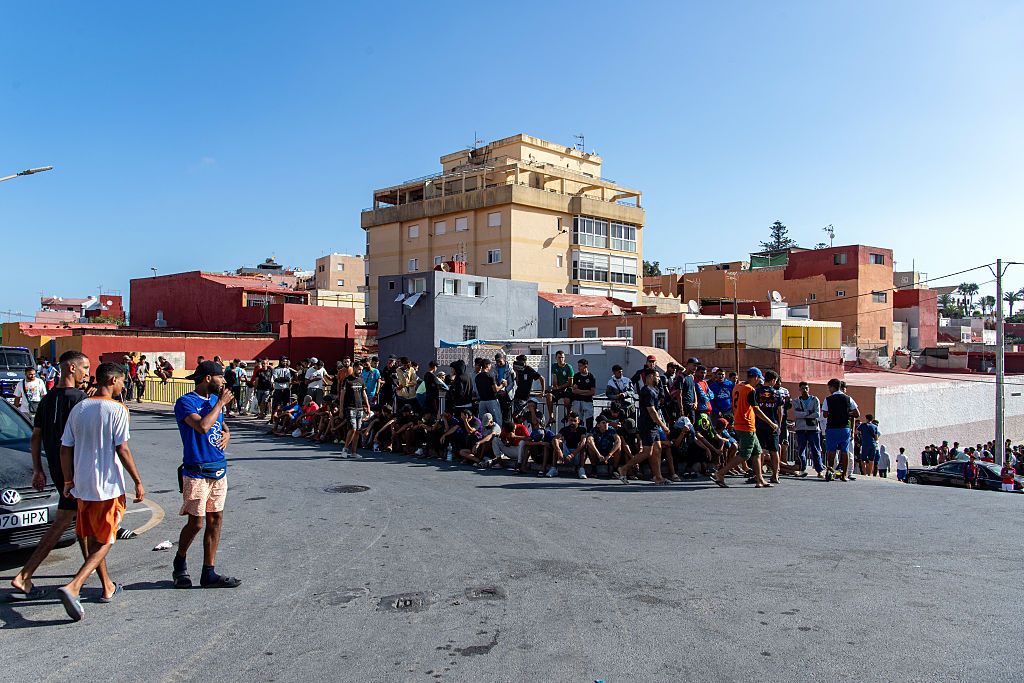
How many of the migrants who crossed from Morocco to Ceuta at the end of July remain in the city? Madrid has suggested that “only” about 5,000 remain in its North African exclave (population 83,000). But in that case why has Spain’s socialist government promised to create reception places for 6,000? The Ceuta government, meanwhile, puts the figure at about 13,000. Other local estimates run as high as 15,000.
The argument over what Madrid knew about Ceuta beforehand is becoming increasingly embarrassing
Hundreds of migrants unable to find places in official accommodation have been sleeping rough. One resident told El País: “Do you know what it is like to live with hundreds of blokes outside your front door shitting and pissing on the corners?” He says nightly drinking and fighting make so much noise that children struggle to sleep.
Businesses have had to take emergency measures. Cafés and bars have taped over their electrical sockets to stop migrants charging their phones and closed their lavatories to them. Supermarkets employ additional security.
At one school, parents and staff have complained of rubbish, excrement and foul smells, with migrants sleeping nearby, including in a burnt-out car. The school’s only cleaner has reportedly been overwhelmed. Some parents have refused to send their children back until security and cleaning improve.
Violence continues. Last week two Guardia Civil officers were assaulted and a soldier suffered a fractured fibula. In the first incident, a Moroccan migrant violently resisted the two officers during an identification operation. Hours later, according to the Guardia Civil association AUGC, a soldier attempting to identify a group of migrants was pushed as another fled. The soldier fell among rocks, fracturing his fibula and injuring his shoulder.

On Saturday, three Moroccan migrants were arrested after allegedly robbing an older man of his shopping in the city center. Fights and fires are frequent. Interior minister Fernando Grande-Marlaska has described the situation as one of “subjective insecurity”.
Perhaps the clearest measure of the strain is Ceuta’s hospital. After meeting emergency doctors, Tomás Cobo, president of Spain’s Organización Médica Colegial, described their condition as one of “maximum exhaustion” and the situation as “dramatic.” They are now seeing twice – sometimes more than twice – their normal number of emergency cases. Their workload includes knife and fight injuries, sexual assaults and ambulances arriving with four or five patients at once. Some doctors are already on sick leave and Cobo says the emergency department needs at least twice its present resources: “There are colleagues right now who are breaking down emotionally under the overload.”
Meanwhile, the argument over what Madrid knew beforehand is becoming increasingly embarrassing. The government has now declassified material showing that Spanish intelligence warned officials on July 29 – the day before the influx – of social media calls for an “assault by fence and sea.” The groups involved had some 180,000 followers. What then happened about the warning remains disputed. But Socialist prime minister Pedro Sánchez has conceded that Spain needs to improve its ability to anticipate and prevent another such event.
What the people of Ceuta want to know is when all this will end. The government has now opened at least 1,800 proceedings to return migrants to Morocco. Not one has yet been completed through the ordinary administrative process. Madrid stresses that the procedure is necessarily slow and legally complex, allowing migrants as well as the administration to make representations, and says it is proceeding at a “reasonable pace.” For Ceuta’s residents though, the nightmare continues.





Comments